Tuesday, March 20, 2018

First Night Out in Shinjuku (6/5 - 6/6)

Shinjuku, in contrast to the more famous Harajuku or Shibuya, is known as one of Tokyo's business districts. And while people do come there mainly for work, it also houses a red light district for after-hours enjoyment. Note, though, that "red light district" doesn't signify exactly the same thing in Shinjuku as it does in American cities. It's not hard to find adult entertainment in Shinjuku's red light district, but it also houses things like karaoke bars, night clubs, and late-night noodle shops.

That nuance was lost on me as a teenager, so I mostly steered clear of the area back in 2009. This time around, Sarah and I wanted to explore its glowing neon streets in the dead of night. As luck would have it, the timing suited us perfectly. We woke up from what would be a full night's sleep in the US at ~10:00 pm Tokyo time. Perfect for a night out in the red light district. Well-rested after our slumber (the jet lag would come out swinging a few days later), we excitedly made our way across Shinjuku to a technicolor city-within-a-city.


At the entrance stood a Don Quijote. This was the closest I'd ever gotten to Shinjuku's night life in 2009, and while Don Quijote wasn't exactly a part of the red light district, it may as well have been. I clearly remember walking through it with my family and stumbling, together, upon the sex toy aisle. There was no clear demarcation, so right behind us were the displays of electronic devices that seemed more representative of what we'd seen so far. We were amused by the juxtaposition, and Don Quijote lives on in our memories as a typically maximal Japanese shopping experience.

In 2017, Don Quijote was just one among many places on our list. Sarah had never been in one, but we decided to come back and check it out later. Right now we wanted to get pictures and videos of the incomparable red light district. Many don't realize it, but a lot of the most eye-grabbing photos/videos from Japan come from Shinjuku's red light district. In fact, there used to be a ramen restaurant up the street in Baltimore that had a giant print of a photograph from the Shinjuku red light district. It's very visually appealing, even if Americans don't know about the seedier side. We knew we wanted it to be a major presence in our memories of Shinjuku.


But for all the allure of Shinjuku's red light district, I also wanted to go right to the heart of Tokyo. I wanted to get off at Tokyo Station and see Tokyo City from the center. The dream had long obsessed me as a teenager, but I never worked up the confidence to make the trip myself. Maybe because I would've had to go alone, and I lacked the bravado to do so back then. But this time, with Sarah by my side, I was ready. So we shuttled along by train to Tokyo Station, ready for an even higher dose of future shock than we'd found in Shinjuku.

Upon arriving, I was unsure of where to venture. What does one do in the center of Tokyo? I hadn't though to check ahead of time. We exited the Station and looked around. Business buildings towered over us just as they had in Shinjuku, but this place was totally new to both of us. We decided to walk straight outward from the Station, assuming we'd soon happen upon a similarly thriving netherworld. Sarah began to check her Yelp app to see what places might be open for us to get a late dinner. Since we'd slept in, we still hadn't eaten since leaving our AirBnb. Food was starting to reassert itself in our minds.

Sarah had strange news. It seemed almost all the restaurants nearby were closing, and we were left with only a few to choose from. I was confused, but it corroborated something I was noticing all around me...where were all the people? Where were all the colorful signs? The area was far sleepier than I'd expected. Here I thought we would be catching the first wave of a vibrant night life. But the black sky was seeping into the streets beneath, and we were among the few walking Tokyo's empty streets.


How could this be what the liveliest, most populous city on Earth looked like at midnight? Gradually, Sarah and I pieced it together. This area was more like the rest of Shinjuku, a nondescript place for commuters to do their day jobs. Like Manhattan in New York, as opposed to Brooklyn, Williamsburg, Bushwick or Times Square. I began to feel rather sheepish about my misconception. If only I'd taken some time to plot out an itinerary beforehand. However, we were awake enough to feel up for more exploration. If we backtracked to Shinjuku, at least we could salvage our night with the red light district's offerings.

So, that's what we did! After a half hour or so on the train, we got off at Shinjuku and made our way back to the red light district. Luckily, it was only a few blocks away from Shinjuku Station's South Entrance, which by now we'd entered and exited several times. Back in familiar territory, we picked a noodle shop at random for our very belated dinner. And how lucky we were. We didn't know it at the time, but Tokyo Tonkotsu Noodles was going to serve us the absolute best ramen we'd have on our entire trip. Ordering by electronic interface, we grabbed our tickets and sat down near the kitchen. Mine came with buttery broth, perfectly-cooked noodles, and several side ingredients (seaweed, corn, egg). Sarah and I also ordered two beers to go with our meal. We picked Asahi by chance, and perhaps because it accompanied our spectacular ramen dishes, this also became our favorite beer of the trip.

When I think back to our time in Shinjuku, this is one of the best memories. Undeterred by our anticlimactic arrival at Tokyo Station, huddled up together in front of ramen and beer, alone together at 1:00 in the morning in my favorite city on Earth.


Monday, March 19, 2018

First Day in Shinjuku (6/5)

Blue light filtered in through our apartment windows. After last night's deep darkness, Shinjuku was brightening up again. A whole new day lay ahead of us.

Sarah and I had a plan for how to spend our four days in Tokyo. Since this was our first trip to Japan together, we decided to visit as many places as possible each day. This first day, June 5th, was going to be a special one.

First, we were going to swing by my apartment in Nishi-Shinjuku to see it in daylight. Then we were going to ride the Chuo Line from Shinjuku Station to get to Tama, where my high school is located. It would almost be like a day recalled from 2009, when my morning routine would have been built along this path. Except this time I was starting out from an AirBnb apartment near Chuo Park, walking with Sarah around Shinjuku to see the early morning sights. As close as the past felt, the present was undeniably real too.

Turning the corner that housed the BMW Dealership, we set off in a straight line back toward Shinjuku Station. The route felt less intimidating in the sun than it had in the dead of night. Well-dressed men and women walked to and fro, en route to destinations unknowable. How strange to be in a city where business hums in the background, where salaried professionals cross the same streets as you but enter buildings you cannot. It was only the force of memory and passion that brought us so close to the gears of this urban leviathan. We walked alongside a busy highway, Shinjuku Station hidden behind the city's many skyscrapers. I knew the area well now, as I'd taken several trips to the local Kinokuniya from this angle. Coming up to a railing, we discovered the missing Entrance from
last night! It was tucked away into a small plaza that had little connection to the rest of the Station. It would have been a useful encounter if we hadn't already blazed our own trail to the AirBnb.

From this vexing Station Entrance, we made our way back to the West Entrance. The path seemed much easier now without the nagging weight of stuffed suitcases behind us. Euphoria had settled in, and all of last night's hardships were a different day's concerns. We meandered unhurriedly from the West Entrance back to the East Entrance, where before long we would be taking our first real Tokyo train ride. It's one thing to arrive by train, but it's another to shuttle across Tokyo at your own leisure.

As enthusiastic as we were to start traveling, there was no real timeframe in place. Our only real goal was to visit two areas a day: one in the morning, one in the afternoon. So we took our time getting to Nishi-Shinjuku, stopping along the way to admire the bronzed sunlight striking Shinjuku's towers.

We began our hike along the walkway that would take us to my old apartment. This was a crucial moment for me, and I knew I'd be overwhelmed. In the months before our trip, Sarah and I had debated the idea of staying in an apartment along the same street as the Platine Building. At first I liked the idea. But after considering it some more, I felt sadder and more unsure. To be so close to my old home, I decided, would just emphasize the unbridgeable distance between then and now. Better to build new memories than futilely chase old ones. Sarah agreed, and that's how we chose our first AirBnb. But now it was time to visit the Platine for real. As I turned the familiar corner, everything looked poignantly the same as I recalled. The long cluttered road, the surprisingly short buildings along the block, even that wobbly sewer grate I would hop on for fun in 2009...almost nothing had changed. We walked up to the Platine, and I could sense tears welling in the corners of my eyes. Even writing about this moment now brings a lump to my throat. Here it is, my one-time home in the Shinjuku Ward. Way up there on the eleventh floor. Where I lived for a year in low-grade ecstasy, learning and growing, as open to the immense outside world as I'll ever be.


In (almost) 27 years, I have lived in several places. There are the childhood moves: Wisconsin to Pennsylvania, PA to California and back again...then there were the college years. On campus at Penn State Harrisburg in the dorm on a hill. Off-campus in an apartment complex with many other students. That last one I actually did have a chance to revisit. It was a truly profound coincidence. A friend called from Harrisburg, where she was visiting some friends. She wanted to know if I'd be interested in joining them. I ran the idea by Sarah, and she liked the idea of seeing an important place in my life history. So I said yes, and we drove out to meet her. We ambled around the area a while, even stopping by my favorite pizza restaurant, before ending up in my old apartment complex. My friend asked if we'd want to say hi to a friend. Sure, why not. So the three of us walked into the same building I lived in, and walked right up to the door of my old apartment. I was in disbelief. It was 2015, and we were about to walk through the door to my 2011 apartment. Of all the buildings and all the apartments in this bustling college town, a friend of a friend was living in mine...
Of course, I didn't get that kind of luck at the Platine Building. But the feeling was almost as momentous, even just standing outside the front doors. Perhaps because it had been even longer since I'd left this home of mine, and since I'd come so much farther. Sarah took a picture of me by the sign and texted it to my mother. We also walked down the street and looked for my favorite Indian restaurant. Astonishingly, Muthu was right where I remembered, though it wasn't open for the day just yet. I was elated to see it again.


It's entirely possible that this restaurant was my first real encounter with Indian cuisine. Since then, it's become a huge part of my life. Sarah always cooked masalas and curries when I first started spending time with her, and they remain a staple in our repertoire to this day. Yet I don't recall having much exposure to Indian cooking as a kid or teenager. It really may have been Muthu where I was first introduced.

There were a couple of restaurants Sarah and I planned to visit in Shinjuku. Muthu was at the top of the list, but I hadn't been sure if it was still open seven years later. The other main one was Spaghetti Goemon, where my family and I often went out to eat. That was a long-standing Shinjuku institution, so I was considerably more sure we'd get to go. There was also a Thai restaurant near the Platine Building that I visited with my family several times, but it was part of a big interchangeable restaurant complex. I think that one was unchanged as well, though we ultimately decided against revisiting it. We simply had too many other options.


Boarding the train at Shinjuku Station, I felt confident about our next steps. We would take the Chuo Line to Takao and disembark two stops early, at Musashi-Sakai. From Musashi-Sakai, it would be another two stops to Tama. I'd made this trip over 100 times, and even in 2009 I was pleased with how easy a route it was. As we rode toward Takao, I reminisced on the days when I'd listen to my iPod en route. I got to know several artists and many albums well on this trip, and I can even recall looking out the left side of the train as Shinjuku passed by...


Tama is a small city, special to me because it houses The American School in Japan. I was so excited to finally show Sarah my high school. There were few places in Japan I spent more time than here, and I thought seeing it would make my experience feel more real to her. We walked alongside the train tracks up a long road, stopping to grab an iced drink on this hot summer day (just like I would in 2009!).


We turned the corner at the end of the street, veering right for ASIJ. One change I noticed along the way was a school where I'd always seen children playing. In its place was a big gated building. Possibly it was still a school, but it looked very different from what I remembered. I wish somewhat that I could explore Tama more, as I didn't experience much of it outside ASIJ in 2009. If other areas had changed, I would not know. I did check a map before our trip to see if there was anything else in Tama for us to see, but more on that soon...

Throughout 2017, I kept debating myself over whether I should try to contact ASIJ and get permission to visit. It's a private school, but most of the people I knew there were friendly and accommodating. I think there's a good chance I could've gotten approved for a visit, but I never quite felt strongly enough to do it. At the time I was still overcome with anxiety about conversations with people I didn't know well. I would've been overwhelmed by touring the school and possibly meeting several teachers I knew from 2009. So I decided we'd just walk by and maybe try to go in another time. That facade you see in the picture is totally new, and I was shocked to see how much remodeling had occurred. When I went to school here, that space was wide-open and patrolled only by a single security guard.
Now it seems they have a whole fleet of buses where incoming traffic once entered.

There's a lot more I could share about my senior year here: being a new student, Homecoming, my girlfriend at the time, my art classes, my short films, my field trips...but those all deserve more space and attention than they'd get here. And so many other noteworthy things happened on June 5th, 2017. I have to cordon off the more distant past just to get to these newest memories.


Veering left of ASIJ, Sarah and I sat for a while in a small park. We'd bought a couple of little food items earlier to eat for a snack during our Tama trip. I don't recall ever spending time in this park back in 2009, so I really appreciate that we hung out together there in 2017. At this early point in our trip, it felt like we had limitless time ahead of us to explore Japan together.

While ASIJ was the main reason we came to Tama, I did have another goal in mind. To my very great surprise, there was a location just blocks away that carried an incredible significance. I had been looking into my favorite Japanese authors before the trip, thinking about which books I might like to buy before (or during) our time in Japan. In so doing, I discovered something incredible: Yukio Mishima, one of my favorite authors and one of Japan's most notorious, was buried in the cemetery minutes away from my school! From the comfort of my Baltimore apartment, I experienced a jolting thrill. Not only could I show Sarah ASIJ, but we could also visit the gravesite of an author whose work I cherished.


After our break in the park, we beat our way along an overgrown path that wrapped around the cemetery. It was a big plot of land, and we hadn't chosen an entry point beforehand. Upon entering, I realized I also hadn't located Mishima's grave beforehand either. Luckily there was city Wi-Fi that we could use on our phones. The connection was weak, but I was able to peruse several sites in search of directions. We also checked the maps posted by Tama Cemetery, but none of them told us much about where to go. Sarah and I must've sat for a half hour while I tried to gather information about Mishima's tombstone. Eventually, we realized the only thing left to do was ask at the information center. The maps could at least direct us there, so we walked through the ornate gardens toward the entrance.


The information center was modest and sparsely staffed. We were a little unsure of how to conduct ourselves, but I went up and approached two ladies behind a counter. I had speculated to Sarah that Mishima must be one of the more popular graves, even if his reputation in Japan isn't exactly sterling. As foreigners, I hoped our interest in it would seem respectful. The ladies asked if they could help, and I told them I was looking for Mishima's grave. One gasped softly and asked "Mishima Yukio?" in an incredulous tone. I nodded politely, a little embarrassed myself. The women retreated into a back room to see what they could find. I wondered if I had crossed a line after all. When they returned, they tried to explain that Mishima's family didn't want visitors. There were concerns about the tombstone being defaced by critics of Mishima. They suggested I try to Google search the location instead.

I thanked them for their explanation, and let them know I'd already Google searched to see what I could find, to no avail. After I spoke, the two women conferred amongst themselves. They produced a map of the cemetery and beckoned for Sarah and I to look. We leaned in, and they circled the numbered zone where we could find Mishima's grave. It was a row of tombstones, and they indicated to us which one they believed it was. However, they encouraged us (with smiles) to be discreet about our visit. We thanked them profusely for their generosity and exited the building.

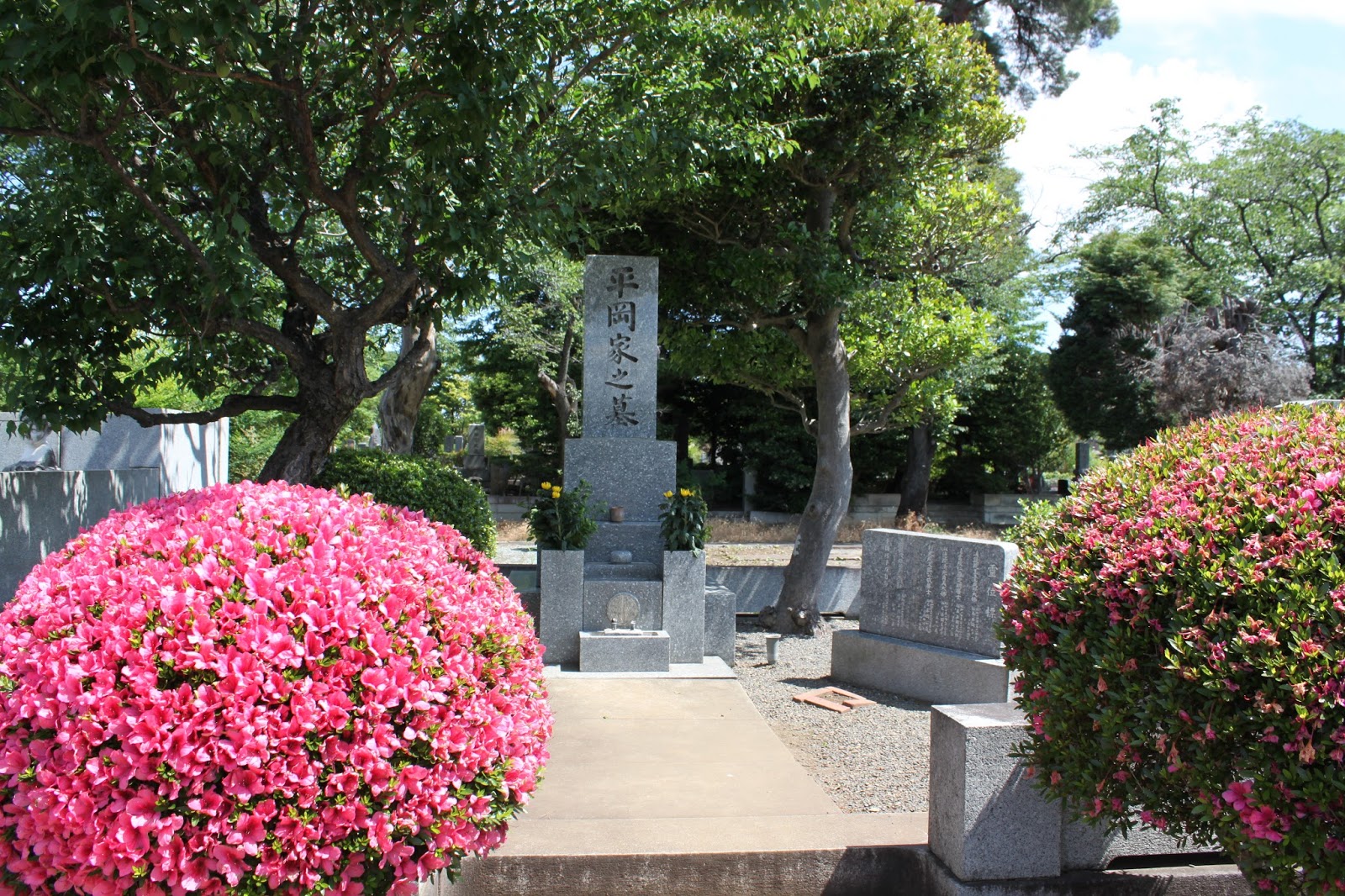
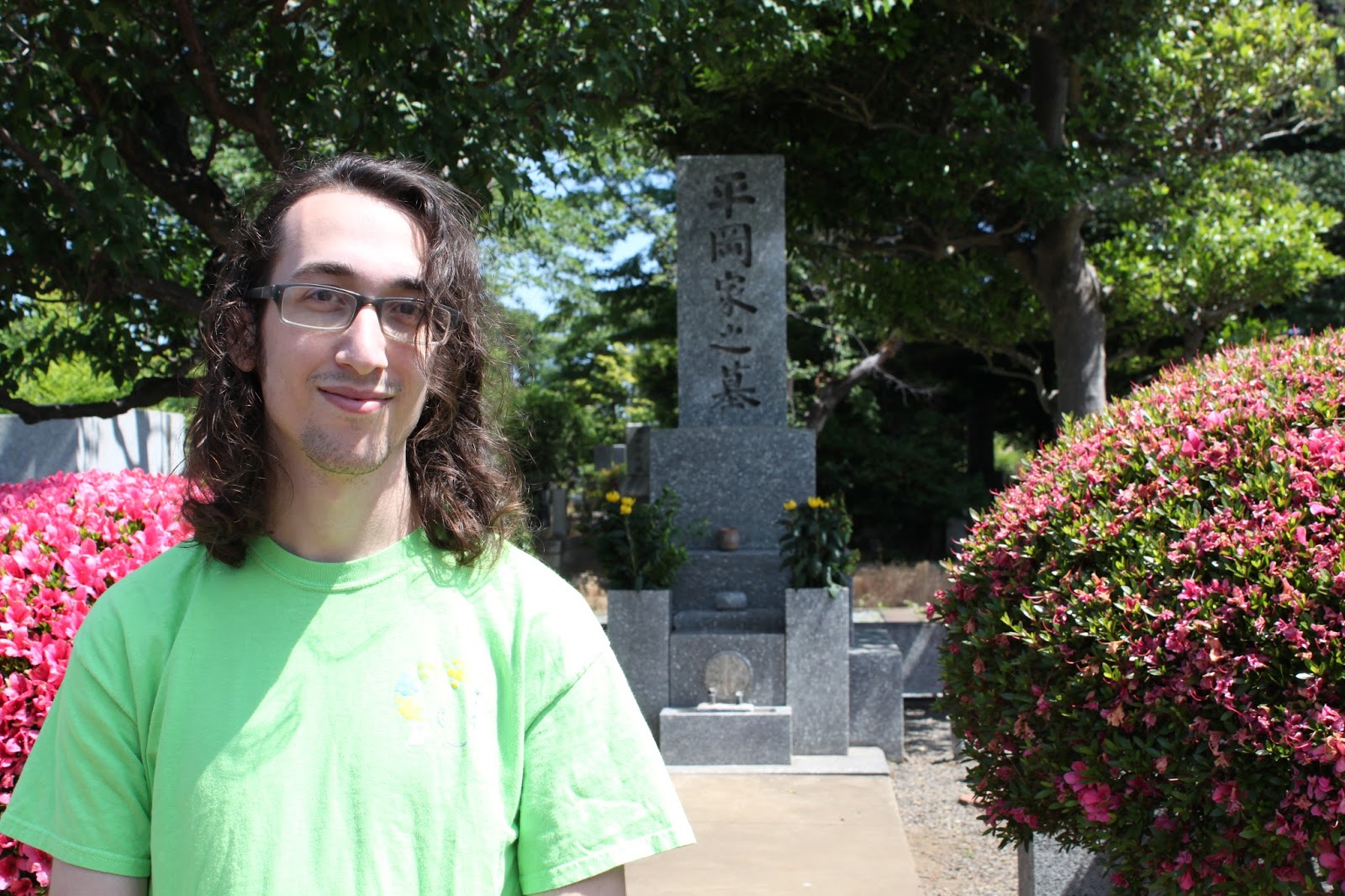
Amazed by what had just happened, Sarah and I made our way into the heart of the cemetery. Because it was quite large (and the map was quite small), we had trouble orienting ourselves toward the row of tombstones we'd been shown. We kept an eye out for distinctive landmarks to help us discern the way. After moving straight ahead for a long while, we turned left and walked parallel to the row in question. It was a still and sunny day, and while I doubted anyone would be keeping an eye on us, the conspiratorial conversation had made me a little apprehensive. We reached the end of the outer row and determined Mishima's grave would be just a row or two farther. So we entered the first row, looking for a tombstone that would match the images I'd found online. I scanned the tombstones intently, focusing on the kanji and the surrounding foliage, before Sarah called me over to join her. I came over and looked, and sure enough...


I was totally humbled. Already I'd felt honored by the two ladies' trust in us. As good-natured foreigners, maybe we gave off the appearance of trustworthiness. Perhaps they'd made an exception for us. But still, I was unprepared for the solemnity of standing near Yukio Mishima's remains in a cemetery that guarded their presence. All was silent except for the click of the camera as Sarah took those pictures of me. As you can probably tell by my expression, it was a bright day, and I had to squint while facing the sun. But in my smile, you might also see some shock at this singular situation. Wide-eyed amazement at this experience I'd been granted by two generous confidants. I felt exhilarated, but also a little undeserving of the privilege. 

We shot the pictures quietly. Not because we seriously feared punishment, but because of the mood of secrecy that hung over this private moment we'd been granted with Mishima.

After leaving Tama Cemetery, Sarah and I headed back to Shinjuku by train. Needless to say, it was yet another uncanny experience, seeing as I came home from school this same way countless times. Today, though, our destination was the Kinokuniya nearby Shinjuku Station. I loved that store's English language selection in 2009. My hope was that I could grab a few books from there, maybe even some I'd passed up years back. Sarah also wanted to visit the Tokyu Hands and see if there were any souvenirs we could pick up. It would be a good one-stop shop before our lunch at Muthu.

Except, there was one problem. I'd read a few months earlier that the Shinjuku Kinokuniya, the original location of the whole franchise, had been downsized recently. I was saddened by that discovery, yet I still wanted to look and see what remained...maybe I shouldn't have bothered. Almost the entire store had been shrunk from six floors to one, and the English language section offered mainly bestsellers. There was nothing to get here that I couldn't get at a USA bookstore. Dispirited, we exited and looked around Tokyu Hands, a department store that had changed far less in the intervening years. Sarah quickly discovered a huge plush cactus, which in fact I'm leaning against now as I write this paragraph! We also found lots of other little knick-knacks for ourselves and our families. Sarah's intuition was right: it was a great place to load up on souvenirs without losing too much time in a day. And ironically, I ended up enjoying myself more at Tokyu Hands than in my long-anticipated return to Kinokuniya.


Our last expedition of the day ended up being lunch. I'd forgotten this myself, but there's a gap of almost 10 hours between my pictures of lunch and our night out in Shinjuku. So I'm guessing we slept for most of the afternoon and evening! Anyhow, we swung by Muthu again and found they were open for lunch. Their menu offered certain lunch specials on certain days, so I got that day's option while Sarah ordered something different for herself. The dishes came with little cups of the most incredible chai, a pleasure I'd forgotten in my seven-year absence. Sarah explained to me that our meals were South Indian style, different from the Northern style more common in America. She said it reminded her of her grad school trip to Kerala, and she recommended I try the paratha if I ever got a chance. She said she knew I'd love it. I believed her, so I began to speculate about a time we could come back to Muthu and get different dishes. Our meals were as delicious as I'd expected, and Sarah agreed that it would be worth it to come back. I was so happy to share this very personal memory with her, just the two of us in a tiny restaurant on the other side of the world.


This post has grown very long, so I'm going to take a break here where our naps began! Next up I'll write another post that hopefully won't be too long, detailing our first night out in Shinjuku. That was something we'd really been looking forward to, and several parts of it are worth exploring at greater length. So, expect that addendum sooner than later!

Friday, March 16, 2018

Leaving for Japan (6/3 - 6/4)

It was a dark night, illuminated only by streetlights. Sarah and I were in a friend's car, on our way to BWI Airport. This was a moment that we'd been spent several months waiting for. I'd somehow managed to get two weeks off at work, even though they didn't usually let people leave that long. It helped that I was becoming an important member of my team at work. It also helped that one of the weeks I'd be missing was just a "prep" week, meaning paperwork and building maintenance.

But even with that stroke of luck, the wait felt endless. Every week leading up to June 4 felt like a hurdle. I counted the days, and I counted the hours within those days. I dreaded the rough days at work, rejoiced when they were over. It was, I believe, about a month away from our departure date that things started feeling really real. I knew intellectually that the date was fast approaching, even while it was still hard to imagine. Three weeks out, my anticipation was growing. Two weeks out, disbelief. Would I really be returning to Japan for the first time in seven years so soon? One week away, I could only surrender to the inevitable. There was no more room, or time, for disbelief. Each day felt flimsier, just one more small cluster of hours to brush aside.

At last, it was the night of our departure. We woke up in the dead of night to catch our early flight. The drive was short, but we got a little lost driving around the huge circuit that surrounds BWI. We weren't quite sure how to get in, and there was little indication of what the proper entrance was. No matter though. We picked a path and found our way to the building's front. That was the pivotal moment, seeing the airport itself and getting ready to make our way through it. My parents took me on vacations a lot as a child, so airports always felt like charged liminal spaces to me. Years of excitement were imbued into this airport, unfamiliar to me yet similar to all the others that came before. In a daze, we took out our suitcases from the car and parked them on the curb. When everything was accounted for, it was time to say goodbye to the friend who'd look after our apartment while we were gone. He didn't know what to say, because "have fun" sounded like too much of a cliche. But he said it anyway for lack of a better send-off. I'd always believed cliches often become cliches because they're broadly true. That seemed especially true tonight of all nights.

He drove away, and we entered the airport. It would be some time before they could check our luggage, so Sarah and I sat in the seats by the entrance and excitedly shared our feelings. We'd spent years planning for this exact moment. How surreal to finally be in the airport when our past felt so near. All those nights walking around our college's perimeter, fantasizing about our first Japan trip...We sat together contentedly, carefree as we'd ever been. Then a woman joined us, looking distressed. She was from China, and she was here to fly back. But she'd discovered, too late, that there's an extra document required to fly on a Canadian plane for non-US citizens. We'd heard of this document in our planning process. I'd been nervous that our flight would be blocked by it too. Yet it seemed we were the only nationals who needn't worry about it, and so I'd forgotten about it until this very moment.

The woman told us her story. She'd been in the airport for three days, having been shut out from her original flight and just barely missing another. Her family was waiting for her, and she was terribly upset about the delay. She was adamant about making it into this flight and getting home. We felt so sorry for her, and I hoped she'd be let through when it came time to check the luggage. Eventually, the attendants told us all we could get in line. Sarah and I stood up with the other passengers and got in line. The woman was in front of us, and when it was her turn to check her luggage, she spoke in a tone suffused with righteous anger. She regaled the attendant with the miseries she'd suffered at this airport and demanded assurance that everything was in order this time. The attendant raised no objections, and the woman was allowed through. I felt relief on her behalf. She met our eyes as she passed by, and we wished her luck on her return voyage. She thanked us, though her spirits weren't exactly high. I could hardly blame her.

We made our way to the terminal of our first departure. We were flying Air Canada, and there'd be two layovers: one in Toronto, one in Calgary. So we sat and waited for our first flight. Even though it would be a short trip from Baltimore to Toronto, this beginning to our trip was thrilling all its own. Onboard, I knew I'd want to listen to music and create associations. The issue, which I should've foreseen, was that it's hard to hear quiet music on a plane. Our plane's ambient roar drowned out most of what I could hear. So I picked the one genre I knew I'd have no trouble hearing: grime. I'd saved Wiley's two most recent albums just for the occasion, and I felt that would be an ideal start to the flight. After that, Skepta's appropriately-titled Konnichiwa. In the summer of 2017, I was feeling an especially strong affinity with accelerationism. The rave spirit of grime was what I was responding to most, and I knew months ahead that it would be an essential part of my Japan trip.

Toronto. Daylight had broken, and we were back in capitalist time, so to speak. Except Sarah and I were taking this trip for our own pleasure, so this moment existed in parallel to capitalist time. It was superfluous the way all aesthetic experiences are, separate from the demands of work and profit. Whatever the intentions of our fellow passengers, we were here because we wanted to be. This block of time had been carved out from a larger block that was not fully ours. We were content to repossess this small piece.


Calgary. This layover would take a little longer, so we decided to find lunch before arriving at our terminal. We settled on a Thai outpost in Calgary airport. It offered quick fixes of Thai classics, and though we hoped it would be a pleasant surprise, the food ended up merely serviceable (Sarah described my dish's sauce as tasting like tomato sauce). We sat at the far end of the airport finishing up our meals and waiting for the plane to board. This time we were among many Japanese passengers, which incrementally increased our feeling that Japan wasn't far away now.

More grime on the plane. Ghetts this time. I drifted in and out of sleep, catching stray lines and songs before nodding off again. I also had some Street Bass compilations from Starkey's label, and these would end up being among the songs most tied to my time in Japan. Despite this flight lasting longer than 10 hours, I was neither uncomfortable nor impatient. I felt content just to be on my way. I'd wanted to watch movies, but I felt curiously unaffected by the ones being offered. Most seemed too inconsequential to be worth a watch, while a few were too good to watch on a place (I think I remember SILENCE being there). Disconcerted, I settled on Ken Loach's I, DANIEL BLAKE, which I felt would be both interesting and visually straightforward enough to justify my watching it on a plane. Next came Leslye Headland's BACHELORETTE, chosen on similar criteria. I liked both quite a bit, but I couldn't help remembering my first flight to Japan in 2009. On that one, I watched just about anything they were playing: X-MEN ORIGINS: WOLVERINE, PUSH, STAR TREK, etc. This time I wasn't so omnivorous. I even tried watching Dreamworks' RISE OF THE GUARDIANS because I'd always heard it was "one of the good" Dreamworks movies. 15 minutes in, I realized I didn't care. Nothing about it appealed to me at all. So I shut it off. I don't regret that, yet I do have fond memories of watching all those Hollywood movies in 2009. I'm sure I wouldn't get much of out them now, but even those inauspicious choices are coated in the general glow of nostalgia. Perhaps that youthful enthusiasm is just lost to me as an adult.

Between the music and the movies, I'd whittled away a large amount of the flight. I remember looking out the window and ecstatically spotting the shore of Japan. Soon I could see forests, streets, rice paddies. I marvelled at how far away Sarah and I were from the United States. This was our first international trip, and we could hardly have been more ambitious. But here we were. The plane landed, and we disembarked.

***


Sarah and I progressed along the moving sidewalk and found ourself at Domestic Arrivals. All around us, Narita airport was decorated with travel advertisements and traditional Japanese relics. We made our way to the check-in point marked as FOREIGNER. After sorting out our paperwork, we took a bathroom break while waiting on luggage. At this point, I was overtaken by a sense of freedom. We'd made it to Japan, and the next steps were up to us.


The first step was obtaining our JR Passes. A JR Pass allows you travel across Japan on the shinkansen for a one-time payment. We'd thought about paying for a two-week pass, but since we only had about a week and a half, we decided it'd be better to spend a few days in Tokyo before traveling around the country. So we approached the JR East Travel Center, where we could trade in pre-purchased vouchers. Since JR Passes are only available to non-Japanese citizens, there were a lot of white people in line with us. This period of time would be one of the few when we'd see a significant amount of white people in one area. That was quite alright by us.

Next, we had to pick out travel times for our JR Passes. We were lucky to meet with a very friendly attendant who not only gave us the train tickets we wanted, but also advised us when we could just ride a local train instead of the shinkansen. For example, since Nara and Osaka are so nearby, he suggested we not bother getting shinkansen tickets for a connecting ride. Sarah remembers this as a moment that alleviated a lot of anxiety for her. Having our JR Passes and our train tickets was an empowering feeling, and once we bought our Suica cards to transport us around Tokyo's train system, we were very well-equipped for our stay. And since we both had experience riding Tokyo trains in the past, our next steps would be a matter of muscle memory.


Before leaving the airport, I went and exchanged a couple hundred dollars for yen. I also bought my first food item of the trip: tuna-and-mayonnaise onigiri! This was a personal favorite of mine, one I often ate for lunch as a student at the American School in Japan.


Riding the train, Sarah and I gazed serenely out the windows at a familiar view. The Japanese countryside was passing by under a late afternoon sun. We were both blissed out and loving every second of the ride. In fact, we were so happy to be on a train to Tokyo that it took a while for us to notice how slowly the train was going. It stopped every few minutes at local stops, and we were on track to arrive at Tokyo late in the night. Curious, I checked the electronic display perched above the train doors. After a long discussion with Sarah, I came to conclusion that we were on the Local Train, when what we wanted was the Rapid Express. It wasn't a disaster, but we needed to transfer if we wanted to get to Shinjuku anytime soon.

I perused the screen display carefully and checked the departure point with Sarah. I was pretty sure we'd figured out a point where both the Local Train and Rapid Express stopped. If we got off there, we would be able to hop on the Rapid Express the next time it stopped. We felt uncertain, but it was worth a shot. At worst, we could just jump back on the next Local Train. So we got off and waited around at a countryside station. Sarah suggested we buy drinks, so I opted for another old favorite: Royal Milk Tea!

The sun was sinking lower in the sky at this point. We were a little behind schedule, but it wasn't worrying us. There was no hurry. Sure enough, the Rapid Express rolled up after a while, and we climbed aboard. Most of the stops from the Local Train were no longer listed, and we were shuttling right along to Shinjuku. Our gamble had paid off. Before long, we were entering the tunnel that would take us to Shinjuku Station. This huge station had been my nexus point for so long, the beginning and end of so many explorations. Coming back seven years later at this new stage in my life was wildly disorienting. It was almost like no time had passed after all.

After disembarking, I looked around for a way out of the station. It looked familiar, yet I wasn't entirely sure we needed to be. The Airbnb we'd be staying at wasn't necessarily near the apartment where I'd lived. I thought that if we could get to the East Entrance, at least I could find our way to the Entrance we needed. That plan would've worked if I hadn't gotten us lost inside Shinjuku Station. At least two times, I swore the East Entrance was right around the corner only to discover we were still trapped inside. Not only could I not locate the East Entrance, I couldn't locate any Entrance at all. Defeated, we eventually found our way out the West Entrance. This was a fairly new area for me, since it was facing away from the area I'd lived in. However, I knew we could walk around the station's perimeter to reach the East Entrance.

Sarah and I weaved our way through a huge crowd of mostly young people. We followed the narrow sidewalk underneath the railway bridge and worked our way back up to the East Entrance. It was an enormous 180 degree turn, in a sense, but it got us to a familiar spot. I was back at the Entrance I knew from countless trips to school and other areas of Japan. We were on firmer ground now, but we needed Wi-Fi so Sarah could download the directions to our AirBnb. That took us on a loitering spree with the intention of soaking up some unwitting business's free Wi-Fi. Eventually we ended up outside the big BIC Camera store along Shinjuku Station's elevated walkway. While she downloaded the directions from her email, I looked around at the huge buildings. It was surreal to see how little had changed. I felt as if the past had overtaken the present, and this was merely another day living in Shinjuku. But of course the time would soon come to leave, just as it had in 2009. Just as I can't stop returning to Shinjuku, neither can I stop leaving.


Our route took us back around Shinjuku Station. We were looking for the South Entrance to get started, so we doubled back to the West Entrance to orient ourselves. This would be the easy part, I figured. Now that Sarah and I were outside, all we had to do was find what should be a clearly-marked sign. We marched in the other direction, away from both the East and West Entrances. We walked and walked, but the South Entrance didn't announce itself to us. Bewildered, we backtracked again in case we had overshot our mark. By now the sun had gone down, and we were moving through that inimitable neon-studded Tokyo darkness.

There were still throngs of people in our path, but we ducked and dodged as needed. Our heavy luggage began to weigh us down. We were growing tired and our morale was flagging, but our jittery excitement kept us moving. The West Entrance loomed ahead, and I was getting very confused. Walking left would only take us around to the East Entrance, but we'd just come from the right and found nothing. All we could do was head to the right, again, to see if the South Entrance was somewhere along the way.

It was not. I asked Sarah if I could see her phone. We deduced that the Tokyo Hilton was visible in one of the pictures we'd received from our AirBnb host. We both knew what it looked like, and I knew it was near the apartment I'd lived in. Exasperated but determined, we swung our luggage around and headed back to the left, bypassing the West Entrance and making that arduous loop back to the East Entrance. From the East Entrance we scaled the walkway, passed the BIC Camera store, and headed toward my old home. I remarked to Sarah that this was the exact path I walked coming home from school all those years ago. From those familiar intersections, I led us in the general direction of the Tokyo Hilton.

Once that tall white building became visible to us, we oriented ourselves according the host's directions. We were striking out in a direction that was unfamiliar to me, so we kept an eye out for any landmarks in our host's pictures. The breakthrough moment was when we spotted the 'Morinda' building. That was when we knew we were definitely on the right path. At the Morinda, we took a sharp right turn and headed up a long street. The next landmark was a B&W Auto Dealership, and from there it was just a short left turn to our final destination. We entered the building, rode the elevator, and opened the door to the apartment we'd be living in for the next four days.


Immediately, I sprawled out on the bed. We laid out our luggage and took a well-deserved break. I played some music. The first song was Footsie's Two in the Front, midway through an album I was listening to at the airport. Next I played Butterz' TQD album for Sarah while we lounged in this tiny space. The walls were a clean white, and we had a small window view out onto the street. A washing machine crouched in the corner next to a bathroom door. The tiny kitchen seemed not worth the trouble of cooking. So we decided we'd go to the 7/11 near my old home and grab some food for the night and the next morning.

Free of our luggage at least, walking regained its pleasure. Even though we were sleepy and worn out from all the previous wandering, Sarah and I were happy to be walking the streets unburdened. I thought about how touching it would be to see my old apartment building the next morning. We arrived at the 7/11 and picked out a few pre-made food packages to take back. Now that I knew where I was, I figured we could easily backtrack to our AirBnb. That turned out to be overly-optimistic. Sarah and I headed back the way we came, but I couldn't discern any of the landmarks from before. We scaled walkways I thought I remembered, only for them to lead us in unfamiliar directions. We were lost once again. All the while, huge impassive buildings loomed over us in the cold grey night. Our meandering had lost its sense of fun. Now we just wanted to get back, and the city was offering no help. I found myself distressed by how unwelcoming Shinjuku felt at that moment. This city I loved more than any other seemed totally indifferent to me. I no longer felt the warm bond of those earlier years, and I couldn't even feel the echo like I had just hours before. I might as well have been a stranger here among the monoliths. Looking back, Sarah and I agree that this was the worst night of our trip. With aching legs and bags stuffed with food, we were in no mood for meandering. Our stamina had bottomed out, and we desperately needed to recuperate.


After spotting that lucky Morinda building, we made our way up to the B&W Dealership and around the corner. Now we were ready to settle in for the night. The next day would be full of new experiences, but for now we just wanted to eat and go to bed. I tore into my spaghetti bowl and got ready for bed. I said goodnight to Sarah, feeling proud once again how far we'd come. As rough as the night had been for us, it was good to lay in bed knowing we had days ahead to get familiar with our surroundings. We turned out the lights, and I switched on my iPod for a few more music encounters. My first pick was a new album from shemusic, a huge influence during my year living in Shinjuku. It sounded different than I expected, but I wasn't too surprised. Just like much had changed in the time since I lived in this city, so had the musicians I once listened to. I acclimated myself to the male vocals and slower pace of the music before finding a familiar delight in the buzzing electronics. shemusic's chiptune melodies and glitch effects are deeply connected to the sustained future shock of living in Shinjuku. For all the things that were different, those sounds felt as timeless as ever.

I was close to falling asleep, but before I nodded off, I was lucky enough to click on to a stray song hidden in my gallery of new music. It was a collaboration between two artists newer to me: Manual and Orange Crush. The former I'd encountered through Sean Baker's STARLET soundtrack, and the latter had deeply impressed me with a remix on an EP I'd gotten for other reasons. Since I'd discovered them in such different contexts, I wasn't expecting to find that they had worked together. So I downloaded their joint track Calderone before leaving, and the first time I heard it was in that AirBnb apartment.

Immediately, I felt deep wells of emotion washing over me. All the discomfort of our first night in Japan receded far away. At last, I felt the profound connection to Shinjuku I had been dying to experience again. The past seven years seemed to melt into one vast pool of memory, and I was floating on my back right in the middle of it. I thought about how all the contingencies of my life had guided me to this beautiful moment of warmth and love. There was even sadness at ever having left Shinjuku, but I could handle that as well. Regret was just a small part of the swelling orb of emotion I felt inside me. The apartment was dark, and I was sure Sarah was asleep by then. I felt ready to sleep too, but I couldn't stop listening to this song as I drifted off. The distance between past and present, melancholy and joy, Pennsylvania and Shinjuku, Pennsylvania and Baltimore, Baltimore and Shinjuku, all seemed like a sprawling vista seen from miles above. A tangle of paths I could look upon with fathomless affection, both closer and farther away than I had ever noticed. Nothing ever so distant as it seems.

Thursday, March 1, 2018

Post-2011 Post-Human James Ferraro Index

A close listen from 1:00-2:00 AM has convinced me that Ferraro is squaring a very difficult circle. He's found beauty in the Baudrillardian simulation and layered it into his productions. He knows that programming the word Clorox to repeat throughout a song won't cheapen or toxify it. This is a very generous ouevre: although there's a lot of skill in his compositions, hypothetically his style could be adopted by anyone willing to give it a try. There's often a selfishness to independent music, a performative distancing from the vulgarity of commerce and modern life. Ferraro pushes in the opposite direction, drawing on one of the few true universal experiences (living under capitalism) and creating something singular and personal with it. Music for everyone.

Art suffused with commercial detritus can still be profoundly moving, Ferraro knows that and has proved it. However not all of his projects are equally "accessible," nor need they be. Some of these albums are incredibly dark, abrasive, alienating, depressing. That is also part of capitalist life. And while those works are very worthwhile, I've made this list to help beginners ease into Ferraro.

Sushi
Skid Row
Cold
SUKI GIRLZ
Human Story 3
SILICA GEL (BODYGUARD)
Far Side Virtual
NYC Hell, 3:00 AM

The order of access needn't be linear, and it certainly wasn't for me. But, for example, I had an easier time with Human Story 3 than Far Side Virtual, even though FSV was my first Ferraro album. Only by exploring Human Story 3 could I finally find a way into the junk-art of FSV, and even now I still find the latter to be his most challenging album.

For me, the first album that really spoke to me was SILICA GEL, a sometimes nasty work of ultrasmooth plastic texture. Its pummeling, distorted, cavernous beats actually made it easier for me to access the album's core. On other works, the affect is subtler and more diffuse. I needed SILICA GEL's obviousness before I could traverse the rest of Ferraro's discography and make my own connections.

So the point is, you can jump around freely on the spectrum to find what is most engaging. I wouldn't presume to know what side of Ferraro speaks most to newcomers. I just know I really like his music and think it's worth the effort. For so long, I kept tripping over what I thought was "irony," getting lost in a self-aware hall of mirrors. But that was my own over-intellectualization. Pushing through the consumer products and silly titles, you can experience something deep, meaningful, and immediate with Ferraro.

Wednesday, February 28, 2018

Revisiting Metroid

I have a memory of Metroid which may or not be my first experience with it. It's 2002-03, and I'm obsessed with the Nintendo GameCube my family got me. One of the games I have is Metroid Prime, which looks a lot more grown-up than the likes of Mario Party or Super Mario Sunshine. The dusty brown cover and faded steel graphics communicate maturity to me in a way the cartoonishness of other Nintendo properties avoid. I begin to play. It's exciting to feel like a big kid exploring this desolate space station. But soon the eerie ambient music and creepy creatures start to scare me, and I realize I may not be ready for this game after all. I put it aside and think the matter over some more at my grandmother's house. Maybe I'm not ready for adulthood after all.

It's possible that I may have played Metroid Fusion first. But somehow I doubt it. I don't think I would've gotten through that game and then had trouble with Metroid Prime's atmosphere. There was something too immersive about that lifeless space station that scared me away. I scared easily as a kid, so I tended to avoid anything that would get under my skin too much. Although I did used to read as many R.L. Stine books as I could...perhaps because their terrors were imaginary, while audiovisual terror felt more immediate.

But eventually, after avoiding it for a while, I decided I was ready for Metroid Prime after all. It was important that I approached it on my own terms without feeling pressure to toughen up. The wait paid off: I thrilled to its moody ambience, and Metroid quickly became a favored franchise to me thereafter. Its vast empty worlds must have struck a chord with me, living as I did in borderline-rural Pennsylvania. Being the lone lifeform in a forbidding wilderness wasn't such an alien experience after all. 

In those adolescent years where video games were an all-consuming passion, few loomed larger in my imagination than the Metroid series. My favorites formed an indelible quartet: Prime, Fusion, Prime 2, and Zero Mission. Two from 2002, two from 2004, each one a key experience in the shaping of my teenage sensibility. 

This was also an unusually fertile moment in a franchise that often goes dormant for years without warning. Nintendo seems baffled by the success of its Metroid games, commissioning a few before getting skitish once again. After the hostility that greeted Other M's release, Nintendo held off on Metroid games for a full six years before releasing the reviled Federation Force. Only with last year's Samus Returns did they find the critical and commercial success they were seeking. At least one new game is in active development now, but if history's any guide, this hot streak can't be taken for granted. It could go cold just quickly.

As for me, my own video game mania coincided with that small window's opening. Metroid became a vital part of my life, simulating in electronic form the oppressive hugeness of an adult world I was just beginning to glimpse. I'd long since barricaded myself inside my childhood home to keep out my unkind peers. I think that early retreat from the social world marked me more profoundly than I even knew. To this day, I can only feel emptiness around me despite the world's infinite busyness. Living in a big city hasn't altered my perception of being the only person around for miles. Outside my apartment walls, humankind is a vanishing abstraction hidden somewhere far away from me.

I want to try and describe the experience of my four favorite Metroid games. But my perception of them is inextricable from my own self-perception. I have to backtrack and make sense of myself before I can talk about them.

Here's my impression of playing Metroid Prime. Hot creeping vines. Stagnant water. Desiccated skies hanging over dusty, dry fields. Crumbling sandstone pillars. Underground tombs full of magma. Scorching cold winter air. Softly blowing snow that hides toothy bipedal monsters. Corrosive chemicals tearing apart the DNA of indigenous creatures. An alien race watching with sadness as its culture is melted into burning blue plasma. The incongruous confidence of walking across melting icebergs. The melancholy of a world sleeping beneath permanent cold. Waterlogged regret. A ship knocked out of orbit, consigned to purposelessness. Steroidal marauder-warriors who undergo forced mutilation to achieve new levels of rage and hatred. The creature of pure growth they worship for its limitless appetite. Envy of a pettier, weaker species. Those yellow eyes glaring with inarticulable emotion. Dodging the plasmic beast as it patrols its territory. Intelligent but wordless.

There are moments of total emptiness in Metroid Prime that are hard to convey in words. Even the cinematic time-image can only convey so much empty space. To really feel your aloneness, you have to move through a space that can't feel your presence. You must walk over the inert metal that's been wedged into the crust of a frostbitten planet. Spelunk the scientific facilities of an alien race whose primal need for power scars the pristine icy surfaces. The three-dimensionality of Metroid Prime is key to its desolate affect. It's the traversal of a dying world, moving from lush swamps to blistered ore mines, that tells you just how vital your own life is. Samus is a latecomer to this entropic scene, and that's very much the point. All the ferocious turmoil of invasion and rebellion has already happened. All that's left is to walk among the ruins and piece together what happened.

Metroid Fusion is somewhat more stark. There are plenty of ominously open spaces, but the lines are crisper now. Its sharper graphics are a metaphor for the limits built into the game. Here you can see the edges of the screen because every artificial room you enter has circumscribed limits. And while the game's excitement lies in watching nature "find a way" through such a sterile environment (a lot like JURASSIC PARK, now I think of it), Samus remains confined to an enclosed space station. We are watching a microcosm of video game ecology, a simulation of a simulation.

Fusion seems well-liked by fans who, admittedly, don't have many other options to choose from. It feels rather like a remix, combining various environmental themes (hot, cold, tropical, water) into one unnaturally pristine space. The RESIDENT EVIL: RETRIBUTION of Metroid games, you could say. But just as that film is my favorite of its series, I find a lot to like in Metroid Fusion. The computer narrator, tedious for some, is for me an essential part of the game's tension. There is a dialectical relationship between the computer and its domain, where the A.I. is constantly trying to make sense of the uncontrollable energies blasting through walls. Samus and her digital advisor are always one step behind the viral lifeforms, which makes the game's flow feel more urgent than in the other entries. Some find that approach too linear for a famously non-linear series, but I think it's a clever innovation. The uneasy anticipation of Fusion comes directly from its written prompts.

With Metroid Prime 2's release, the yawning void at the series' heart literally entered a new dimension. This time Samus was tasked with exploring a bleak world and its blackened clone, hidden on the other side of a dimensional rift. The familiar expanses of barren earth now had an even darker complement.

It's been a while since I last played this game, though the urge occasionally retakes me. Several years ago, I suggested to my step-brother (who spoke little English at the time) that we play Prime 2 together. He agreed, and so we took on the task together, slowly building a relationship with one another meanwhile. Before that, I delved deep into this game in middle school, ensconced in the guest bedroom where the family GameCube was located. I spent a lot of time in that room as a teenager, somewhat more exposed to the rest of my family but still absorbed in my own pursuits.

It was progress though, I suppose. As a child I hid in my room most days, passionately drawing, building, and writing to my heart's content. Adolescence made me bolder than I'd been as a shy, sensitive child. I kept my guard up around others, but at least my curiosity about the world was leading me into new spaces. Still, I could only grasp my place in the world by seeing myself as alone in it. Metroid Prime 2 visualized that feeling more profoundly than I could've expected. I am haunted even now by those moments of utter stillness on the dark planet, far removed from life itself. Stranded in un-reality that feels as if it could collapse at any moment, and with me inside it. Perhaps that's why the game ends as it does, with the dark planet folding back into its "real" originator. The exceedingly tenuous reality carved out by Prime 2 is too fragile to last forever. But like all art, its effect/affect can linger in one's mind far longer.

Now, I'm finishing up Metroid: Zero Mission. This one always recedes into a haze of memory, reflected in its fuzzier graphics. The whole game feels more like a fantasy re-imagining of the original game than something real. Another simulation, another retromanic rewind. And it is that, but there are things to like about it too. The music is top-notch as ever, and some boss fights (Kraid, the Imago larva, Mother Brain, Robo-Ridley) are memorably surreal. I enjoyed the experience, even if it all feels a bit like inhaling the vapors of someone else's fading memory. A secondhand nostalgia that becomes, in time, my own nostalgia.

What really piques my interest about Zero Mission now, though, is the prospect of playing Metroid: Samus Returns. The latter game is a direct sequel to the former, and so I felt I should end my recent Metroid replays on Zero Mission. The Metroid series is always retracing its steps, doubling back twice for every cautious step forward. I suspect that's another reason Metroid Fusion gets a pass: despite being little more than a mash-up, it also remains the farthest leap into the future that Metroid has yet taken. We're all still waiting for Nintendo to push past the line in the sand drawn by that 2002 entry.

I'm not much of a gamer these days, yet I can still find time to enjoy reliving memories of old favorites. I almost wish I liked video games more, except I already feel sheepish about the amount of time I spend on movies. I don't need to add another medium to my repertoire. So for now I'll give Samus Returns a try, and hopefully my copy of Metroid Prime 3 will show up someday (it's lost in my apartment at the moment). As reluctant as I am to "get back into" video games, I can't deny the formative influence of Metroid. I will forever return to these games, listening to their music, soaking in their affects, retracing my steps on their familiar lifeless terrains. Sometimes it's hard not to feel like the best days of Metroid are behind it, but who knows what the coming years will bring. For a series so bound up in sci-fi possibility, it seems only right to keep waiting for another dose of that old future shock.