The night before Cannes' 2015 Main Competition lineup was announced, I watched GOODBYE SOUTH, GOODBYE for the first time. Call it a hunch, call it an omen, but I was close to certain we'd finally see Hou Hsiao-Hsien's THE ASSASSIN emerge this year. I felt some sort of tribute was in order, and it had been too long since my last Hou experience. If I'd been less excitable, rudimentary research might well have confirmed my suspicion for me ahead of time. But who wants to prove Santa Claus isn't real? The next day, it was Christmas. I suspect THE ASSASSIN will easily be this year's heavyweight, though I'm very excited for Jia's and Apichatpong's entries, the latter of which was uncertain until a day or two ago. It's been 2 years since Jia's newest feature film and 5 since Apichatpong's. Hou, though, wins out at a full 8 years of absence. He hasn't been inactive, but it seems we're a long way from the 80s and 90s, where Hou seemed indefatigable in his output. THE ASSASSIN has loomed large in the aging auteur's path, absorbing year after year in which another two or three films might have emerged. With Hou, it's hard not to be greedy! By all accounts THE ASSASSIN was a challenging shoot, and I expect we'll see the proof in motion very soon. Now, anxious horizon-scanning no longer necessary, I feel free to fully appreciate what we already have.
With my love for THREE TIMES (viewed beautifully, appropriately, in a skyscraper in Japan) and warm fondness toward FLIGHT OF THE RED BALLOON, it's been a lovely couple of weeks exploring Hou's older films. I've been missing the experience of getting to know a great auteur, as I've already exhausted a fair few impressive filmographies. I enjoyed the drifting GOODBYE SOUTH, GOODBYE quite a lot as my first reacquaintance with Hou. There is a sense of despair in it echoing more softly than in the film I'm about to discuss, but that subtle unease unexpectedly lifts every now and then to euphoric results, as in the mountainside motorcycle trip and that orange-tinted entrance to a party. GOOD MEN, GOOD WOMEN situated me deeper in Hou's stake in history, even if it is the least of the films I've seen so far. THE PUPPETMASTER is so intricate and reserved that I will need some time before consolidating my experience of it into an opinion. Still, it's an exceedingly impressive film. Even as I've left most of Hou's earlier, smaller-scale films untouched (not entirely by choice; few are available to me at this point in time), his mid-to-late period films have warmed me back to the hope that there are still cinematic surprises and delights in the world yet to come.
At the apex, so far, comes FLOWERS IN SHANGAI. My current favorite, it's one of those films you can't help imagine being made for you, melding perfectly into sensibilities you suspect few others share. I love this film, and I feel lucky to have seen it. For this experience, I must unexpectedly thank YouTube, of all sources. Yes, Hou Hsiao-Hsien's FLOWERS OF SHANGHAI is on YouTube, and it is available at reasonable quality, with English subtitles. Or it was, until recently. A recent check confirms that it's been snatched away. What a shame. No matter. I have found YouTube to be a helpful resource lately, after first discovering Manoel de Oliveira's MON CAS there days after its maker's death. The aforementioned GOODBYE SOUTH, GOODBYE is also on Youtube, and just for good measure, here is Anh Hung Tran's THE VERTICAL RAY OF THE SUN. As you may suspect, I am impressed with such a proliferation of "rare" films, especially in contrast to the hegemony of Netflix. I have only just received a disc of Hou's GOOD MEN, GOOD WOMEN from Netflix, its "Very Long Wait" status being the ostensible reason for such a delay.
I somewhat doubted I would receive the film at all. Netflix seems content to spirit away whichever films it pleases, evidenced most ludicrously by David Cronenberg's CRASH now being unavailable for rental. It is not my intention to bog down this post on Hou's superlative film with an anti-Netflix polemic, but I do think there is a point here worth making. I am admittedly not familiar with the workings of DVD distribution, and I know that, for example, Nicholas Ray's IN A LONELY PLACE has gone out-of-print, thus accounting for its unavailability on Netflix. It is possible that such mundanity explains the placement of 56 other films in my Queue's Saved section. Still, I can't imagine what is causing the "Very Long Wait" behind FRIENDS WITH MONEY, a Sony Pictures Classics film starring Jennifer Aniston, as well as my (presumptive) next delivery. To focus on the logistics ignores the climate of forced scarcity that Netflix helps maintain. There are, of course, always power differentials affecting which films are deemed profitable enough for production, let alone global distribution via home media. However, it is precisely the least accessible films which suffer the most from the supposed "invisible hand" of the market. The corporate curation of Netflix withholds as much as it provides, its relative abundance the necessary corollary to the many films it deems too uncommercial. Now that YouTube's hidden library of foreign and independent films has emerged as an alternative to these artificial holes, I plan to use it as often as needed to supplement Netflix's paltry offerings. Without YouTube, FLOWERS OF SHANGHAI would remain an "Unknown" to me.
Anyhow, onward to the film. FLOWERS OF SHANGHAI illustrates a particular sadness that is well-known to me but hard to articulate through art, if my many years of not finding it there are any indicator. It's the sadness of rueful and uncomprehending self-destruction, set against a world unconcerned with interfering in any way. In that sense, I doubt it's a coincidence that the film is set entirely within opium dens. Drugs, as a whole, seem uniquely able to spin a sense of internal worthlessness into rituals of self-harm. There's a great distance between this belief of mine and puritanical Reaganite sternness, so don't get too offended. Drugs have their own unique effects on the mind and body, but I'd hardly be the first to claim a given activity is an opiate (aha!) to the masses. Religion, television, the usual suspects, all of which have been argued long before this day today. Not to be snide, of course, because I think it's a great big deal to acknowledge that people seem to have a dark flair for self-destruction, and it pays to recognize those tendencies, if they exist, in yourself, and in others. Drugs and their users are a metaphor for this fear/tendency as much as an actualization. The drug addict is only the most visible and stigmatized of people who can't make sense of their place in the world. Neither a false sense of superiority nor a rigid aversion to drugs can keep away the existential dread so literalized by drug abuse. Despair, loneliness, and isolation pervade.
Which, to come around finally, is I think what Hou is getting at in FLOWERS OF SHANGHAI. If I have to bend over backward to explicate the non-judgmental stance of the film, it's mostly because I think that its hazy sadness is best experienced direct, undiluted. Opium is a stranger to me, but the feelings it's meant to ward away are not. Therefore, I can follow its users every step of the way up until the high itself, at which point I can substitute some other equivalent feeling. I love this film, and I would hate to get tangled up in any preconceptions I'd brought to it. Perhaps speculating on the presence or absence judgment is something only Westerners need to do, as Hou seems to have jumped right into his milieu without reservation. But I'm less interested in unpacking the judgmental Western mindset than I am in the difficult feelings that judgment, as a critical approach, is meant to obfuscate. So, if we can take for granted the existence of judgment, Western or otherwise, let's agree to ignore it and look more closely at what judgment effectively hides.
In Hou's Shanghai, when even the tumultuous 20th century was still a distant future, the world exists in miniature within the confines of brothels. Men parade their wealth and cluster together to drink and gamble, women occupying as much of their attention as they see fit. Which is ironic, since the economics of running those comforting hideaways seem shouldered entirely by the female owners and prostitutes. The courtesans, far from world-weary, come across as impulsive and naive. Susceptible to the fickle affections of male visitors, they fight and wage rebellion against their "Aunties." In turn, the Aunties are quick to remind their employees of their financial dependence. There is a constant feeling of insecurity in FLOWERS OF SHANGHAI: employer and employee cannot trust one another, nor can customer and provider. When bad feelings erupt, as they always seem to, inequality gives the edge to the more financially secure. The many inhabitants of the brothel coexist in a narcotic lull when times are good, but equilibrium is always destabilized by unruly emotion, and no one is prepared to deal with confronting the resultant power imbalances face-to-face.
Really, I'm spelling out the themes and throughlines more than Hou ever does. And even those aren't what hit me hardest, necessary as they are. Hou Hsiao-Hsien, like many artists I consider great, can reliably sketch out the sources and effects of power through a variety of metaphors and environments. A 21st-century Taiwanese nightclub is just as fertile ground for him as the aftermath of World War II. I'm quite in thrall to his skill and adaptability. But it's the emotions he teases out from the forces of history that stay with me most. Ultimately, a movie like FLOWERS OF SHANGHAI tells me about myself, with a clarity greater than I myself might be able to summon. As much as it is a story about China and its people, it is also a story of days wasted in social diffusion, of pleasant times forcefully repressing bad memories. Of codependence and the emotional inscrutability of all people. The inability to see or understand yourself clearly. The horror of realizing that no one else can help or explain themselves to you any better. Is this why I seek refuge in art? Because artists spend years constructing something so beautiful and affecting, itself synthesized from years of inchoate personal experience? The emotions art can create in me, and the passion poured into it by people I don't know, is a form of intimacy. Art is a performance and an endeavor, undertaken by sensitive and creative people the world over. I am the spectator. Film is a recording, sight sound and sensation, which I can return to at my leisure, from a safe remove, in a safe place. The world is out there around me, but emotion is inside me, and I bring myself to art in times of need so that I can commune with something that makes more sense than I do to myself. Art is a substitute, a distraction in some ways but a vitally important one in others. There's always a dialectic at work, between me finding what I need in art and turning away from the real, harder work of putting myself into the world.
Viewed through my own personal context, it's no surprise to me that one of my favorite films is IN THE MOOD FOR LOVE. Quite apart from its mood of aching melancholy, which it shares with FLOWERS OF SHANGHAI, it is an ornament of despair on which I can ruminate from afar. Most likely it's not a coincidence that both films share a cinematographer. And both were made by citizens of Chinese territories prone to disruption and uncertainty. The connections are there, even as they spiral quickly out of firm meaning. I suspect it would be foolish to attempt any deeper reading of my unexpected connection to Chinese-language post-colonial cinema. In any event, I have memories of both films now, the gut-level sense of recognition in its characters and situations, and each subsequent revisit will bring those memories to surface. I have seen IN THE MOOD FOR LOVE many times over many years. Only now am I seeing in FLOWERS OF SHANGHAI what I'd turned to IN THE MOOD FOR LOVE for previously. With these two similar films, I can see more clearly what moves me most in art, and with that insight I can turn my gaze inward to remind myself that movies crystallize for me an understanding of the world that is uniquely my own, but shared enough by others that I can rely on their perceptions to augment mine. In sum: I am no longer so alone, so lonely, so crushed by social forces that serve to isolate me from other people. But in the worlds of these films, I see the damage that was done to me, how it was both self-generated and imposed from outside. They come together and alchemically reflect something always and already beyond my grasp. Their national origins, the remote eras in which they take place, and the kinds of people they depict all somehow overlap to create, improbably, an image of my inner self. A deeply strange process, but after all, it's the possibility of such an unlikely connection that drives us to art in the first place.
If this essay ends up not being very much about FLOWERS OF SHANGHAI at all, I hope I've communicated that the film has brought me outside of myself, to take a closer look at who I am and what brought me to appreciating a movie like this so deeply. There will be many other times when I can admire its craft and its beauty. It's certainly not a film I'm planning to forget, so I will be gladly reconsidering it often in the future. I could offer a wealth of observations about its mournful color scheme, that liltingly sad violin that drifts subliminally through most scenes, and Hou's famously intricate long takes that somehow feel unprecedented in the history of cinema. And what about the characters, who embody their own caprices and react to those of others so precisely? Frankly, I'm not even sure I'm equal to the task of capturing the deathly malice Tony Leung casts over the film, let alone the excruciatingly sad acts of defiance by the film's many actresses. A whole essay deserves to be written just on Hou's beautifully sorrowful treatment of the unrealized hopes of women with nowhere to go and no one to count on. Today's not the day, though. I'm tired and I've said enough for now. There will be more to say later.
Tuesday, April 28, 2015

Monday, March 30, 2015
EL CHACAL DE NAHUELTORO (Littín 70): [4]

EL CHACAL DE NAHUELTORO survives for now, and I am glad, because it's a film I would regret losing the chance to see. It is familiar in its focus but original in its telling, and that originality plays no small part in the effect it achieves. Its impoverished locale suggests Béla Tarr, but its shooting style suggests, of all people, Wong Kar-Wai. Or perhaps, more accurately, one of Wong's French antecedents. A film of 1970, EL CHACAL seems uncannily tuned in to the frantic energy of the French New Wave. The first flowerings of the Nouvelle Vague had only just begun to infect cinemas of the world, and though I can't speak with any authority on the cinephile circles of 1960s Chile, it seems stunning to me nonetheless that Littín would have internalized the Nouvelle Vague to such an extent already. Beyond its appreciation for kinetics, the film seems similarly aware of how a generic plot can be distorted to lay bare inner truths. EL CHACAL contains elements of the procedural, the redemption drama, and the neorealist cri de coeur, but is ultimately none of those things. It is, in its hybridity, something new. It sees differently. By watching it, so do we. Littín's camera is perpetually unmoored, ambulating along a depressed rural Chile in pursuit of one restless soul. This is El Chacal, the Jackal, and his life seems defined by movement as much as Littín's cinema. Our first glimpse into his childhood finds him at a sprint. He is being chased by a Chilean policeman, but the fury of his young feet seems to suggest something far larger is after him.
El Chacal, or José del Carmen Valenzuela Torres, is rootless in the most fundamental ways. With no father and a mother barely able to support him, José's early life is a string of trials with no resolutions. José's affectless voiceover in recounting these years reveals the full damage of these hardships. There is no room for fondness, modulation, or even distance. The miseries of those times are the miseries of now. José's life has not improved in any appreciable way, and his final damnation seems like the most inevitable of all. Alone and intoxicated, he kills, in quick succession, a widow and her five children. Though each killing has its own gravity, I was viscerally repelled by the sight of El Chacal stomping on a baby's carriage. The mere filmic association between wailing cries and crushing foot made my breath catch in my throat, even though there was plainly no infant was actually harmed.
There is a bottomless mystery here that the film never pretends to know, and that is what interior state could possibly compel such a series of murders, most of whom were children. The film's José is repeatedly asked that question, and other than a twistedly honorable desire to not have the orphaned children suffer, he has no answers for us. I like this very much about the film, because no narrative could convey the depths of such pain, victim or perpetrator. Movies may be able to conjure the fantastical madness of homicide at times, and certainly the "antihero" concept/narrative is predicated on some notion of proximity leading to understanding. I find those approaches rudimentary and useless, respectively, so it pleases me to see EL CHACAL DE NAHUELTORO leaving its main character's personality as something of a cipher. Littín is correct: El Chacal is a product of social forces, and though we may become familiar with other aspects of his personality, it is a fool's task to try and vicariously educate ourselves about the act of killing. And I very much doubt the real José del Carmen Valenzuela Torres could teach us anything we don't already know.
In place of psychologizing unfathomable moral transgressions, Littín opts to examine inhumanity of a more familiar kind. The bigger crime, a crime too vast to fully grasp, is the endurance of living conditions that starved José del Carmen Valenzuela Torres of any hope for a better future. Poverty, in its benumbed agony, leaves human beings jagged and raw. Help comes from nowhere, cruelty comes from everywhere. Chile is hardly the only guilty nation, but especially before Allende, it had little help to give its poorest citizens. More often than not, they died as they lived, destitute and ignored. The irony at work here is that El Chacal's lifelong poverty was more than normal in his time, it was expected. Neither did the widow and her five children receive any help that might have kept their paths from crossing El Chacal's. It was only his eventual brutality against them that brought the group of them any attention. One can almost see the seeds of a satire here, murder as the key to overcoming lifelong invisibility.
But that's not what Miguel Littín is up to. His approach is despairing but gentle. It's clear that he has empathy for the widow and her hardships. One stray line of dialogue, about the difficulties faced by the bereaved once their loved ones can no longer help, sums up a lifetime of struggle. She and each of her children bore their own private crosses, and Littín grants them the place they deserve in the narrative of their killer. At first, it may seem that they are the real-life subjects more worthy of a cinematic tribute. As Littín's formally oblique narrative reaches its midpoint, though, his approach becomes clear. El Chacal, like so many anonymous strivers, find his life changed by sudden fame. He is partially rehabilitated, learning to read, craft, and connect with other people. Vagrant no more, he can focus on matters other than brute survival. I've said little of lead actor Nelson Villagra so far, but his performance seems almost designed to elude easy description. El Chacal, in this film, recedes from both personal interactions and the movie frame. Despite his notorious crime, the man himself creates little impression before or after it. He is barely present in his own life's story. It is only when he receives the kindnesses of society does he, at long last, speak up for himself. The detachment of his early autobiography morphs into deep engagement in his new life. José del Carmen Valenzuela Torres, it turns out, likes soccer. He likes to construct guitars, and he accepts the faith that was thrust upon him before it meant anything. He feels remorse for a crime whose origins he cannot explain. As a (puzzlingly nondescript) supporting character interviews him for television, José hopes aloud that Chile's president will be moved by his progress and pardon him.
Can it be a coincidence that this film was released in 1970, the year of Salvador Allende's election? Miguel Littín more or less avoids the actual work of the political process, preferring instead to depict Chile's countryside as its living, breathing result. The tragedies simply pile up by inertia. Then they give way for a brief moment, and José finds himself removed from the vicious cycle. The narrative follows as he grows and learns, cresting with his final plea for mercy. Judging by the decadent parade that accompanies as Chile's president meets Brazil's, even such an inspirational transformation cannot puncture the apathy. What head of state could be bothered to recognize a lowly murderer's moral awakening? The film evinces no anger, only a bitter resignation. Far from reducing EL CHACAL DE NAHUELTORO to an apolitical film, Littín's narrative points all the way to the top. If Patricio Gúzman chronicled the first time a president gave a damn about the poor, then Miguel Littín reminds us why such a president was necessary in the first place.
(photo credit: en.wikipedia.org)
Monday, March 16, 2015
SALESMAN (Maysles/Maysles/Zwerin 69): [3.5]
First: a heartfelt RIP to Albert Maysles, the man who has shaped film documentary beyond measure. In a moment of true existential absurdity, I found myself informed of his passing seconds after sharing my most recent blog post on Twitter. That post, on Werner Herzog, grappled with Herzog's craft by citing none other than the Maysles brothers themselves. How many people in the world do you spontaneously recall, hours before their unexpected deaths? The sight of his name in the Trending topics had an ominous feel to it, and my suspicions were confirmed when I clicked to find out the news. Based on my own reaction and that of the Twitter algorithm, I'm sure the sense of loss was heavy among cinephiles. Still, seeing all of Twitter lit up with remembrance seemed a worthy tribute to Albert Maysles' legacy. Any superlative describing the Maysles' contributions to film would be a gross understatement. They are (despite there being two of them) singular.
I may not think of Albert and David Maysles every day, but their films are never far from my mind. I remember watching GREY GARDENS with my mom in mutual bemusement, a memory we still reference to this day. That viewing was a formative experience of surfing the same cinematic wavelength with another person. The world of the Beales beguiled us, and our venture into it was the kind of precious shared time I always hope to have with my mom. Their GIMME SHELTER, equally notorious in its time, remains to me a defining tower of non-fiction complexity. To stare into the murky depths of its supremely troubling last sequence is to stare into the abyss of murder itself. Few documentaries dig so deeply into their subjects and our minds, and we have the Maysles brothers to thank for both of them. Who were these men, who have brought us such films? I know so little of them, but now they are both gone. As I finish watching SALESMAN, the last of the Big Three films I haven't seen, I hope my continuing experiences with their films bring me a greater appreciation of the men behind the camera. We are unlikely to be gifted with another such pair of masters anytime soon.
I mention the Big Three films, by the way, because they have had long afterlives as cultural landmarks, and the Criterion Collection has seen fit to enshrine them as such. And I mention the Criterion Collection because I watched SALESMAN through Criterion, and it brought something interesting to mind. The clean presentation of this movie, more than half a century old at this point, removes any easy distance between the subjects and the viewer. This movie could very well have been filmed yesterday, save for a few give-away period details. The absence of distracting scratches or film grain has an odd effect of removing it from its historical time. It is not ahistorical in the sense that it transcends its cultural context and somehow becomes "universal," but rather that its specificity is contiguous with any period of modern American history. These are men of my grandfather's generation, men who look like younger versions of him, or perhaps of my dad. Or me. They are white men, and I'd wager that white men in generations to come will look a lot like them as well. We cannot view them as relics of a bygone age because they are simply the white men we have always known, for better and (often) for worse. They are representative of a time in history that extends far beyond 1969 in both directions. We cannot distance ourselves from them anymore than we can distance ourselves from the white men of today.
This is what film restoration can do for us. Where postmodern pastiche knowingly perverts iconography and stereotypes of earlier eras (witness, say, the American Horror Story series on cable TV), a restored film from decades earlier exudes an almost uncanny familiarity. This is not the self-conscious fantasia of period pieces. This is reality, or reality filtered through the cameras of Charlotte Zwerin and the Maysles brothers. While we cannot directly access our own reality any better than Zwerin and the Maysles could access 1969's, we interpret these realities similarly, because the world has simply not changed very much since then. The casual racism of the Bible salesmen is ugly to watch, but I can confirm from personal experience that this is the way white men talk to each other, alone in a room together. Their profane and cynical jabs at the world around them are the stuff of high-profile comedy today, presented to you by such curators as Seth Rogen and Daniel Tosh, Sony Pictures Studios and the Comedy Central Network. Is this really the enlightened age from which we can lampoon the stuffy, conservative mid-century America? To put it lightly, I have my doubts. When we do not view the past as influencing the present, we cannot see the source of what pollutes the present. SALESMAN doesn't have any answers of course, and how could it? What it can do is capture its world from its particular perspective, so that even we who do not sell Bibles for a living can learn to see the world more clearly.
SALESMAN is instructive in other ways as well. When the four main salesmen take time to attend a sales conference, the terms of their employment become remarkably clear. Melbourne Feltman, "the number one salesman of the world's number one best-seller," exhorts the less-successful attendees to put their hearts and (Christian) souls into their work, to truly believe in what they do. Here we can see the beginnings of the "do what you love" mantra*, under which laborers are meant to devote their lives to capitalism, not because it is a necessary (?) evil, but because it is the moral thing to do. In the 60s and 70s, neoliberalism as we know it was still just a twinkle in Alan Greenspan's eye, and its ideology had not yet evolved into the dominant logic of American culture. It made sense at the time to expect Bible salesmen, presumably religious as they were, to love what they do. Indeed, as one speaker at the conference notes, why would they abandon higher-paying positions for something as lowly as door-to-door salesmanship, if not to honor the one true God? This joining of sacred spirituality and vulgar commerce may seem like the ultimate form of Sartrean bad faith, but again, who are we to judge? We are a nation of mediocre DIY artists, English-major digital freelancers, and aspirational businessmen/coding specialists who sleep next to bedside tables stacked with Steve Jobs biographies**. The noble promise of spiritual enlightenment promised by Melbourne Feltman has long since crumbled to dust. Our gods are consumer goods, and we worship them dutifully, selling our labor for them in place of a distant, unknowable higher power. We are the precariat, and we do it all out of love.
This irony of putting on your public face for such private subject matter doesn't go ignored. The film's main focus is on Paul Brennan, the salesman who seems least able to reconcile the gap between profit and prophet. He is a fascinatingly inscrutable man. Mumbling bitterly about his customers when he's not speaking in caricatured Irish patois, Brennan seems poorly-equipped to the false intimacies of salesmanship. Listening to his spiel tells a different story, if only for that span of time. He claims the Bible is the best purchase a customer can make, that it would never lose its value and always hold a cherished place in the home. He draws on his own Irish heritage and buoyantly chats up his customers en route to sealing the deal. The first scene of the film, showing Brennan pitching to a young mother, appears as a suburban idyll, a place where believers can meet in piety. But by the end of the film, Brennan is falling apart at the seams. He seems the truest believer of all when he's selling, but his constant grumbling leaves his colleagues hardly able to stand him. Even he seems aghast at times how cynical he is.
Where is the real Paul Brennan? The brief glimpses into his personal life provide scant clues. A phonecall home to his wife (conspicuously unseen) reveals little inner life. He claims to be homesick for Boston after only four days, but that train of thought disappears soon after emerging. In any case, it's hard to imagine what could be rooting him there. He profanes the name of Jesus with the Maysles brothers around, only to put on a wholesome performance for the customers moments later. Out of all the salesmen, he seems the least devout, as well as the least willing to hide behind pleasantries. What drives him to house after house, door after door? My guess, and it can only be a guess, is what I've recently come to view as "infra-ideology". It's belief in belief, or a belief in the sanctity of ritual. The challenge and the overcoming. Absent any meaningful manual labor, the likes of which men tend to valorize, Brennan's extended journey seems to be the reason in and of itself. There's no end in sight, nor any particular goal, other than the eternal chase of the sale. Paul Brennan simply continues onward. Who knows, maybe there's something over the horizon. Or in the next life.
If Paul Brennan's ambivalence seems pitiably unexamined, I would at least argue this is an honest response to the affective labor demanded of him. He's clearly no fundamentalist, and whatever depths of spirituality move him to sell those hefty Bibles, they're not enough to give him peace of mind after repeated failure. Those dead ends illuminate the falsity of his salesman performance all the more, leaving him adrift and alone in a sterile American landscape. But this confused Bible salesman never really left us. He just learned to sell different things. When religion was the glue of white American culture, we were sold cheap, gaudy paraphernalia to capitalize on it. The omnipresence of religious knick-knacks grew oppressive to the children of those believers. Before long, an exodus began. Malls replaced churchs, rock stars replaced gods. The cycle continues, and the worship becomes secular. Throughout it all, capitalism didn't blink. It's just as happy to sell us iPhones instead of Bibles. Hell, iPhones cost more and go "out of date" every few years, so this state of affairs is probably even better. Who needs the permanence of religion when you can have planned obsolescence instead?
Of course, we have not fallen from a lost paradise. America was never any kind of Eden, not at its inception nor on the cusp of Christianity's decline. One need only look at the lonely and quiet homes of SALESMAN, the elderly women whose families have left and the people of color struggling to assimilate. Changes came, and we duly adapted. My main observation, one I find myself struggling with quite often, is whether anything has changed for the better. I do often think so, and even the smallest of gains made by marginalized people give me hope and courage for a future worth seeing. But on the flipside, I see a steep and ugly plunge from door-to-door Bible salesmen to tech industry entrepeneurs. I see a generation of armchair nihilists who lost their faith in gods, politics, and maybe most importantly of all, in people. Trust in others, and in change, comes with time, patience, and communication. If you can't be bothered, well, I guess there's always Netflix.
Paul Brennan at least had the ability to doubt. Next time you walk into an Apple Store and find a young, bearded Genius rushing up to greet you, look to see how much uncertainty you find in his eyes. I imagine it won't be much, because consumerism doesn't leave room for doubt. There is only belief, infinite and cold, in the beauty and the power of the iPhone. Innovation, creativity, and progress. Disruption, growth, and potential. Speed. Glamor. Love.
*I'm aware that Jacobin has lately come under scrutiny for its bullying behavior as a major leftist magazine (e.g. against The New Inquiry). I'm most familiar with the plight of Sarah Kendzior, but I imagine there are others as well. So I cite this article with apologies, as I don't want to legitimize them any more than they deserve. This article is the only one I've ever read from them that significantly guides my thinking, meaning I won't have much reason to cite any other ideas/articles of theirs in the future.
**I cite middle-class "career" examples because this is, at its most repulsive, a middle-class problem. Where before labor unions were meant to prevent exploitation of lower-class industrial workers, the disappearance of organized labor has not only freed capital to roll back the rights of the lower-class, but also to rebrand this exploitation into a Faustian bargain for the middle-class. Work tirelessly all your life without a set salary, benefits, or a pension, and maybe one day you'll be famous enough to not need any of it anyway! It's hard to imagine the working poor accepting further instability for deeply dubious promises of luxury and fame. Lucky for capital, then, that the middle-class is too estranged from the lower-class to intimately understand exploitation; and proximal enough to entrepeneurs through mass-media and social media to believe it stands a chance of joining the .1%!
Thursday, March 5, 2015
THE DARK GLOW OF THE MOUNTAINS (Herzog 84): [4.5] / BALLAD OF THE LITTLE SOLDIER (Herzog/Reichle 84): [N/A] / PRECAUTIONS AGAINST FANATICS (Herzog 69): [2.5]
If we can permit the dubious comparison of film directors to writers, the analogy that would best suit Werner Herzog is, I believe, prose poet. Where Volker Schlondorff and Rainer Werner Fassbinder worked in various ways with narrative to illuminate social concerns, Herzog seems all the odder for his free-ranging inquiries into fundamental matters of life, nature, and death. There is of course no rule that a film movement, New Wave or otherwise, be bound by some sort of membership guideline. Striking, though, how occult Herzog appears in the light of his contemporaries' pointedly social film works. This is perhaps why his narrative features have been met with decreasing acclaim in the new millennium, while his documentaries remain highly regarded. Classical narrative, with its tightness and tidy resolutions, can only confine the shamanic Herzog. Such fastidiousness presents few opportunities to engage the vast fullness/emptiness of mortality. When Herzog speaks at the end of his superlative short documentary THE DARK GLOW OF THE MOUNTAINS about his desire to walk endlessly with no attachments, it sounds much like a metaphor for his films' searches for the transcendent beyond conventional plotlines.
But where someone like Terrence Malick seems alive to all the possibilities of experience in a given moment, creating a mosaic of emotion that gradually takes the shape of a plot, Herzog does conform somewhat to storytelling basics. He loves mapping out the beginnings and ends of experiences in his films (all the better to frame the incredible changes that happen within them, I'd assume). It would be a mistake to call this structure "narrativity" in the strictest sense; our own lives, and the events that comprise them, also have start- and end-points. More accurately, Herzog feels his way through a moment with words and pictures, letting his imagination roam freely in pursuit of the means to express that moment's sensations. It's this quality of his art that brings prose poetry to my mind. We can see it in Herzog's sometimes blunt manner of interviewing his subjects. He is often accused of manipulation, but is such directness any less manipulative than, say, therapy? Rather than sitting back and waiting for some vaporous, self-evident truth to reveal itself, Herzog dives in and messily fishes for depth. He enacts a confrontation and waits for an effect to emerge.
This approach, as I've said before in relation to Marker and the Maysles, seems more honest than falling back on such dubious notions as authenticity, spontaneous truth, or hands-off authorship. Herzog acknowledges his own specific inclinations and those of his subjects in order to create a dialogue that, at its best, can be continued by the viewers of his films. This is very much the case in THE DARK GLOW OF THE MOUNTAINS, in which several Teutonic adventurers brood over the nearness of death and extreme isolation. Occasioned by the looming danger of the mountains, an unlikely loquacity emerges in Reinhold Messner. After a (comically affectless) denial of friendship between himself and Hans Kammerlander, Messner becomes almost unable to stop sharing his feelings as the expedition nears its start. The walls of self-defense crumble, and Messner reveals that his brother's mountaineering death killed him in some way as well. He sobs when Herzog asks him how the death affected his mother, and we know even from his short reply that losing his brother irrevocably affected his life. These are men, like many, who cannot express the feelings that compel them to act the way they do. Fortunately, the tears do the explaining.
Not that Messner is totally inarticulate. He is, in fact, quite able to explain how climbing mountains is like addiction. Life goes on for him in the shadow of the peaks, and sooner or later he must ascend again. It is his great artistic achievement, as he says after the completion of his mission, a form of creation that only he can fully see and feel. His remarks close out an affecting interlude in which Herzog gifts us images of the men in action, backed by an instrumental score that humbly intimates the swirling emotions they must feel. It seems almost bizarre that the actual climbing of Gasherbrums I & II occupy such a small amount of the runtime, but Herzog's rationale was made clear from the beginning. It's the men's relationship to the mountain that matter here. In that context, one lengthy pan, from Messner and Kammerlander at the mountain base to Gasherbrum II's distant top, says everything we need to know.
-
Let's not mince words. BALLAD OF THE LITTLE SOLDIER is a horrifying film. I was crushed by the abjection Herzog and Denis Reichle captured in his trip to Nicaragua, where the Sandinistas have been steadily destroying the indigenous Miskito people. Herzog summarizes the situation well: whether it's the Somoza dynasty or the Sandinista insurgents in charge, Nicaragua will not look after its original children. The Miskito, already ravaged by colonialism and imperial slavery, have little choice but to fight back, because civil war is already permanently in effect.
I was so overwhelmed by Herzog's and Reichle's documentary that I had to watch it twice to even wrap my head around it. The shock I felt in my first viewing couldn't be matched with a rewatch, and so I found myself full of weariness and resignation the second time around. Here, now, the disturbance lingers. To hear a mother talk of seeing her four children killed, or children recalling the murders of their parents and siblings, leaves me with nothing but horror. It's a horror that inflates well past the initial pained response and into an existential nightmare. I found myself glued to the faces of the Miskito as they recalled their traumas, observing in the place of whatever a more meaningful reaction would look like. There's little to say and even less to do. All I can do is pay attention while I see them and remember them after they've gone.
I can critique the film itself on ideological grounds. The rare attention given to the indigenous and Afroindigenous people does little more than parade them to an uncomprehending world. We learn little of their history beyond the textbook facts. Herzog, as I mentioned above, is never a neutral party, so his interviews with the natives can be defended by their (relative) horizontality of engagement. Even Reichle literally speaking to the camera over a silent Miskito boy's head has some merit to it, since his story of serving as a child soldier for Germany is, at the very least, an empathetic outreach into the experience of the film's subjects. Less defensible are the voiceovers straining for scholarly omniscience. This academic approach reveals itself most unattractively in the use of various words, such as "Indian," that belie the seeming impartiality of the process. Objectivity, that eternal illusion, is nothing but a fantasy of absolute knowledge yet to fade from the Western mind. In our vainglorious approximations of objectivity, white observers walk dazedly in circles within their own epistemological simulacra, where the Miskito are a "tribe" and white communities are "civilizations." It seems particularly ironic to view their communal lifestyle as "a primitive form of socialism" when far more developed Western countries have yet to even approach the social interdependence achieved by the Miskito. I believe in Herzog, but he is only as perceptive as his culture allows him to be, and so this short film finds him kneecapped by his own blind spots.
Likewise, Herzog's later insistence on the film's universal nature disservices the very real and unavoidable political circumstances which have shaped the tragedy he claims to be so apolitically observing. Phony humanism cannot sublimate the history of CIA-sponsored dictatorship and the resultant insurrections into some kind of philosophical lesson on the human condition. Unlike the educated white adventurers Herzog usually prefers, the Miskito cannot responsibly be reduced to objects of study for curious minds. To do so would create an immense power imbalance, a spectatorial condescension toward the realities of disadvantaged people who cannot be helped by pious liberal guilt. Their story is necessarily a political and social story. It is here that we encounter the ultimate limitations of Herzog's romanticism, however stirring it may be elsewhere.
For all my complaints, though, the atrocity remains. And I scarcely know what to do with it any better than Herzog or Reichle do. The button-pushing sight of a child firing a machine gun becomes, against the reality of the situation, just another heartbreak for which there will be no mourning. There's not much in the way of solace, other than a handful of songs which give voice to the pervasive sorrow. First an armed child sings along to a song on his radio, ambiguously channeling the singer's lamentations ("no puedo leer ni escribir;" I can neither read nor write). Another man sings a pretty love song in a refugee camp, its object of loss somewhere outside our ability to perceive. The last song, at the end of the film, comes from a second boy soldier, some wistful tune of lost or unrequited love. These songs, when interpreted by these singers, seem to speak to sadnesses greater than documentaries can visually grasp. The tears, the melodies, and the scars are all various forms of trauma. What we can see, as viewers, are only the last tremors of a seismic torment.
-
At the tail end of this DVD from The New Yorker which has so distended this blog title comes PRECAUTIONS AGAINST FANATICS. To double back to a shameful metaphor previously used, this film strikes me as a short story. Films this length can be inexplicable sometimes; the sketch-like nature of a short story at least suits the ease of the medium, whereas even a 12-minute short film such as this requires quite a bit of money, technology, and effort. To what end Herzog made this film I cannot say ("elaborate on-camera practical joke" seems like the best explanation we'll get), and its placement following two grave short documentaries seems like an odd choice on behalf of The New Yorker. This film also has the distinction of being Herzog's first in color, having been made in 1969, while the other two come from 1984, mid-career, and thus make an agreeable couplet. It's all very strange.
Still, hermeneutics. The film's premise is amusing in an observational way, the idea that racehorses stand a serious risk of being swarmed by excitable viewers. Before long, that slender idea gives way into what almost reads as sketch comedy. A variety of young men give halting, thick-tongued monologues about their jobs and horses, almost invariably interrupted by a wheezing old man who insists they leave. The atmosphere turns peculiar, and the disorientation becomes funny. I thought at first that Herzog was shooting for a Roy Andersson-style take on sociality (or that of friend and fellow oddball Errol Morris), and I didn't expect him to pull it off with such drab style and subject matter. But to his credit he does, and so the film works. Like a short story, it establishes a distinct setting, a path to its destination, and a cluster of teasingly unique occurrences on the way. Herzog's intention remains opaque, but it's a testament to his craft that something so forgettable becomes lightly entertaining in his hands.
Tuesday, February 24, 2015
REMEMBRANCES OF THINGS TO COME (Bellon/Marker 01) / COLETTE (Bellon 51)
Is it possible to trust images? They tell us very little, and yet we feel so strongly about them that we surround ourselves with them, let them snake their way into our imaginations. We adore them, but they look back at us with stillness and silence. Images are presented as accidental snapshots of a place or a person's consciousness, but both people and places are built over time, and we are rarely there for their beginnings. Conversely, movies invite their own criticism by their conspicuously constructed nature. It seems telling that documentaries only lasted several decades before the auto-critiques of cinema verite and Direct Cinema (among others) emerged. Because how could a film, with all its edits and omissions and outright manipulations, express anything close to objective truth? The film theorists were right to problematize film's claim to authenticity. And yet, where are we with images themselves? If a film is 24 lies per second, as Godard once said, what is an image?
I can only shine a light on this abyss and back away. Other than perhaps Harun Farocki, I feel Chris Marker is one of the few filmmakers who began exploring the connection between images, other images, and ideas. Few of the images in his films lead to a sequentially expected follow-up. The linearity of most films instead expands into 360 possible degrees, any of which points of departure are as likely to be followed as the next. Marker zigzags, asserting without words that there is no one true way to tell a story. This may seem an obvious observation, but think closely about how much of cinema is one sustained lie of causality, each image necessitating the next and building upon the last. There is beauty in these lies, of course, or how could we call ourselves cinephiles? We learn to love the lies. Less often do we question them, allowing ourselves to be troubled by the omni-directional potential an isolated image presents.
What amazes me about Chris Marker is that he refuses to ignore either the truth or the lie of an image. He presents both simultaneously, digging insightfully into one image before moving onto the next in a way that complicates the previous truth. In light of this methodology, Denise Bellon strikes me as an almost ideal subject for Marker. Her photographs speak to hidden truths just as often as they miss them. As her daughter Yannick points out, the proud bodies and daring aerial feats of interwar France show us just how the weight of repression was being cast off by everyday Parisians. The love of skin was captured anew in images, and the thrill of adventure was opened up to a waiting world by air travel. And yet these photographs cannot tell us about the horrors of the second World War. They gain their power from knowledge of the past, but they are not yet darkened by the shadow of the future. We can only perceive that gloom in retrospect.
The interwar period is unique in this aspect, not so much for being bookended by tragedies (what time period isn't, after all?) but for the blending of its orgiastic freedoms and sternly repressed secrets. In acknowledging both, Marker and Bellon find a fuller truth than either state of mind could express. The film's title becomes almost unbearably apt in its evocation of past and future mutating one another. Much of the film feels filtered through this unique pallor, brief moments of beauty amidst inevitable historical failure. Marker is masterful as always, and Yannick Bellon does a fine job of weaving her family history through this all-consuming metanarrative. I have heard jeers directed toward the affectless narration of Alexandra Stewart, but considering the sophistication of Marker's craft, I can only assume this serves some purpose unknown to me. Criticizing the mysterious workings of a Marker film seems to me about as useful as telling a cat it's done something wrong.
-
Considering Denise Bellon was a staunch supporter of the surrealists, it's no big surprise to see Jean Cocteau making an appearance in daughter Yannick Bellon's short film COLETTE. Other than LA BELLE ET LA BÊTE, I am mostly unfamiliar with Cocteau, so this cameo isn't as meaningful to me as it ought to be. Of course, I could say the same of the film's subject, Colette herself. I know precious little of her either, but I am well aware of her importance in France due to none other than Simone de Beauvoir. In her truly magnificent book The Second Sex, Beauvoir references Colette time and again, parsing out mysteries of the gendered experience through Colette's writing. Of the many thinkers cross-referenced by Beauvoir, few are given such credence and respect as Colette. For this reason alone, she exists to me as a major writer, one I'd dearly like to discover soon. Credit to Bellon for reminding me of that wish. I imagine I'll revisit this little film one day and appreciate it more fully for the charming encounter it captures.
Wednesday, January 28, 2015
ALICE DOESN'T LIVE HERE ANYMORE (Scorsese 74): [3.5]
For most of my young life, a lot of my exposure to movies took place in the house I grew up in. Or if not there, then places nearby. Friends' houses, movie theaters, the occasional movie night with extended family. I did a lot of my own searching, but I also counted on other people to expose me to movies I wouldn't have sought out otherwise. For some reason, I don't recall relying much on my mom for that, even though she and I enjoy quite a lot of movies together now. It seemed always to be my dad, a cinephile in his own hyper-specific male way, who was there to sit through some of his old favorites with me as I tested my boundaries. And father-son time can be a hard thing to conjure out of thin air, so there's not much easier for a working dad than taking a seat nearby on the couch. I was on the brink of young adulthood as my cinephilia began, introverted enough to need long hours at home but restless enough to crave adventure and stimulation. Sadly, the adult world was just as confusing to me as the hallucinatory realm of childhood. Movies were always my safe path to a happier and more perfect world than the one I knew, so I sublimated my wanderlust into moving images, with my dad as a mostly silent chaperone. Together we watched all the usual suspects, and I was the eager siphon, vicariously experiencing a world I'd only just begun to imagine.
Despite being imaginary, the world of cinema is no less real than the living world around us, and for people constituted like me, it can perhaps be even more real than real. I can't say for certain what draws my dad to movies, but judging by his strangely expansive collection, something about them speaks to him more deeply than most other areas of life. He must know the excitement and awe I feel when watching a movie I don't yet know I'll love. Maybe that's an experience he hoped to facilitate by sharing his favorites with me, many of which are established film classics? Well, who can say. We're not the most communicative of people. A sense of shared appreciation is our language, something ironed out over long years of adaptive cohabitation. And as much as I'm beginning to loathe the spans of silence I've learned to accept in my personal life, there's a narcotizing comfort in sitting down for a movie with my dad, he as eager as I am for a new awakening through cinema. In the absence of an ability to speak meaningfully of what goes on inside us, we live through art, even if only in the most circumscribed and stereotypic ways (hello, hundredth THE THING rewatch). It's in our DNA.
Despite being imaginary, the world of cinema is no less real than the living world around us, and for people constituted like me, it can perhaps be even more real than real. I can't say for certain what draws my dad to movies, but judging by his strangely expansive collection, something about them speaks to him more deeply than most other areas of life. He must know the excitement and awe I feel when watching a movie I don't yet know I'll love. Maybe that's an experience he hoped to facilitate by sharing his favorites with me, many of which are established film classics? Well, who can say. We're not the most communicative of people. A sense of shared appreciation is our language, something ironed out over long years of adaptive cohabitation. And as much as I'm beginning to loathe the spans of silence I've learned to accept in my personal life, there's a narcotizing comfort in sitting down for a movie with my dad, he as eager as I am for a new awakening through cinema. In the absence of an ability to speak meaningfully of what goes on inside us, we live through art, even if only in the most circumscribed and stereotypic ways (hello, hundredth THE THING rewatch). It's in our DNA.
Like many young American men, I was impressed by the Martin Scorsese films my dad had experienced firsthand in his youth. To this day, images and memories from GOODFELLAS, RAGING BULL, and THE DEPARTED float around spectrally in my cinematic imagination. CAPE FEAR and THE WOLF OF WALL STREET are recent favorites, both possessing a furious energy I find thrilling. Then there's the endearing HUGO, technically masterful and tenderly emotional. I still would like to see such oddities as THE AGE OF INNOCENCE and KUNDUN, and I'd like to rewatch TAXI DRIVER and THE LAST TEMPTATION OF CHRIST now that I feel more equipped to appreciate them. Overall, though, the Martin Scorsese days are mostly over. And of course I'll still make the trek to see SILENCE and whichever new films of his catch my eye. I just hope I'm not blowing any minds to propose that Scorsese has grown old, and that he's said just about all he has to say. He knew his world well, but his world isn't mine. He's not going anywhere, so I can see him whenever I want. But he won't be coming with me. It's time for me to take what I've learned from him and move on.
ALICE DOESN'T LIVE HERE ANYMORE opens with a subversion so sincere. The stylized Technicolor prologue, reminiscent of THE WIZARD OF OZ, belies the ugliness in its young protagonist's life. She'll escape this congealed studio lot fantasy, but its beauty and squalor will stay with her all through adulthood. Looking back, she remembers the loves of her youth and seeks the path to return her to that intensity of feeling. It's a fondness we all experience in one way or another, though for Alice and Scorsese, it found its highest expression in classical Hollywood cinema. Sometimes I wonder where the fondness for those old films went, as we hardly see it anymore in modern movies of any kind, musicals or otherwise. Then I remember it's none other than Scorsese who made NEW YORK, NEW YORK, passionately defending the form well past its decline. Grandiosity suits him well, and not just in his stories of male megalomania. It's mad love that Scorsese seeks to portray in all his films, whatever the object of that love may be (a few notable ones: self, woman, brotherhood, spirituality, times gone by, color, city, music, film itself). The ugly jump cuts and apathetic handheld camerawork of TV comedy is about the farthest thing from Scorsese's evocative widescreen wonderlands. While ALICE borders on the mundane more than most of Scorsese's filmography, its drab scenery only serves to strike a greater contrast with Alice's rich interior world.
 And just who is Alice, anyhow? Other than Ellen Burstyn, that is, giving a virtuosic performance. There are heavy hints that she's a survivor of childhood and domestic abuse, a caged bird who gets a second lease on life when her husband dies in an accident. He is the quintessentially Scorsesean man, brooding and angry but not without moments of tenderness. Shortly after his passing, Alice leaves with her young son to follow a long-forgotten dream of becoming a singer. She sings and plays piano well, so why not? Unfortunately, for a single mother in the 1970s, the world is not so welcoming. She finds herself frequently unemployed, working for less than she deserves, and entangled in a destructive affair with a young Harvey Keitel. When Kris Kristofferson finally comes along offering old-fashioned masculine strength, it clashes with the newfound freedom Alice has grown to enjoy, even as she secretly yearns for such paternalism. Compared to the toxic but numbing sameness of her married life, self-determination comes with some nasty thorns. All the while, her son Tommy (oddball Alfred Lutter) aches for stability and acceptance. His mother's new life is a draining change the two of them aren't sure they can endure forever.
According to my dad, this is a chick flick. Strip away the element of derogatory judgment that implies, and I'd have to agree. This is very much a movie for women. It was developed by Ellen Burstyn at the height of second wave feminism and released during that tumultuous time in American gender relations. I almost wonder if my mom saw it all those years ago, or what she'd think of it now. There's an empathy for women in this film that's borderline extinct in American movies, despite a brief 70s resurgence. To watch it is to almost reimagine from scratch what an American movie can be. My dad, for his part, remarked that this is the kind of movie he wouldn't have watched at a younger age. He noted the familiar Scorsese kineticism, but he was surprised to see it in the story of a housewife's emancipation. I understand, because it is surprising to see Scorsese so passionately and skillfully depicting the life of a woman, and it is the kind of movie that gender policing keeps young men away from. This is as much a gap in our ongoing Scorsese retrospective as it is a gap in our own lives spent away from women. But where my dad has mostly kept up his phallocentric ways, I watch this movie having spent the last decade surrounded by women and their lives, emotions, beliefs. So we come at this movie from opposite angles, and from different lives. This is our nexus, a revered male auteur's detour into the wider world of women.
If it seems ironic that I'm mentioning my dad so much in relation to a film so wonderfully gynocentric, it's because that's the strange history I bring with me to any film we watch together. With my dad in the room, I'm made to ponder my own gender identity in relation to the film, to him, and to the child I was when he was more fully my parent. An adult relationship to a parent is weird in many ways, even in the reverie of movie watching. He was surprisingly talkative when we watched ALICE, and that's because it set off a series of flashbacks he wasn't expecting. The late-film turn towards Alice's diner job revealed to him that this movie is the basis for the TV sitcom "Alice." He was stunned, having enjoyed that show for the many years it was on TV (and it seems, incidentally, that the more feminized medium of cable TV plays on different expectations in him than auteurist masculinism). My dad excitedly informed me that Vic Tayback was the same Mel from TV, but that everyone else was played by someone different. He remembered the characters, though, and I'm amused to imagine how that affected his experience of the latter half of the film. He was also insistent that the character of Audrey was played by a brother of Jodie Foster, which I thought too. We were cartoonishly dumbfounded to discover it was, in fact, Jodie Foster herself (the DVD skipped, so we may have missed any contextualizing gender information).
It was fun to talk our way through a movie experience together. I pointed out at one point that Ellen Burstyn looked a lot like my middle sister's piano teacher, which my dad was eager to share with the rest of the family. He was more animated than I'm used to, and I think I can see that as him trying to be more open than he's been for most of his life. It's a good development, and I hope it keeps up, but I won't be around to watch it continue. Because I've just told my dad I'll be moving in with my girlfriend soon, and he's given it his blessing. And I just told my little brother, who sighed and lied about being "a little sad," but told the truth when he said he was happy for me, and for my girlfriend. And soon I'll tell my middle sister, whose best friend will soon be living in this house with her. And then I'll tell my littlest sister, who will live in my room once I've left. My room of twenty years or more, my home for most of my life. It's too small for me now, and we only just replaced the bunk bed I've had for all that time. But it will always be my room in my heart, and I'll remember it as it was. It's right next door to the room my oldest sister always lived in, one she's unlikely to return to either. She's moved on now, and soon I will be too, and then only the second generation of our family will be left in this house, with my dad at the center of it all once again. And as my oldest sister and I converge, diverge, and converge again over the spans of our lives, we'll live in this house in our minds, the house we knew best, and we'll walk through it together in ways our parents have long ceased to with each other. We'll remember where we spent our youngest years, and we'll remind each other of who we were, and how nothing seems to have turned out the way we expected. We'll grow old alongside each other the way our parents won't, and we'll make the trips back to see our parents wherever they end up in their last few decades. And I'll see my dad and remember all the sad times, the bad times, the long and hard times of never knowing what to do or say.
But I'll also remember the good times, when words fell away and we let down our guards long enough to make this house a home. I'll remember the games and the toys, the puzzles and the stuffed animals, the spaghetti and the baked potatoes. And I'll remember the movies, the ones that eased us into sharing a space together, however briefly. I'll look back on ALICE and others, filtering them through what I know about my dad and myself. So even as I remember the man who didn't know what came next after the kids grew up, I'll remember the days when I thought he knew, when it seemed like only a few more movies stood between me and adulthood. Because it's here, adulthood, now more than ever. And I've certainly watched a few more movies. And I'll certainly watch a few more still. But for now, ALICE DOESN'T LIVE HERE ANYMORE. Alice has somewhere else to live. Somewhere else to be. Something else to find.
(photo credit: en.wikipedia.org)
ALICE DOESN'T LIVE HERE ANYMORE opens with a subversion so sincere. The stylized Technicolor prologue, reminiscent of THE WIZARD OF OZ, belies the ugliness in its young protagonist's life. She'll escape this congealed studio lot fantasy, but its beauty and squalor will stay with her all through adulthood. Looking back, she remembers the loves of her youth and seeks the path to return her to that intensity of feeling. It's a fondness we all experience in one way or another, though for Alice and Scorsese, it found its highest expression in classical Hollywood cinema. Sometimes I wonder where the fondness for those old films went, as we hardly see it anymore in modern movies of any kind, musicals or otherwise. Then I remember it's none other than Scorsese who made NEW YORK, NEW YORK, passionately defending the form well past its decline. Grandiosity suits him well, and not just in his stories of male megalomania. It's mad love that Scorsese seeks to portray in all his films, whatever the object of that love may be (a few notable ones: self, woman, brotherhood, spirituality, times gone by, color, city, music, film itself). The ugly jump cuts and apathetic handheld camerawork of TV comedy is about the farthest thing from Scorsese's evocative widescreen wonderlands. While ALICE borders on the mundane more than most of Scorsese's filmography, its drab scenery only serves to strike a greater contrast with Alice's rich interior world.
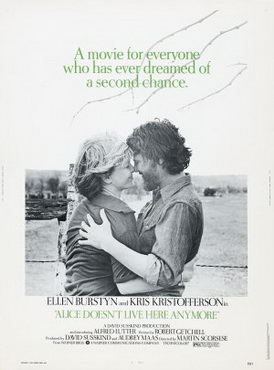 And just who is Alice, anyhow? Other than Ellen Burstyn, that is, giving a virtuosic performance. There are heavy hints that she's a survivor of childhood and domestic abuse, a caged bird who gets a second lease on life when her husband dies in an accident. He is the quintessentially Scorsesean man, brooding and angry but not without moments of tenderness. Shortly after his passing, Alice leaves with her young son to follow a long-forgotten dream of becoming a singer. She sings and plays piano well, so why not? Unfortunately, for a single mother in the 1970s, the world is not so welcoming. She finds herself frequently unemployed, working for less than she deserves, and entangled in a destructive affair with a young Harvey Keitel. When Kris Kristofferson finally comes along offering old-fashioned masculine strength, it clashes with the newfound freedom Alice has grown to enjoy, even as she secretly yearns for such paternalism. Compared to the toxic but numbing sameness of her married life, self-determination comes with some nasty thorns. All the while, her son Tommy (oddball Alfred Lutter) aches for stability and acceptance. His mother's new life is a draining change the two of them aren't sure they can endure forever.
According to my dad, this is a chick flick. Strip away the element of derogatory judgment that implies, and I'd have to agree. This is very much a movie for women. It was developed by Ellen Burstyn at the height of second wave feminism and released during that tumultuous time in American gender relations. I almost wonder if my mom saw it all those years ago, or what she'd think of it now. There's an empathy for women in this film that's borderline extinct in American movies, despite a brief 70s resurgence. To watch it is to almost reimagine from scratch what an American movie can be. My dad, for his part, remarked that this is the kind of movie he wouldn't have watched at a younger age. He noted the familiar Scorsese kineticism, but he was surprised to see it in the story of a housewife's emancipation. I understand, because it is surprising to see Scorsese so passionately and skillfully depicting the life of a woman, and it is the kind of movie that gender policing keeps young men away from. This is as much a gap in our ongoing Scorsese retrospective as it is a gap in our own lives spent away from women. But where my dad has mostly kept up his phallocentric ways, I watch this movie having spent the last decade surrounded by women and their lives, emotions, beliefs. So we come at this movie from opposite angles, and from different lives. This is our nexus, a revered male auteur's detour into the wider world of women.
If it seems ironic that I'm mentioning my dad so much in relation to a film so wonderfully gynocentric, it's because that's the strange history I bring with me to any film we watch together. With my dad in the room, I'm made to ponder my own gender identity in relation to the film, to him, and to the child I was when he was more fully my parent. An adult relationship to a parent is weird in many ways, even in the reverie of movie watching. He was surprisingly talkative when we watched ALICE, and that's because it set off a series of flashbacks he wasn't expecting. The late-film turn towards Alice's diner job revealed to him that this movie is the basis for the TV sitcom "Alice." He was stunned, having enjoyed that show for the many years it was on TV (and it seems, incidentally, that the more feminized medium of cable TV plays on different expectations in him than auteurist masculinism). My dad excitedly informed me that Vic Tayback was the same Mel from TV, but that everyone else was played by someone different. He remembered the characters, though, and I'm amused to imagine how that affected his experience of the latter half of the film. He was also insistent that the character of Audrey was played by a brother of Jodie Foster, which I thought too. We were cartoonishly dumbfounded to discover it was, in fact, Jodie Foster herself (the DVD skipped, so we may have missed any contextualizing gender information).
It was fun to talk our way through a movie experience together. I pointed out at one point that Ellen Burstyn looked a lot like my middle sister's piano teacher, which my dad was eager to share with the rest of the family. He was more animated than I'm used to, and I think I can see that as him trying to be more open than he's been for most of his life. It's a good development, and I hope it keeps up, but I won't be around to watch it continue. Because I've just told my dad I'll be moving in with my girlfriend soon, and he's given it his blessing. And I just told my little brother, who sighed and lied about being "a little sad," but told the truth when he said he was happy for me, and for my girlfriend. And soon I'll tell my middle sister, whose best friend will soon be living in this house with her. And then I'll tell my littlest sister, who will live in my room once I've left. My room of twenty years or more, my home for most of my life. It's too small for me now, and we only just replaced the bunk bed I've had for all that time. But it will always be my room in my heart, and I'll remember it as it was. It's right next door to the room my oldest sister always lived in, one she's unlikely to return to either. She's moved on now, and soon I will be too, and then only the second generation of our family will be left in this house, with my dad at the center of it all once again. And as my oldest sister and I converge, diverge, and converge again over the spans of our lives, we'll live in this house in our minds, the house we knew best, and we'll walk through it together in ways our parents have long ceased to with each other. We'll remember where we spent our youngest years, and we'll remind each other of who we were, and how nothing seems to have turned out the way we expected. We'll grow old alongside each other the way our parents won't, and we'll make the trips back to see our parents wherever they end up in their last few decades. And I'll see my dad and remember all the sad times, the bad times, the long and hard times of never knowing what to do or say.
But I'll also remember the good times, when words fell away and we let down our guards long enough to make this house a home. I'll remember the games and the toys, the puzzles and the stuffed animals, the spaghetti and the baked potatoes. And I'll remember the movies, the ones that eased us into sharing a space together, however briefly. I'll look back on ALICE and others, filtering them through what I know about my dad and myself. So even as I remember the man who didn't know what came next after the kids grew up, I'll remember the days when I thought he knew, when it seemed like only a few more movies stood between me and adulthood. Because it's here, adulthood, now more than ever. And I've certainly watched a few more movies. And I'll certainly watch a few more still. But for now, ALICE DOESN'T LIVE HERE ANYMORE. Alice has somewhere else to live. Somewhere else to be. Something else to find.
(photo credit: en.wikipedia.org)
Sunday, January 18, 2015
ON THE SILVER GLOBE (Żuławski 87): [N/A]
An incomplete post for an incomplete movie. Different kind of writing for a different kind of movie. I think i can say what I want, because I am what I am. Because I am what i am. I can say anything. I don't need a chorus or verses. Make some money. Blue and silver light in a field of white. That similar hybrid color draped over a beach at the ends of the earth, not our earth, but another's, whoever they may be.
It's not long before we lose our way in Żuławski's extraterrestrial pagan phantasy. Three astronauts leave at some point, there's no Earth worth saving. this is understood to be our life. They arrive and find vast emptiness. does this emptiness bring them to doom? Time comes rushing in like white waves, lives peak and crest and dissolve, children are born and Jerzy is still alive, a society emerges in which he transforms from man to king, divine alien.
the problem with pastiche might be that its makers have minds too small and fragile. an expansive and courageous mind, open beyond limits of selfhood, can cobble something together new and amazing just by virtue of existence, brushing away all faint and obvious pastiche.t hat must be how its always been the synthessi comes from the big artists they make it all new as everything else turns pale and cold, warmth from warm hearts ond brains
My partner and i both have family from Poland, the glum, grim giant of Europe. She knows more than I do of this, but I know the pressure point of Poland and Germany held my forebears. What does it mean for me to be in this relationship, experiencing the art of a land I don't know Who? is Andrzej Żuławski, and what is he to me? What makes me adore this film. How Polish is my adoration?
Marek, Szern, Malachuda, Thomas (the Third, Aza? Arta? Jacek, and others.
(photo credit: en.wikipedia.org)
the only hint this film's of humans is blasts of 70s/80s cockrock a blue globe's extrusion not a silver one's
 Philosophy screamed like the bare truth of life, in contrast to the filmic dollops of Europudding spooned into American maws. This is how we speak of our convictions and terrors, at the top of our lungs. I should scream feminism, because the world can't hear me without disruption. murmurs won't do
Jump cuts from behind your eyes, and the people speaking twitch from word to word, we see them anew but though they are new to us already. seeing them as we do, their planet is ours.
No rating? 4.5, 4.56788654? futility, untenable hierarchies, strained binaries. I begin to suspect there's a world out there beyond ranking films. Graded art. to return to this place implies we've left it, or I sure have, so I mourn my spontaneous creativity and find solace in Żuławski the madman. I pull my punches, not him.
Whatever wrongness a blue globe holds a silver globe might yet show us new life
Science fiction is served well by abstract art, because the convulsing life in ON THE SILVER GLOBE seems to flow unprompted from a group of aliens. inscrutable and spectacularly strange i accept them as undiscovered beings. orgies are no longer orgies expressions of unknown passions in misunderstood bodies. Keep us on edge and we consider more deeply than when these sights are known to us.
faces of mud they're not so clear, fetid stench of blood and fear, the bird men and Men who converge away from earth, life undefined but needing it after all, defintion not so easily ignored
The Żuławski camera roves and dashes, even the exposition he must provide for this 80% of a film fills in the gaps with sprints, his eye and ours eyes racing through anonymous stretches of Poland, always Poland, Poland from which this film radiates its scorching mystery, Poland where Żuławski learned his Żuławski, Żuławski the elder who dreamed of birds and women breeding men, it's all Poland and we are all Poland, if anyone is Polish in the end after all
poesia.
I want to commit to sharing my emotions but the act of sharing is bogged with presuppositions for recipient + giver so what does sharing look like can it look like i want it to, how much sharing is mine, or yours, who shares and why, and how will it sound when something is, at last, shared?
Narrative's not dead, it's just in bad shape in worse hands, it won't save us and we can't fully trust it but we can let it in like a harmless friend from time to time, it may have things to tell us if we have ways to listen, but those ways come from us and we build them in our privacies
make art and feel your love for it, and all who articulate your art affect you but not your art, the art lives and maybe you die, if they decide to kill you, my hope is that made art is a heart's strongest pulse
The tragedy of censorship is not its abstract threat toward all voices but its malevolent gaze upon highly specific voices. The silver globe is dented, damaged, flawed, unfinished, but how many movies are complete, how many were allowed their life, and why was this one not, and why is Żuławski so far from our minds, and when will we know Żuławski, twitter in 2014 did indeed like POSSESSION but how many POSSESSIONs will it take to bring us back to Żuławski, how many worlds hide behind infinite space, where Poland resides and we do not?
i am a reflection of What is in you but you are not a reflection of What is in me
It's not long before we lose our way in Żuławski's extraterrestrial pagan phantasy. Three astronauts leave at some point, there's no Earth worth saving. this is understood to be our life. They arrive and find vast emptiness. does this emptiness bring them to doom? Time comes rushing in like white waves, lives peak and crest and dissolve, children are born and Jerzy is still alive, a society emerges in which he transforms from man to king, divine alien.
the problem with pastiche might be that its makers have minds too small and fragile. an expansive and courageous mind, open beyond limits of selfhood, can cobble something together new and amazing just by virtue of existence, brushing away all faint and obvious pastiche.t hat must be how its always been the synthessi comes from the big artists they make it all new as everything else turns pale and cold, warmth from warm hearts ond brains
My partner and i both have family from Poland, the glum, grim giant of Europe. She knows more than I do of this, but I know the pressure point of Poland and Germany held my forebears. What does it mean for me to be in this relationship, experiencing the art of a land I don't know Who? is Andrzej Żuławski, and what is he to me? What makes me adore this film. How Polish is my adoration?
Marek, Szern, Malachuda, Thomas (the Third, Aza? Arta? Jacek, and others.
(photo credit: en.wikipedia.org)
the only hint this film's of humans is blasts of 70s/80s cockrock a blue globe's extrusion not a silver one's

Jump cuts from behind your eyes, and the people speaking twitch from word to word, we see them anew but though they are new to us already. seeing them as we do, their planet is ours.
No rating? 4.5, 4.56788654? futility, untenable hierarchies, strained binaries. I begin to suspect there's a world out there beyond ranking films. Graded art. to return to this place implies we've left it, or I sure have, so I mourn my spontaneous creativity and find solace in Żuławski the madman. I pull my punches, not him.
Whatever wrongness a blue globe holds a silver globe might yet show us new life
Science fiction is served well by abstract art, because the convulsing life in ON THE SILVER GLOBE seems to flow unprompted from a group of aliens. inscrutable and spectacularly strange i accept them as undiscovered beings. orgies are no longer orgies expressions of unknown passions in misunderstood bodies. Keep us on edge and we consider more deeply than when these sights are known to us.
faces of mud they're not so clear, fetid stench of blood and fear, the bird men and Men who converge away from earth, life undefined but needing it after all, defintion not so easily ignored
The Żuławski camera roves and dashes, even the exposition he must provide for this 80% of a film fills in the gaps with sprints, his eye and ours eyes racing through anonymous stretches of Poland, always Poland, Poland from which this film radiates its scorching mystery, Poland where Żuławski learned his Żuławski, Żuławski the elder who dreamed of birds and women breeding men, it's all Poland and we are all Poland, if anyone is Polish in the end after all
poesia.
I want to commit to sharing my emotions but the act of sharing is bogged with presuppositions for recipient + giver so what does sharing look like can it look like i want it to, how much sharing is mine, or yours, who shares and why, and how will it sound when something is, at last, shared?
Narrative's not dead, it's just in bad shape in worse hands, it won't save us and we can't fully trust it but we can let it in like a harmless friend from time to time, it may have things to tell us if we have ways to listen, but those ways come from us and we build them in our privacies
make art and feel your love for it, and all who articulate your art affect you but not your art, the art lives and maybe you die, if they decide to kill you, my hope is that made art is a heart's strongest pulse
The tragedy of censorship is not its abstract threat toward all voices but its malevolent gaze upon highly specific voices. The silver globe is dented, damaged, flawed, unfinished, but how many movies are complete, how many were allowed their life, and why was this one not, and why is Żuławski so far from our minds, and when will we know Żuławski, twitter in 2014 did indeed like POSSESSION but how many POSSESSIONs will it take to bring us back to Żuławski, how many worlds hide behind infinite space, where Poland resides and we do not?
i am a reflection of What is in you but you are not a reflection of What is in me
Subscribe to:
Posts (Atom)