Wednesday, January 31, 2018

Top 5 MVs 2017 (and a Much-Delayed Sixth)

I hadn't really planned on doing another post, but the last one got a lot longer than I expected! So I wanted to give special attention to these MVs, all of which gave me lasting pleasure the last year.


"Ho" came out of nowhere and destroyed me. For such a short song, the affect of it is just totally annihilating. It's the feeling of unrequited love/lust, of knowing you'll never reach the person who means most to you. Drowning in misery and bitterness, paralyzed by yearning, lost in your own anguish. I spent months returning to this song in fits of abject despair. It seemed to embody my many years spent in romantic turmoil. That time of my life is over, but the memories of it are strong and insistent. That kind of pain never dies. It only weakens with time.

Perceptive Twitter followers will notice I've pulled a few moments from this video for my own profile...


A very tough choice between this and Kim Lip's Eclipse. What clinches it for me? Nothing more and nothing less than that double-time beat. A friend pointed out that I gravitate toward frantic music, and I can't argue otherwise. In this song especially, the pummeling beat imbues JinSoul's forceful vocals with an extra intensity. It all comes together before the chorus' last reprise. When it hits, you feel the accumulated passion that's been building the whole time. Like a head rush of infatuation, the effect is totally dazzling. As muted as the cool tones of the MV are, there's nothing restrained about the song. It just keeps crescendoing until you've joined JinSoul in a heightened state of bliss, only becoming cognizant of the rush after the song abruptly cuts out. This was my first encounter with the LOONA project, and I've been hooked ever since.


Kinetic, heavy, intense, frenetic. The percussion clicks and clatters while the rich bassline lurches back and forth. The jungle heritage really comes through in that interplay: you can soak up the lower frequencies or keep to the 140, whatever suits you best. Incredible production from Footsie as usual, and he brings the bars too: "Yeah man ah unruly can't be ruled, man ah unschooly can't be schooled, don't try pull the wool over my eyes nah fam I can't be fooled, I'm way too hot I can't be cooled..."

(Also, are those his parents in the video? They look just like him!)


Got this one onto the Singles Jukebox! For months now I've been obsessing over this intoxicating concoction. It's all in Bảo Thy's voice, never better than here: gentle and pleasant during the verses, acrobatic in the bridge, affectless through that whiplash chorus. Kimmese's verse is silly, but by the time she shows up, the song's settled into a joyously bouncy groove that carries things through. No need to get hung up on the words with such a crystalline instrumental. Then it's back to Bảo Thy, voice soft as ever despite the more insistent beat. Similarly, the video fluctuates between soft-focus warmth and scorching neon. It's lively enough for dancing yet mellow enough to savor at length. A total aesthetic experience, anchored by Bảo Thy's entrancing charisma. V-Pop mostly took the year off, but it could afford to with a release this good. Here's to another groundbreaking year of EDM in 2018! While the rest of the world goes chill, Vietnam continues to provide a much-needed energy to electronic music.


Past the farthest horizons of sound, affect, image, and human existence. Beyond all known categories of being. Deeper than the most cavernous chambers of emotion. A music video with few precedents, even within PUSSYKREW's extraordinary back catalogue (perhaps only this really compares).

I am totally overwhelmed by this video. Watching it is like experiencing the emergence of new forms of thought and feeling. It's the feeling of futurity Mark Fisher longed for, an absence so much music this past decade has been mourning. Yet here it is, as if it never left, as if it were here all along. I'd almost forgotten what it feels like.

We've been lost for so long that being shown the way back is destabilizing. But then they didn't call it "the shock of the new" for nothing.

**


Writing from February 2020...MONDO GROSSO's Labyrinth, a huge oversight, one I forgot because I made this whole list from memory, and thus was more prone to omissions. I've been keeping more careful track in the years since, but I can't believe I forgot this one. That opening shot of the twilit Chrysanthemum Complex may have been our single biggest impetus for our trip to Hong Kong in 2018. Hope you enjoy as much as we did.

Monday, January 15, 2018

Best MVs 2017

Not really in order! More like an ongoing sequence of inter-related thoughts. Hardly a comprehensive survey of every video released this year. I don't like most kinds of music enough to do that. So you'll see a lot of grime and K-Pop, because that's mostly what I listen to. Plus other things I encountered along the way.

2017 wasn't much of a year for films, but MVs more than made up for that slack. Whatever malaise is afflicting the broader cinematic culture hasn't made its way to the sub-cultural realm of music video. Many of the ones detailed here have already taken a place among my all-time favorites.

Honorable Mention:


From limited graphic components, a rudimentary post-cinematic affect is born. Glitches, visual effects, and digital imagery swirl into something hypnotic (and a little unsettling too). Like all the best music videos, the song and images combine into something irreducible to either half, bigger than the sum of its parts....also, we think that's a penis in the background.

The Best:


A really joyous start to the year. I'd just begun to realize my total adoration of MoMoMo, and that soon led into a broader love of the Cosmic Girls. I was very ready for this MV, and it was as wonderful as I'd hoped. The soft, glowing colors match the mood struck by the song's skipping and wistful beat. "Pleasant" is the word that keeps coming to mind, but with the Cosmic Girls there's always this subtle euphoria that makes me extra fond of their music. They do a better job consistently giving off effusion than most other groups I can think of, comparable with Carly Rae Jepsen in my opinion! I think they're one of the best K-Pop girl groups active right now, and I look forward to anything they have to give in 2018.

Little Dragon - Sweet/High


Not sure these held up all the way, but I liked them at the time. Sweet's the cooler song and video (credit to the great Ossian Melin for the latter). From the beginning of my general effort to keep track of impressive MVs.


Brilliant deconstruction. Not much I can say that this most self-aware of MVs doesn't already. Joseph Kahn mentioned on Twitter that he's been in this situation too, which must be so much more common than we know. It's a miracle any audiovisual art ever coheres.


Minimal flipside to the still-unbeatable WTF. Love that Missy co-directed. The way water is used creates a dream logic, like you could wake up at any moment and physics would return in force. But as long as that slow beat creeps on, you're submerged in Missy's world.


Never really got into Arca, but this song and video give me some insight. Bizarrely vulnerable, loss of control as fearful erotic fulfillment.


The biggest names in hip-hop enjoying themselves and basking in their own endless creativity. I have to be honest, I haven't kept up with any of these guys much in the past few years. But I respect the obvious amounts of skill that brought them such success; the concentrated weirdness in this MV is hard to deny.


Another low-key delight. Desiigner's enormous smile in this video makes me really happy, and I've always liked his voice a lot. Ebullient yet laidback, silly and serene, short but sweet. Hip-hop videos are a gift to the world.


Not much made me happier in 2017 than watching Wiley finally getting the respect he deserves. Not only did he release a victory lap album to his highest sales yet, he also published an autobiography and was made an MBE by the Queen herself. I'm no royalist, but I could tell how much that meant to him. Underestimated by some and under-appreciated by all, Wiley's been one of the best artists in grime for over a decade now. His influence on the music world, both material and artistic, is beyond calculation.

This track boasts some killer grime brass along with percussive flourishes that, when you listen to them at the proper volume, are razor-sharp complements to Wiley's bars. The man himself has nothing to prove at this point, but he's not one to rest on his laurels. Listen to that astonishingly nimble flow from :48-:55. If the rest of the song can't live up to this blistering first minute, there's no shortage of Wiley tracks that reach similar heights. Godfather II hits in a month, and I don't doubt it'll be one of the major musical events this year.


I discovered this one at the same time as that Meljoann video (thanks TSJ!), and it immediately became a strong contender for best of the year. Over a beat that owes more than a little to grime, Trippie Redd exorcises the bloody pain of a break-up in eviscerating wails. We were shocked to find out how young he is, but youth is definitely a virtue in this unapologetic wallow (I'm calling attention to his age not to infantilize him; rather, I deeply respect hearing that un-selfconscious vulnerability most adult artists outgrow).

At TSJ, emo was mentioned as a reference point for what Trippie Redd is doing in Love Scars. I think that's spot-on. Listen to the boyish frustration in his voice around :30 in the video and you can hear the heritage of that much-disdained artform in full melodramatic bloom. The sudden slurs and changes in volume recall Young Thug, but with Trippie Redd, the technique's crossed with youth's raw heartbreak. If this is the future of emo, I'm all for it. 

(As for the video, it's a solid neon trip, though it comes up a little short against the hallucinogenic odyssey undertaken by another rapper soon to come on this list...)


The first of several appearances LOONA will make in this post. Of all the songs I've heard, this one took the longest to grow on me. I thought it was solid but unremarkable at first, especially when considered against my other favorites. But I've changed my mind since then. I actively look forward to hearing it now. I always love the lilting vocalization that repeats throughout the song, but I'd neglected to notice what a great voice Choerry has. It's the perfect fit for a song so lighthearted. Even her whispers on that V-Pop breakdown give unity to the unexpected stylistic shift. Don't make the mistake I made in underestimating this.


Best chorus of the year? Not much else can compare. HeeJin's the ostensible leader of LOONA, and while that might seem like a big responsibility, she already seems up for it. Her performance in this MV is very charismatic, and there's a ton of personality in her vocals. The long LOONA roll-out means she's been sidelined a little lately, but I'm sure she'll resume her place at the center before long.


Haunting loneliness, the decay inside your head....I listened to this song and watched its video while drunk a lot last year. Correspondingly, I tend to keep a watchful eye on the hikikomori phenomenon, a parallel way of life that could take over mine without notice. Claustrophobia of the mind finds its form in spatial distortion. There's a great Making Of video for this MV that reveals its visual effects are largely practical, though digital effects come into play too. 


Another early January arrival. How even to explain the effect this beer advertisement has on me? A big part of it is Toc Tien's charisma, unparalleled here. Every image of her is magnetic, often drawn out through slow motion. Whatever affection she's supposed to be expressing for Budweiser far exceeds contractual obligation, opening into something vast and moving. Though she's mostly smiling, her vocals suggest something more complex...maybe resignation? The Afrojack instrumental seems just as ambivalent, bouncing along softly when the beat isn't disappearing altogether. At those moments I'm just surrounded by the echoes of Toc Tien's voice, reveling in her emotional directness. She released another song of her own making earlier in the year, but frankly I much prefer this. A truly strange alchemy of corporate synergy, disposable to most yet precious to me. The big heavy drop at the end is like a bonus, the thing you'd expected in the first place instead of this beguiling anomaly.


It's hard to think of another song that aurally conveys wooziness so well. Even that reverberating Spaghetti Western guitar sounds like some distant memory echoing through an altered state. Travis Scott came out of nowhere to me, but he's big enough now that it seems to have become almost a cliche to be into him. Me, I'm still just stuck on this incredible MV. Visualized by BRTHR (who I clearly need to look into more), the video's an infernally psychedelic attempt to place Scott's subjectivity onscreen. The thing that chills me most is how Scott seems barely awake as he drifts through this bad trip. His presence is so minimal amidst the warped reality engulfing him. I can't lie, I feel that in a very personal way.


ViVi is my favorite LOONA member at the moment. She's so adorable, and I love this video dearly. It somehow manages to express that dreamlike sensation of exploring Japan (though this seems to be Hong Kong), a feeling that's always lingering in the back of mind. I even prefer this rendition of the song to its dance version, which almost never happens! It's just too beautiful to be improved.


(TW: domestic violence)

I spent a good deal of time with Asia Argento's art last year, and I'm beginning to think she's one of the major female artists working right now. Her film performances are well-known and widely acclaimed, but I think it's time for everyone to revisit SCARLET DIVA and THE HEART IS DECEITFUL ABOVE ALL THINGS. Her direction in those films is just as uncompromising as her acting style, and each of them contains one of her very best performances. This music video is yet another crowning achievement for her, a bruising existential inquiry into male psychic damage. It's all the pain and torment of masculinity, compressed into a few scorching minutes...I can hardly describe in words how upsetting it is. When the first-person actor strikes Asia and he futilely tries to comfort her, it's one of the most raw and wounding moments in art that I can recall. It's so private that I feel disgusting even witnessing it. It's an outgrowth of his repeating desire to choke women, that almost automatic need to cause pain. He may function as an adult, but there's no disentangling the good and bad with him. He seems to swing abruptly from each extreme to the other. Or perhaps the bad is always burning a hole in the good, leaving only ashes where this man's conscience should be.

I can't even watch this video too often because it's so honest. A whole heritage of violence is summed up and seen through to its end, this man's life a blight upon himself and the people he fails to love properly. Experiencing it is like shock therapy to me even now. It's a fully-realized nightmare, a tragedy with all the filler stripped away. I love it profoundly, but I fear it too.

(The song's nothing special btw, but who cares? On another day I might consider this the best film of 2017, let alone the best music video.)


A fulfillment of the promise made by Happiness all those years ago: astonishing, blissful, effervescent K-Pop. It even has a fruit theme! I can only assume that's a conscious callback to Red Velvet's debut, which for us was like a whole new level of K-Pop in 2014.

Maybe this is just my own melancholia speaking, but it feels like K-Pop has plateaued in recent times. ~2009-2012 seems to be the consensus golden age, though I'd argue even up till 2014 there was no beating the best K-Pop. Each video premiere brought with it the anticipation of something freshly exhilarating. My girlfriend and I couldn't get enough. Our enthusiasm knew no end, and the embarrassment of riches just kept coming. 2014 felt like it could last forever.

In retrospect, it seems significant that we were to get the last 2NE1 album that year. No one knew it at the time, but that last release signaled the end of those unmissable early years. Myself, I'm still too sad to listen to 2NE1 much at all nowadays. Their music carries with it that optimism, so tied to a specific time, that I could look forward to many more years of 2NE1 at their peak. When they disbanded, a certain center of gravity vanished from K-Pop.

I'm not even sure K-Pop needs a center of gravity, considering the high bar its groups regularly set. But who could be considered the standard-bearers three years out? Red Velvet's as good a guess as any, except they're a bit too eccentric to command attention the way 2NE1 once did. I don't think elevating them above all the other groups does anyone any favors. Red Velvet are at their best when they experiment, even when not all their attempts succeed. In forsaking global domination, they've managed to accrue an impressive back catalog under the radar. This track is surprisingly minimal for long periods of time, given shape only by an irregular spray of percussion. But then that bridge hits. More than any other track since Happiness, Red Flavor basks in the pleasure of unguarded ecstasy. By the time the bridge makes its third appearance, revealing itself to be the climax of the song, I'm overwhelmed with joy. It's what I always hoped Red Velvet would go on to do, and I don't mind that it took them three years to get there.


LOONA haven't even debuted as full group yet, but this song would be the envy of many veterans. I don't even know how they do it, but 2018 will definitely be their year. If any K-Pop act could be considered the new apex, it's these girls.


This could be easily be in my Top 5, but since there's still another LOONA song yet to come, I'm putting it here just to maintain some variety. Eclipse is my girlfriend's favorite, and it's a close one for me too. It's just so gorgeously sensual and dreamy. K-Pop can nail that vibe when it wants to, and I'd love to see Eclipse become a classic for future acts to emulate. The video is also stunning: bathed in reds and pinks, everyone in thrall to Kim Lip's gentle charisma. Maybe the best voice of the group too, and that's no small feat.

Top 5 soon to come!

Reorientation

When I started this blog, I intended for it to be solely about movies. At that point in my life, film meant more to me than just about anything else. I was a nascent leftist then, so several of the films I wrote about involved left issues. To date I remain very proud of my BATTLE OF CHILE posts.

After a while I began to lose the enthusiasm I had for writing long analyses of the films I watched. Real life had begun to reassert itself in various ways. I got a job after graduating and had to restructure my life around that. But I was also confronting several other personal matters, including crises that concerned people I care about deeply. I didn't have much time or desire to write anymore, even though I'd sometimes feel the urge after watching a movie.

Another part of what happened was that I'd set my standards too high. I didn't want to post anything here that couldn't bear substantial critical analysis. I've always had an inferiority complex about film writing, so I wanted to differentiate myself from what I'd considered mindless consumers of media. Maybe I also felt insecure about devoting so much energy to film writing when it might have been spent more productively elsewhere. 

I don't know that I've resolved those doubts for myself yet, but what happened in 2016 was that I began to be enticed by the website Letterboxd. At first I wrote cautiously and laboriously on Letterboxd, again hoping to earn the respect of others through high-quality work. Lately I have been more carefree, dashing off little reactions to films I watch in between the monolithic critiques. What Letterboxd has taught me is that there's room for both kinds of writing, casual and concentrated.

Which brings me full circle back to this blog I started years ago. I was never able to confine my energy entirely to film writing, despite that being my stated aim. I diverged into different topics and made exceptions as I saw fit. In hindsight I can see that I was pushing back against the constraints I'd set for myself, but as long as the structure held, I felt value in maintaining it. Now, ironically, I'm finding that not everything I want to write about really fits on Letterboxd. I write frequently and copiously on movies, but I also want to write about books, music videos, real life and myself. It makes more sense to explore those other possibilities with this utilitarian blog than to cram my various whims into Letterboxd film reviews. 

So I'd like to start writing more experimentally here than I have before, whether or not the focus is films. These many years have helped bring me back to writing again after a long absence. I wrote profusely and obsessively as a kid and as a teenager, but somehow adulthood had dimmed that passion for me. I don't know why, nor do I really even know why I've been so compelled to write all my life. But writing is more motivating to me now than just about any other activity. In fact it's almost as if writing about films was just a pretext for writing at all, like films were just the stimulant that made me able to write again. That seems likely, looking back now.

I was very troubled when I began this blog. Some of those issues have abated, yet there are always new and challenging difficulties to fight against. It never really ends. But maybe writing can help. I must have some reason for doing it. Anyhow, this is all to say that I am now going to focus more attention on my blog. Taking some time away from it was just what I needed to figure out where I should take this next. I expect it to be a livelier and more full-bodied entity than I ever let it be when I was monomaniacally fixated on films. I look forward to writing more than ever in 2018 now that I'm surer of my approach. And though I hope this all has value to anyone reading, the most important thing is that it has value to me. Still, I'll try to make it worthwhile to outsiders as well.

Footnote: I will also begin cross-posting reviews from Letterboxd here, and vice versa. There are some things I can do with a blog that I can't with Letterboxd (funny how limitations always energize me to find a workaround). I'll be compiling those writings here in different formats than they appeared on Letterboxd. Maybe by director, or theme. I'll have to see what seems best.

Saturday, December 12, 2015

WHO ARE YOU, POLLY MAGGOO? (Klein 66)

To watch this film is to pinpoint a very slippery moment in the transition from modernism to postmodernism. Amidst the multiplying perspectives and reflective surfaces with which POLLY MAGGOO outfits itself, a series of white caverns sit impassively. They seem oblivious to the spectacle they are housing: an adoring audience, rapt before a group of female models, absurdly in thrall to the gleaming sheets of aluminum the women are wearing. Between the oblique contours of the caverns and the abstractions formed by the aluminum sheets, you could be forgiven for thinking we are still dealing with modernism's spatial mutations. But this is a red herring: it is indeed the metal-clad models we will be considering as the movie progresses. The caves are little more than an attractive surface, and its occupants seem unaware of their singularly strange environment, captivated as they are by the world of haute couture. Gone is Antonioni's mute awe in the face of art and landscape. The world is nothing more than a stage, and everyone's an actor. We have entered the eternal present of simulation.

Polly Maggoo, model extraordinaire, seems to be a native citizen of this world. She seems equally comfortable swathed in massive slabs of metal as she is navigating an uninvited TV crew in her own apartment. Not much fazes her (except those excitable male oglers in the streets), and every moment is an opportunity to further accumulate human capital. She was not born beautiful, but she became beautiful as she grew up, learning along the way that the world loves nothing more than looking at women like her. She also has the distinct (mis)fortune of reaching adulthood just as the mass media apparatus is taking off. Before, theatrical films stupefied viewers with their larger-than-life images of the eternal feminine. Now, television provides that same lusty exhilaration in their very own living rooms. Conventionally attractive women are commodified and distributed nationwide at a greater scale than ever. The process decentralizes, shifting from a few influential movie studios to the world's many television producers. Polly Maggoo is one among many. She is American by birth, but she is just at home in France. Phallocentric spectatorship knows no language barrier.

In William Klein's film, as in Cronenberg's VIDEODROME and EXISTENZ, reality seems permeable to emergent media. People spontaneously sing and dance to television commercial jingles. Events occurring in "real life" reveal themselves to be taking place on television. Polly herself attends a dinner party and is seemingly absorbed into the TV placed at the head of the table, where she speaks and is spoken to by her hosts. Edits, montages, and hand-drawn animations fracture the ontology of the film's settings. It's 1966, and although we are only four years removed from Antonioni's L'ECLISSE, the world seems even more alien here than it did in that film. But don't let me overstate the case: I'm just trying to historically situate this startling film. Although we now have video games, CGI, and the internet to account for, the world of POLLY MAGGOO is suspiciously similar to our own. Entertainment industries continue to provide stimulation in the form of elaborately constructed beauty. Publicly and privately, women are bombarded with the demands of male desire. The Polly Maggoos may gain some measure of counterbalance, but most women find themselves the subjects of endless control, which slowly seeps into their self-image. It becomes ever harder to see yourself without seeing through the eyes of onlookers, real or imagined. In this dystopia, there are the watchers and the watched (even the watched do watching of their own, fractally pushing the process into increasing abstraction).

VVV unfinished extrapolation VVV

Is it so simple? Are women nothing but empty receptacles for social norms? Passive vessels whose bodies are fetishistically contorted by heteronormativity? It seems most see things this way, but I can't help thinking this is an oversimplification of the way things work. And surely women have some say in the matter, even under such compromised conditions? The story of Paris Hilton is instructive here.

The one time Polly mentions her life before modeling is through a performance for the TV program "Who Are You?" Her anecdotes are charming, even as they're cut short prematurely by Gregoire the director. Soon after, we view a brief montage that dispassionately illustrates Polly's life up until now. It is only those few seconds that are devoted to the life-defining events that shaped the interiority of our ostensible main character. In Polly's world, it seems she can only be known briefly before men interrupt to reassert their control.

In POLLY MAGGOO, men are extensively involved in the construction of femininity. It is the models who wear those ungodly metal 'dresses', and yet their male designer receives all the adulation after the fashion show ("I'll be doing the same collection in copper!"). The men in Polly's apartment try out a number of different scenarios for her TV appearance. One man slips a microphone up her shirt. Then, in the editing room, a gnomish editor chops her rather insightful musings on fame and beauty into gibberish (prompting a nearby woman to mutter about how idiotic Polly sounds). Men walk up to Polly in the street to explain to her that she's "not a real woman," and Gregoire launches a similar monologue at her in her own home. The panopticon nips and tucks according to its commercial whims, ensuring that Polly is constantly at her most marketable.

--

Additionally, how do we account for the real and sincere pleasure people of all genders get from fashion and beauty? Doesn't it seem transphobic to imply that artifice is inherently opposed to some supposed authenticity, of which gender is frequently seen as a component? And aren't drag shows all about the possibilities of reality achieved through artifice? Through this lens, condemning pleasures of the surface suddenly seems to stigmatize women, drag performers, and transgender people alike. How progressive is that?

Wednesday, June 24, 2015

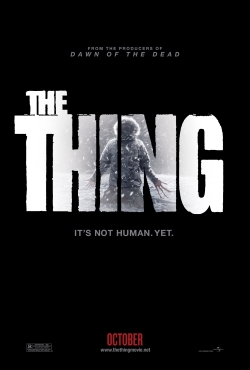
THE THING (Heijningen Jr. 11): [2.5]

Absent any particularly deep digging, I feel I can assert with confidence that John Carpenter's THE THING has developed quite a cult fanbase for itself. In my earlier days of secondhand Generation X nostalgia, I quickly determined that John Carpenter was a favorite amongst genre junkies. There was an innocent auteurism at work in the forums I frequented, a critical method less deductive than inductive by this point. The armchair critics, whose social networks I had just begun to skulk, had cobbled together a consensus of cinema based on their formative consumer experiences. Those media objects which most delighted them were, ipso facto, demonstrably superior to all the things which failed to stir up such pleasure. I believe most young people stumble across film theory this way now, as the recent glut of entertainment hyper-stimulates susceptible young minds before any organizational framework can be imposed. The chaos of mass culture excites without limitation. Extreme indulgence refines itself into compulsive pattern-seeking, which is then sculpted into theory formation (and later, I suspect, calcified into rigid taste-making systems).

For me, at least, that process meant familiarizing myself with the names of the established white guy filmmakers. If they were so beloved, it stood to reason, their films must have been made transcendent through the alchemic power contained within that Great Man-liness. Even as I failed to delight in ESCAPE FROM NEW YORK and BIG TROUBLE IN LITTLE CHINA as a generation of mallrats had before me, I persisted to believe that it was my duty to love John Carpenter in lockstep with the only cinephiles I had yet found. Would I have one day concluded that the alleged universality of Carpenter's appeal was in fact a self-sustaining myth, based on a confluence of factors that only tangentially included the opinions of my instructors? If not for THE THING, I imagine so. But there it is: I love THE THING, and I have enjoyed it deeply every time I've watched it. I am a fan, and everything THING-related is filtered through that perspective. Maybe one day I can explain more fully what about John Carpenter's film compels me. Now's not the time, as I don't have the words and I'm sure any number of movie geeks do. It's no longer any great statement to admit loving THE THING. I have little interest in adding my voice to the chorus. For now, and for the sake of the argument I'm about to make, it is enough simply to establish that I am as big a fan of the film as any.

When news of the most recent THING came my way, I was not especially troubled. I see a lot of reflexive moaning about the reconfiguration of previous pop culture items into new ones, and while I sympathize in theory, in practice I try to remain open-minded. If this potential new THING would indeed be seen through to fruition, why not see what it has to offer? I don't feel the need to offer that generosity to any and all corporate branding experiments, but THE THING '82 exists in my mind as an irreducibly layered experience. How many times had I reached out to it for its much-anticipated jolts and destabilizations? How many friends had I roped into watching it alongside me? How many times, since that fateful first viewing, had my dad and I agreed it was about time to remind ourselves how much we will always enjoy THE THING? It seemed almost churlish to reject the new THING out of hand. To do so would serve only to glorify a fond memory which hardly needed the help. There were, of course, no guarantees that the new THING would be anything but a mediocre rerun. But then, who could have predicted that THE THING '82 would act upon so many people as it did? THE THING FROM ANOTHER WORLD hardly lacks for appreciators among those who have seen it. Almost exactly three decades separate each THING from the next, and the original's esteem must have been as secure in 1982 as the middle THING's reputation is now. Why, then, should a new THING be greeted so derisively when its nearest relative has earned such admiration?


Admittedly, the point I'm making would be a lot stronger if THE THING '11 were greater-than-or-equal-to the next-most recent THING. I have not seen THE THING FROM ANOTHER WORLD, but as a Howard Hawks fan, I don't have a hard time imagining I'll like it more than THE THING '11. Because THE THING '11 is decent, even impressive at points, and yet it is no match for an imagined Hawks movie, much less the THING I know and like so much already. Even so, I'm not content to stop investigating my reaction here. There is enough going on in the new THING that I wish to push back against the general indifference (cultural and financial) with which it's been met. I doubt THE THING '11 will win as many followers as either of its predecessors. Even so, its hierarchical standing in THING fandom will be determined with some amount of arbitrariness. How much so, and how much in comparison to its well-loved forebears, I cannot say. Still, let's tease out what we can before that consensus magically appears.

When THE THING '82 is spoken of admiringly, its practical effects are often mentioned as exceptional. Its impressively sinister tone is also a frequent topic. Those diegetic aspects and their awed reception are also a big part of the love for Ridley Scott's ALIEN. Interestingly enough, ALIEN also received a prequel just a year later than THE THING '11, the better-known and more successful PROMETHEUS. I happen to think PROMETHEUS is excellent, and I plan on writing about it sooner or later, but I've noticed that PROMETHEUS also was received unenthusiastically by most ALIEN fans. How ironic that these two new films were commissioned mainly due to the nostalgia for their predecessors, only to be rebuked upon arrival. Looking around at the entertainment world today, it's hard to imagine a more friendly environment for the exact kinds of people who grew up loving movies like ALIEN, THE THING '82, and of course the presumable wellspring of all this sci-fi ardor: STAR WARS. STAR WARS proves particularly instructive here, because it has already received prequels that were widely hated by "serious fans" of the original movies. Yet despite the folk wisdom that the original STAR WARS movies are incalculably better, the three prequels were very successful. If only probabilistically, based on how many people chose to see each successive film, it stands to reason that many viewers enjoyed the STAR WARS prequels. That also seems likely for PROMETHEUS, which will receive a sequel before long due to its financial success. Only THE THING '11 seems to have failed to excite a large amount of people, and considering the success of PROMETHEUS and the STAR WARS prequels, that wasn't a foregone conclusion when it was greenlighted.

What's going on here? Why are these expensive prequel movies being made to capitalize on old sci-fi favorites? And why do some people vocally, viscerally hate them when the movies are generally quite popular at large?

The consistency of nerd hatred of these new films suggests that common denominators exist between the STAR WARS prequels, THE THING '11, and PROMETHEUS. One immediately apparent factor: the use of computer effects. There is a strain of thought that insists that computer effects are generally inferior to practical effects. You know the arguments: constraints productively challenge artists, physical labor makes practical effects more realistic and meaningful; computer effects are easy, they're cheating, it all looks the same, etc. etc. In other words, Ray Harryhausen and Rob Bottin are singular geniuses, and all those CGI drones are just anonymously clicking together an unwanted movie. Leaving aside the devaluation of all the unseen labor that goes into creating computer effects, this argument has a suspicious bias. Most people old enough to lob that complaint at the new digital movies are old enough to remember a time when practical effects were more the norm. Whether it's CLASH OF THE TITANS or Jim Henson, the fond memories these people have for practical effects were shaped by the time period they grew up in.

It begins to look like the issue with all these remakes and prequels is not that they're unoriginal at all, but rather that they are not familiar enough to work on the nostalgic vibes these viewers experience from rewatching STAR WARS, ALIEN, and THE THING '82. The odd note of betrayal you hear in many appraisals of the new movies is predicated on disappointment. Nothing, it seems, can ever compare to the formative media experiences of childhood/young adulthood that have so drastically shaped these grown viewers. They are yearning for a consumerist bubble that exactly replicates the one they grew up within. They seek to return to a womb from which they have long since been cast out. A womb in which analogue televisions play only sci-fi movies with lovably antiquated practical effects. There is of course nothing more innately realistic about practical effects, especially compared to the number of ways computer effects can visibly or invisibly create a convincing reality. "Realistic" here means "familiar," the same way "authentic" frequently connotes "with an established tradition." Nostalgists of this kind often neglect to remember that the newness of their old favorites was not immaculately conceived. History is continual and cumulative, built selectively from shards of the past into mosaics of the present. John Carpenter is open about his fondness for Howard Hawks, a sensibility that permeates his filmography even before his outright remake of a (disputed) Howard Hawks film. Carpenter did not conjure an entirely new type of film with THE THING anymore than George Lucas did when he drew on HIDDEN FORTRESS, THE SEARCHERS, and Flash Gordon to make his first STAR WARS film.

You've probably heard this argument before too: nothing is new, everything's been done before, newness isn't commonly recognized in its time. Sure, but why then is hauntology a recent concern among music theorists? Why are studio films reconfiguring 20th century into digital simulacra? On the face of it, nobody seems to like this state of affairs. People seem to crave the "newness" of those old songs and movies. But what if it's the very sameness that compels them, over and over, to seek out those familiar comforts of the past? What if every disappointing sci-fi prequel is just a stumbling block on the way to the infinitely postponed sublime? What if desire is only desire for more desire, never meant to be fulfilled because it would be impossible in the first place? I am concerned that the religious devotion to making the modern world into a remembered image will harm the way movies are perceived. Here at last I can note some of the strong points of THE THING '11: its understated but creeping air of sexism, Mary Elizabeth Winstead's performance, the alien-ness of its elaborate creatures. There's the cleverness of the dental fillings test, especially that scene where Kate has to walk right up and peer into the faces of the potential infected. And then it seems to me that the middle section of the film is uncommonly tense, its mood of hidden menace modulated quite well through surprises and outbursts of violence. From the moment when the crew realizes that any one of them could be infected up to the survivors leaving to investigate the mothership, THE THING '11 could reasonably be called a good movie. If the last section fails live up to the intensity of what came before, and if the whole movie seems a little less vivid and cohesive in memory, there are enough points of interest to make it a failed experiment worth consideration. And it does live under an awfully big shadow, after all.

When we ignore the Wachowskis' mind-boggling JUPITER ASCENDING because it's not the well-established MATRIX series, a loss takes place that's bigger than the reputation of one daring film. An acquiescence to received wisdom prevails, and it's a form of knowing established by a highly suspect group of moviegoers. If a movie fails to shake up the IMDB Top 10, that alone cannot be grounds for failure. As the film industry and its critics continue to choke under a suffocating, blinding white maleness, movies themselves become harder to see clearly. It is easy to see the demographic that influences so much of how movies are made and evaluated. It is harder to disengage from the ideological consensus that they have produced. I cannot claim independence, particular as a cisgender white male myself. But, in the spirit of critique, I seek to at least partially disestablish the bad faith that undergirds art consensuses. I only have my subjectivity as a viewer to compare against the movie nerd monolith. Luckily, with a certain amount of distance from the aging nostalgists, my own opinions naturally diverge from theirs. My opinions are no more innate or impervious to critique than theirs. However, working toward multiplicity over consensus can illuminate the blind spots that an unequal value system produces. Again, that is hardly my duty alone. It's only a precedent that I think many diversity-minded people are working toward as well.

Tuesday, April 28, 2015

FLOWERS OF SHANGHAI (Hou 98): [4.5]

The night before Cannes' 2015 Main Competition lineup was announced, I watched GOODBYE SOUTH, GOODBYE for the first time. Call it a hunch, call it an omen, but I was close to certain we'd finally see Hou Hsiao-Hsien's THE ASSASSIN emerge this year. I felt some sort of tribute was in order, and it had been too long since my last Hou experience. If I'd been less excitable, rudimentary research might well have confirmed my suspicion for me ahead of time. But who wants to prove Santa Claus isn't real? The next day, it was Christmas. I suspect THE ASSASSIN will easily be this year's heavyweight, though I'm very excited for Jia's and Apichatpong's entries, the latter of which was uncertain until a day or two ago. It's been 2 years since Jia's newest feature film and 5 since Apichatpong's. Hou, though, wins out at a full 8 years of absence. He hasn't been inactive, but it seems we're a long way from the 80s and 90s, where Hou seemed indefatigable in his output. THE ASSASSIN has loomed large in the aging auteur's path, absorbing year after year in which another two or three films might have emerged. With Hou, it's hard not to be greedy! By all accounts THE ASSASSIN was a challenging shoot, and I expect we'll see the proof in motion very soon. Now, anxious horizon-scanning no longer necessary, I feel free to fully appreciate what we already have.

With my love for THREE TIMES (viewed beautifully, appropriately, in a skyscraper in Japan) and warm fondness toward FLIGHT OF THE RED BALLOON, it's been a lovely couple of weeks exploring Hou's older films. I've been missing the experience of getting to know a great auteur, as I've already exhausted a fair few impressive filmographies. I enjoyed the drifting GOODBYE SOUTH, GOODBYE quite a lot as my first reacquaintance with Hou. There is a sense of despair in it echoing more softly than in the film I'm about to discuss, but that subtle unease unexpectedly lifts every now and then to euphoric results, as in the mountainside motorcycle trip and that orange-tinted entrance to a party. GOOD MEN, GOOD WOMEN situated me deeper in Hou's stake in history, even if it is the least of the films I've seen so far. THE PUPPETMASTER is so intricate and reserved that I will need some time before consolidating my experience of it into an opinion. Still, it's an exceedingly impressive film. Even as I've left most of Hou's earlier, smaller-scale films untouched (not entirely by choice; few are available to me at this point in time), his mid-to-late period films have warmed me back to the hope that there are still cinematic surprises and delights in the world yet to come.

At the apex, so far, comes FLOWERS IN SHANGAI. My current favorite, it's one of those films you can't help imagine being made for you, melding perfectly into sensibilities you suspect few others share. I love this film, and I feel lucky to have seen it. For this experience, I must unexpectedly thank YouTube, of all sources. Yes, Hou Hsiao-Hsien's FLOWERS OF SHANGHAI is on YouTube, and it is available at reasonable quality, with English subtitles. Or it was, until recently. A recent check confirms that it's been snatched away. What a shame. No matter. I have found YouTube to be a helpful resource lately, after first discovering Manoel de Oliveira's MON CAS there days after its maker's death. The aforementioned GOODBYE SOUTH, GOODBYE is also on Youtube, and just for good measure, here is Anh Hung Tran's THE VERTICAL RAY OF THE SUN. As you may suspect, I am impressed with such a proliferation of "rare" films, especially in contrast to the hegemony of Netflix. I have only just received a disc of Hou's GOOD MEN, GOOD WOMEN from Netflix, its "Very Long Wait" status being the ostensible reason for such a delay.

I somewhat doubted I would receive the film at all. Netflix seems content to spirit away whichever films it pleases, evidenced most ludicrously by David Cronenberg's CRASH now being unavailable for rental. It is not my intention to bog down this post on Hou's superlative film with an anti-Netflix polemic, but I do think there is a point here worth making. I am admittedly not familiar with the workings of DVD distribution, and I know that, for example, Nicholas Ray's IN A LONELY PLACE has gone out-of-print, thus accounting for its unavailability on Netflix. It is possible that such mundanity explains the placement of 56 other films in my Queue's Saved section. Still, I can't imagine what is causing the "Very Long Wait" behind FRIENDS WITH MONEY, a Sony Pictures Classics film starring Jennifer Aniston, as well as my (presumptive) next delivery. To focus on the logistics ignores the climate of forced scarcity that Netflix helps maintain. There are, of course, always power differentials affecting which films are deemed profitable enough for production, let alone global distribution via home media. However, it is precisely the least accessible films which suffer the most from the supposed "invisible hand" of the market. The corporate curation of Netflix withholds as much as it provides, its relative abundance the necessary corollary to the many films it deems too uncommercial. Now that YouTube's hidden library of foreign and independent films has emerged as an alternative to these artificial holes, I plan to use it as often as needed to supplement Netflix's paltry offerings. Without YouTube, FLOWERS OF SHANGHAI would remain an "Unknown" to me.

Anyhow, onward to the film. FLOWERS OF SHANGHAI illustrates a particular sadness that is well-known to me but hard to articulate through art, if my many years of not finding it there are any indicator. It's the sadness of rueful and uncomprehending self-destruction, set against a world unconcerned with interfering in any way. In that sense, I doubt it's a coincidence that the film is set entirely within opium dens. Drugs, as a whole, seem uniquely able to spin a sense of internal worthlessness into rituals of self-harm. There's a great distance between this belief of mine and puritanical Reaganite sternness, so don't get too offended. Drugs have their own unique effects on the mind and body, but I'd hardly be the first to claim a given activity is an opiate (aha!) to the masses. Religion, television, the usual suspects, all of which have been argued long before this day today. Not to be snide, of course, because I think it's a great big deal to acknowledge that people seem to have a dark flair for self-destruction, and it pays to recognize those tendencies, if they exist, in yourself, and in others. Drugs and their users are a metaphor for this fear/tendency as much as an actualization. The drug addict is only the most visible and stigmatized of people who can't make sense of their place in the world. Neither a false sense of superiority nor a rigid aversion to drugs can keep away the existential dread so literalized by drug abuse. Despair, loneliness, and isolation pervade.

Which, to come around finally, is I think what Hou is getting at in FLOWERS OF SHANGHAI. If I have to bend over backward to explicate the non-judgmental stance of the film, it's mostly because I think that its hazy sadness is best experienced direct, undiluted. Opium is a stranger to me, but the feelings it's meant to ward away are not. Therefore, I can follow its users every step of the way up until the high itself, at which point I can substitute some other equivalent feeling. I love this film, and I would hate to get tangled up in any preconceptions I'd brought to it. Perhaps speculating on the presence or absence judgment is something only Westerners need to do, as Hou seems to have jumped right into his milieu without reservation. But I'm less interested in unpacking the judgmental Western mindset than I am in the difficult feelings that judgment, as a critical approach, is meant to obfuscate. So, if we can take for granted the existence of judgment, Western or otherwise, let's agree to ignore it and look more closely at what judgment effectively hides.

In Hou's Shanghai, when even the tumultuous 20th century was still a distant future, the world exists in miniature within the confines of brothels. Men parade their wealth and cluster together to drink and gamble, women occupying as much of their attention as they see fit. Which is ironic, since the economics of running those comforting hideaways seem shouldered entirely by the female owners and prostitutes. The courtesans, far from world-weary, come across as impulsive and naive. Susceptible to the fickle affections of male visitors, they fight and wage rebellion against their "Aunties." In turn, the Aunties are quick to remind their employees of their financial dependence. There is a constant feeling of insecurity in FLOWERS OF SHANGHAI: employer and employee cannot trust one another, nor can customer and provider. When bad feelings erupt, as they always seem to, inequality gives the edge to the more financially secure. The many inhabitants of the brothel coexist in a narcotic lull when times are good, but equilibrium is always destabilized by unruly emotion, and no one is prepared to deal with confronting the resultant power imbalances face-to-face.

Really, I'm spelling out the themes and throughlines more than Hou ever does. And even those aren't what hit me hardest, necessary as they are. Hou Hsiao-Hsien, like many artists I consider great, can reliably sketch out the sources and effects of power through a variety of metaphors and environments. A 21st-century Taiwanese nightclub is just as fertile ground for him as the aftermath of World War II. I'm quite in thrall to his skill and adaptability. But it's the emotions he teases out from the forces of history that stay with me most. Ultimately, a movie like FLOWERS OF SHANGHAI tells me about myself, with a clarity greater than I myself might be able to summon. As much as it is a story about China and its people, it is also a story of days wasted in social diffusion, of pleasant times forcefully repressing bad memories. Of codependence and the emotional inscrutability of all people. The inability to see or understand yourself clearly. The horror of realizing that no one else can help or explain themselves to you any better. Is this why I seek refuge in art? Because artists spend years constructing something so beautiful and affecting, itself synthesized from years of inchoate personal experience? The emotions art can create in me, and the passion poured into it by people I don't know, is a form of intimacy. Art is a performance and an endeavor, undertaken by sensitive and creative people the world over. I am the spectator. Film is a recording, sight sound and sensation, which I can return to at my leisure, from a safe remove, in a safe place. The world is out there around me, but emotion is inside me, and I bring myself to art in times of need so that I can commune with something that makes more sense than I do to myself. Art is a substitute, a distraction in some ways but a vitally important one in others. There's always a dialectic at work, between me finding what I need in art and turning away from the real, harder work of putting myself into the world.

Viewed through my own personal context, it's no surprise to me that one of my favorite films is IN THE MOOD FOR LOVE. Quite apart from its mood of aching melancholy, which it shares with FLOWERS OF SHANGHAI, it is an ornament of despair on which I can ruminate from afar. Most likely it's not a coincidence that both films share a cinematographer. And both were made by citizens of Chinese territories prone to disruption and uncertainty. The connections are there, even as they spiral quickly out of firm meaning. I suspect it would be foolish to attempt any deeper reading of my unexpected connection to Chinese-language post-colonial cinema. In any event, I have memories of both films now, the gut-level sense of recognition in its characters and situations, and each subsequent revisit will bring those memories to surface. I have seen IN THE MOOD FOR LOVE many times over many years. Only now am I seeing in FLOWERS OF SHANGHAI what I'd turned to IN THE MOOD FOR LOVE for previously. With these two similar films, I can see more clearly what moves me most in art, and with that insight I can turn my gaze inward to remind myself that movies crystallize for me an understanding of the world that is uniquely my own, but shared enough by others that I can rely on their perceptions to augment mine. In sum: I am no longer so alone, so lonely, so crushed by social forces that serve to isolate me from other people. But in the worlds of these films, I see the damage that was done to me, how it was both self-generated and imposed from outside. They come together and alchemically reflect something always and already beyond my grasp. Their national origins, the remote eras in which they take place, and the kinds of people they depict all somehow overlap to create, improbably, an image of my inner self. A deeply strange process, but after all, it's the possibility of such an unlikely connection that drives us to art in the first place.

If this essay ends up not being very much about FLOWERS OF SHANGHAI at all, I hope I've communicated that the film has brought me outside of myself, to take a closer look at who I am and what brought me to appreciating a movie like this so deeply. There will be many other times when I can admire its craft and its beauty. It's certainly not a film I'm planning to forget, so I will be gladly reconsidering it often in the future. I could offer a wealth of observations about its mournful color scheme, that liltingly sad violin that drifts subliminally through most scenes, and Hou's famously intricate long takes that somehow feel unprecedented in the history of cinema. And what about the characters, who embody their own caprices and react to those of others so precisely? Frankly, I'm not even sure I'm equal to the task of capturing the deathly malice Tony Leung casts over the film, let alone the excruciatingly sad acts of defiance by the film's many actresses. A whole essay deserves to be written just on Hou's beautifully sorrowful treatment of the unrealized hopes of women with nowhere to go and no one to count on. Today's not the day, though. I'm tired and I've said enough for now. There will be more to say later.