If we can permit the dubious comparison of film directors to writers, the analogy that would best suit Werner Herzog is, I believe, prose poet. Where Volker Schlondorff and Rainer Werner Fassbinder worked in various ways with narrative to illuminate social concerns, Herzog seems all the odder for his free-ranging inquiries into fundamental matters of life, nature, and death. There is of course no rule that a film movement, New Wave or otherwise, be bound by some sort of membership guideline. Striking, though, how occult Herzog appears in the light of his contemporaries' pointedly social film works. This is perhaps why his narrative features have been met with decreasing acclaim in the new millennium, while his documentaries remain highly regarded. Classical narrative, with its tightness and tidy resolutions, can only confine the shamanic Herzog. Such fastidiousness presents few opportunities to engage the vast fullness/emptiness of mortality. When Herzog speaks at the end of his superlative short documentary THE DARK GLOW OF THE MOUNTAINS about his desire to walk endlessly with no attachments, it sounds much like a metaphor for his films' searches for the transcendent beyond conventional plotlines.
But where someone like Terrence Malick seems alive to all the possibilities of experience in a given moment, creating a mosaic of emotion that gradually takes the shape of a plot, Herzog does conform somewhat to storytelling basics. He loves mapping out the beginnings and ends of experiences in his films (all the better to frame the incredible changes that happen within them, I'd assume). It would be a mistake to call this structure "narrativity" in the strictest sense; our own lives, and the events that comprise them, also have start- and end-points. More accurately, Herzog feels his way through a moment with words and pictures, letting his imagination roam freely in pursuit of the means to express that moment's sensations. It's this quality of his art that brings prose poetry to my mind. We can see it in Herzog's sometimes blunt manner of interviewing his subjects. He is often accused of manipulation, but is such directness any less manipulative than, say, therapy? Rather than sitting back and waiting for some vaporous, self-evident truth to reveal itself, Herzog dives in and messily fishes for depth. He enacts a confrontation and waits for an effect to emerge.
This approach, as I've said before in relation to Marker and the Maysles, seems more honest than falling back on such dubious notions as authenticity, spontaneous truth, or hands-off authorship. Herzog acknowledges his own specific inclinations and those of his subjects in order to create a dialogue that, at its best, can be continued by the viewers of his films. This is very much the case in THE DARK GLOW OF THE MOUNTAINS, in which several Teutonic adventurers brood over the nearness of death and extreme isolation. Occasioned by the looming danger of the mountains, an unlikely loquacity emerges in Reinhold Messner. After a (comically affectless) denial of friendship between himself and Hans Kammerlander, Messner becomes almost unable to stop sharing his feelings as the expedition nears its start. The walls of self-defense crumble, and Messner reveals that his brother's mountaineering death killed him in some way as well. He sobs when Herzog asks him how the death affected his mother, and we know even from his short reply that losing his brother irrevocably affected his life. These are men, like many, who cannot express the feelings that compel them to act the way they do. Fortunately, the tears do the explaining.
Not that Messner is totally inarticulate. He is, in fact, quite able to explain how climbing mountains is like addiction. Life goes on for him in the shadow of the peaks, and sooner or later he must ascend again. It is his great artistic achievement, as he says after the completion of his mission, a form of creation that only he can fully see and feel. His remarks close out an affecting interlude in which Herzog gifts us images of the men in action, backed by an instrumental score that humbly intimates the swirling emotions they must feel. It seems almost bizarre that the actual climbing of Gasherbrums I & II occupy such a small amount of the runtime, but Herzog's rationale was made clear from the beginning. It's the men's relationship to the mountain that matter here. In that context, one lengthy pan, from Messner and Kammerlander at the mountain base to Gasherbrum II's distant top, says everything we need to know.
-
Let's not mince words. BALLAD OF THE LITTLE SOLDIER is a horrifying film. I was crushed by the abjection Herzog and Denis Reichle captured in his trip to Nicaragua, where the Sandinistas have been steadily destroying the indigenous Miskito people. Herzog summarizes the situation well: whether it's the Somoza dynasty or the Sandinista insurgents in charge, Nicaragua will not look after its original children. The Miskito, already ravaged by colonialism and imperial slavery, have little choice but to fight back, because civil war is already permanently in effect.
I was so overwhelmed by Herzog's and Reichle's documentary that I had to watch it twice to even wrap my head around it. The shock I felt in my first viewing couldn't be matched with a rewatch, and so I found myself full of weariness and resignation the second time around. Here, now, the disturbance lingers. To hear a mother talk of seeing her four children killed, or children recalling the murders of their parents and siblings, leaves me with nothing but horror. It's a horror that inflates well past the initial pained response and into an existential nightmare. I found myself glued to the faces of the Miskito as they recalled their traumas, observing in the place of whatever a more meaningful reaction would look like. There's little to say and even less to do. All I can do is pay attention while I see them and remember them after they've gone.
I can critique the film itself on ideological grounds. The rare attention given to the indigenous and Afroindigenous people does little more than parade them to an uncomprehending world. We learn little of their history beyond the textbook facts. Herzog, as I mentioned above, is never a neutral party, so his interviews with the natives can be defended by their (relative) horizontality of engagement. Even Reichle literally speaking to the camera over a silent Miskito boy's head has some merit to it, since his story of serving as a child soldier for Germany is, at the very least, an empathetic outreach into the experience of the film's subjects. Less defensible are the voiceovers straining for scholarly omniscience. This academic approach reveals itself most unattractively in the use of various words, such as "Indian," that belie the seeming impartiality of the process. Objectivity, that eternal illusion, is nothing but a fantasy of absolute knowledge yet to fade from the Western mind. In our vainglorious approximations of objectivity, white observers walk dazedly in circles within their own epistemological simulacra, where the Miskito are a "tribe" and white communities are "civilizations." It seems particularly ironic to view their communal lifestyle as "a primitive form of socialism" when far more developed Western countries have yet to even approach the social interdependence achieved by the Miskito. I believe in Herzog, but he is only as perceptive as his culture allows him to be, and so this short film finds him kneecapped by his own blind spots.
Likewise, Herzog's later insistence on the film's universal nature disservices the very real and unavoidable political circumstances which have shaped the tragedy he claims to be so apolitically observing. Phony humanism cannot sublimate the history of CIA-sponsored dictatorship and the resultant insurrections into some kind of philosophical lesson on the human condition. Unlike the educated white adventurers Herzog usually prefers, the Miskito cannot responsibly be reduced to objects of study for curious minds. To do so would create an immense power imbalance, a spectatorial condescension toward the realities of disadvantaged people who cannot be helped by pious liberal guilt. Their story is necessarily a political and social story. It is here that we encounter the ultimate limitations of Herzog's romanticism, however stirring it may be elsewhere.
For all my complaints, though, the atrocity remains. And I scarcely know what to do with it any better than Herzog or Reichle do. The button-pushing sight of a child firing a machine gun becomes, against the reality of the situation, just another heartbreak for which there will be no mourning. There's not much in the way of solace, other than a handful of songs which give voice to the pervasive sorrow. First an armed child sings along to a song on his radio, ambiguously channeling the singer's lamentations ("no puedo leer ni escribir;" I can neither read nor write). Another man sings a pretty love song in a refugee camp, its object of loss somewhere outside our ability to perceive. The last song, at the end of the film, comes from a second boy soldier, some wistful tune of lost or unrequited love. These songs, when interpreted by these singers, seem to speak to sadnesses greater than documentaries can visually grasp. The tears, the melodies, and the scars are all various forms of trauma. What we can see, as viewers, are only the last tremors of a seismic torment.
-
At the tail end of this DVD from The New Yorker which has so distended this blog title comes PRECAUTIONS AGAINST FANATICS. To double back to a shameful metaphor previously used, this film strikes me as a short story. Films this length can be inexplicable sometimes; the sketch-like nature of a short story at least suits the ease of the medium, whereas even a 12-minute short film such as this requires quite a bit of money, technology, and effort. To what end Herzog made this film I cannot say ("elaborate on-camera practical joke" seems like the best explanation we'll get), and its placement following two grave short documentaries seems like an odd choice on behalf of The New Yorker. This film also has the distinction of being Herzog's first in color, having been made in 1969, while the other two come from 1984, mid-career, and thus make an agreeable couplet. It's all very strange.
Still, hermeneutics. The film's premise is amusing in an observational way, the idea that racehorses stand a serious risk of being swarmed by excitable viewers. Before long, that slender idea gives way into what almost reads as sketch comedy. A variety of young men give halting, thick-tongued monologues about their jobs and horses, almost invariably interrupted by a wheezing old man who insists they leave. The atmosphere turns peculiar, and the disorientation becomes funny. I thought at first that Herzog was shooting for a Roy Andersson-style take on sociality (or that of friend and fellow oddball Errol Morris), and I didn't expect him to pull it off with such drab style and subject matter. But to his credit he does, and so the film works. Like a short story, it establishes a distinct setting, a path to its destination, and a cluster of teasingly unique occurrences on the way. Herzog's intention remains opaque, but it's a testament to his craft that something so forgettable becomes lightly entertaining in his hands.
Thursday, March 5, 2015

Tuesday, February 24, 2015
REMEMBRANCES OF THINGS TO COME (Bellon/Marker 01) / COLETTE (Bellon 51)
Is it possible to trust images? They tell us very little, and yet we feel so strongly about them that we surround ourselves with them, let them snake their way into our imaginations. We adore them, but they look back at us with stillness and silence. Images are presented as accidental snapshots of a place or a person's consciousness, but both people and places are built over time, and we are rarely there for their beginnings. Conversely, movies invite their own criticism by their conspicuously constructed nature. It seems telling that documentaries only lasted several decades before the auto-critiques of cinema verite and Direct Cinema (among others) emerged. Because how could a film, with all its edits and omissions and outright manipulations, express anything close to objective truth? The film theorists were right to problematize film's claim to authenticity. And yet, where are we with images themselves? If a film is 24 lies per second, as Godard once said, what is an image?
I can only shine a light on this abyss and back away. Other than perhaps Harun Farocki, I feel Chris Marker is one of the few filmmakers who began exploring the connection between images, other images, and ideas. Few of the images in his films lead to a sequentially expected follow-up. The linearity of most films instead expands into 360 possible degrees, any of which points of departure are as likely to be followed as the next. Marker zigzags, asserting without words that there is no one true way to tell a story. This may seem an obvious observation, but think closely about how much of cinema is one sustained lie of causality, each image necessitating the next and building upon the last. There is beauty in these lies, of course, or how could we call ourselves cinephiles? We learn to love the lies. Less often do we question them, allowing ourselves to be troubled by the omni-directional potential an isolated image presents.
What amazes me about Chris Marker is that he refuses to ignore either the truth or the lie of an image. He presents both simultaneously, digging insightfully into one image before moving onto the next in a way that complicates the previous truth. In light of this methodology, Denise Bellon strikes me as an almost ideal subject for Marker. Her photographs speak to hidden truths just as often as they miss them. As her daughter Yannick points out, the proud bodies and daring aerial feats of interwar France show us just how the weight of repression was being cast off by everyday Parisians. The love of skin was captured anew in images, and the thrill of adventure was opened up to a waiting world by air travel. And yet these photographs cannot tell us about the horrors of the second World War. They gain their power from knowledge of the past, but they are not yet darkened by the shadow of the future. We can only perceive that gloom in retrospect.
The interwar period is unique in this aspect, not so much for being bookended by tragedies (what time period isn't, after all?) but for the blending of its orgiastic freedoms and sternly repressed secrets. In acknowledging both, Marker and Bellon find a fuller truth than either state of mind could express. The film's title becomes almost unbearably apt in its evocation of past and future mutating one another. Much of the film feels filtered through this unique pallor, brief moments of beauty amidst inevitable historical failure. Marker is masterful as always, and Yannick Bellon does a fine job of weaving her family history through this all-consuming metanarrative. I have heard jeers directed toward the affectless narration of Alexandra Stewart, but considering the sophistication of Marker's craft, I can only assume this serves some purpose unknown to me. Criticizing the mysterious workings of a Marker film seems to me about as useful as telling a cat it's done something wrong.
-
Considering Denise Bellon was a staunch supporter of the surrealists, it's no big surprise to see Jean Cocteau making an appearance in daughter Yannick Bellon's short film COLETTE. Other than LA BELLE ET LA BÊTE, I am mostly unfamiliar with Cocteau, so this cameo isn't as meaningful to me as it ought to be. Of course, I could say the same of the film's subject, Colette herself. I know precious little of her either, but I am well aware of her importance in France due to none other than Simone de Beauvoir. In her truly magnificent book The Second Sex, Beauvoir references Colette time and again, parsing out mysteries of the gendered experience through Colette's writing. Of the many thinkers cross-referenced by Beauvoir, few are given such credence and respect as Colette. For this reason alone, she exists to me as a major writer, one I'd dearly like to discover soon. Credit to Bellon for reminding me of that wish. I imagine I'll revisit this little film one day and appreciate it more fully for the charming encounter it captures.
Wednesday, January 28, 2015
ALICE DOESN'T LIVE HERE ANYMORE (Scorsese 74): [3.5]
For most of my young life, a lot of my exposure to movies took place in the house I grew up in. Or if not there, then places nearby. Friends' houses, movie theaters, the occasional movie night with extended family. I did a lot of my own searching, but I also counted on other people to expose me to movies I wouldn't have sought out otherwise. For some reason, I don't recall relying much on my mom for that, even though she and I enjoy quite a lot of movies together now. It seemed always to be my dad, a cinephile in his own hyper-specific male way, who was there to sit through some of his old favorites with me as I tested my boundaries. And father-son time can be a hard thing to conjure out of thin air, so there's not much easier for a working dad than taking a seat nearby on the couch. I was on the brink of young adulthood as my cinephilia began, introverted enough to need long hours at home but restless enough to crave adventure and stimulation. Sadly, the adult world was just as confusing to me as the hallucinatory realm of childhood. Movies were always my safe path to a happier and more perfect world than the one I knew, so I sublimated my wanderlust into moving images, with my dad as a mostly silent chaperone. Together we watched all the usual suspects, and I was the eager siphon, vicariously experiencing a world I'd only just begun to imagine.
Despite being imaginary, the world of cinema is no less real than the living world around us, and for people constituted like me, it can perhaps be even more real than real. I can't say for certain what draws my dad to movies, but judging by his strangely expansive collection, something about them speaks to him more deeply than most other areas of life. He must know the excitement and awe I feel when watching a movie I don't yet know I'll love. Maybe that's an experience he hoped to facilitate by sharing his favorites with me, many of which are established film classics? Well, who can say. We're not the most communicative of people. A sense of shared appreciation is our language, something ironed out over long years of adaptive cohabitation. And as much as I'm beginning to loathe the spans of silence I've learned to accept in my personal life, there's a narcotizing comfort in sitting down for a movie with my dad, he as eager as I am for a new awakening through cinema. In the absence of an ability to speak meaningfully of what goes on inside us, we live through art, even if only in the most circumscribed and stereotypic ways (hello, hundredth THE THING rewatch). It's in our DNA.
Despite being imaginary, the world of cinema is no less real than the living world around us, and for people constituted like me, it can perhaps be even more real than real. I can't say for certain what draws my dad to movies, but judging by his strangely expansive collection, something about them speaks to him more deeply than most other areas of life. He must know the excitement and awe I feel when watching a movie I don't yet know I'll love. Maybe that's an experience he hoped to facilitate by sharing his favorites with me, many of which are established film classics? Well, who can say. We're not the most communicative of people. A sense of shared appreciation is our language, something ironed out over long years of adaptive cohabitation. And as much as I'm beginning to loathe the spans of silence I've learned to accept in my personal life, there's a narcotizing comfort in sitting down for a movie with my dad, he as eager as I am for a new awakening through cinema. In the absence of an ability to speak meaningfully of what goes on inside us, we live through art, even if only in the most circumscribed and stereotypic ways (hello, hundredth THE THING rewatch). It's in our DNA.
Like many young American men, I was impressed by the Martin Scorsese films my dad had experienced firsthand in his youth. To this day, images and memories from GOODFELLAS, RAGING BULL, and THE DEPARTED float around spectrally in my cinematic imagination. CAPE FEAR and THE WOLF OF WALL STREET are recent favorites, both possessing a furious energy I find thrilling. Then there's the endearing HUGO, technically masterful and tenderly emotional. I still would like to see such oddities as THE AGE OF INNOCENCE and KUNDUN, and I'd like to rewatch TAXI DRIVER and THE LAST TEMPTATION OF CHRIST now that I feel more equipped to appreciate them. Overall, though, the Martin Scorsese days are mostly over. And of course I'll still make the trek to see SILENCE and whichever new films of his catch my eye. I just hope I'm not blowing any minds to propose that Scorsese has grown old, and that he's said just about all he has to say. He knew his world well, but his world isn't mine. He's not going anywhere, so I can see him whenever I want. But he won't be coming with me. It's time for me to take what I've learned from him and move on.
ALICE DOESN'T LIVE HERE ANYMORE opens with a subversion so sincere. The stylized Technicolor prologue, reminiscent of THE WIZARD OF OZ, belies the ugliness in its young protagonist's life. She'll escape this congealed studio lot fantasy, but its beauty and squalor will stay with her all through adulthood. Looking back, she remembers the loves of her youth and seeks the path to return her to that intensity of feeling. It's a fondness we all experience in one way or another, though for Alice and Scorsese, it found its highest expression in classical Hollywood cinema. Sometimes I wonder where the fondness for those old films went, as we hardly see it anymore in modern movies of any kind, musicals or otherwise. Then I remember it's none other than Scorsese who made NEW YORK, NEW YORK, passionately defending the form well past its decline. Grandiosity suits him well, and not just in his stories of male megalomania. It's mad love that Scorsese seeks to portray in all his films, whatever the object of that love may be (a few notable ones: self, woman, brotherhood, spirituality, times gone by, color, city, music, film itself). The ugly jump cuts and apathetic handheld camerawork of TV comedy is about the farthest thing from Scorsese's evocative widescreen wonderlands. While ALICE borders on the mundane more than most of Scorsese's filmography, its drab scenery only serves to strike a greater contrast with Alice's rich interior world.
 And just who is Alice, anyhow? Other than Ellen Burstyn, that is, giving a virtuosic performance. There are heavy hints that she's a survivor of childhood and domestic abuse, a caged bird who gets a second lease on life when her husband dies in an accident. He is the quintessentially Scorsesean man, brooding and angry but not without moments of tenderness. Shortly after his passing, Alice leaves with her young son to follow a long-forgotten dream of becoming a singer. She sings and plays piano well, so why not? Unfortunately, for a single mother in the 1970s, the world is not so welcoming. She finds herself frequently unemployed, working for less than she deserves, and entangled in a destructive affair with a young Harvey Keitel. When Kris Kristofferson finally comes along offering old-fashioned masculine strength, it clashes with the newfound freedom Alice has grown to enjoy, even as she secretly yearns for such paternalism. Compared to the toxic but numbing sameness of her married life, self-determination comes with some nasty thorns. All the while, her son Tommy (oddball Alfred Lutter) aches for stability and acceptance. His mother's new life is a draining change the two of them aren't sure they can endure forever.
According to my dad, this is a chick flick. Strip away the element of derogatory judgment that implies, and I'd have to agree. This is very much a movie for women. It was developed by Ellen Burstyn at the height of second wave feminism and released during that tumultuous time in American gender relations. I almost wonder if my mom saw it all those years ago, or what she'd think of it now. There's an empathy for women in this film that's borderline extinct in American movies, despite a brief 70s resurgence. To watch it is to almost reimagine from scratch what an American movie can be. My dad, for his part, remarked that this is the kind of movie he wouldn't have watched at a younger age. He noted the familiar Scorsese kineticism, but he was surprised to see it in the story of a housewife's emancipation. I understand, because it is surprising to see Scorsese so passionately and skillfully depicting the life of a woman, and it is the kind of movie that gender policing keeps young men away from. This is as much a gap in our ongoing Scorsese retrospective as it is a gap in our own lives spent away from women. But where my dad has mostly kept up his phallocentric ways, I watch this movie having spent the last decade surrounded by women and their lives, emotions, beliefs. So we come at this movie from opposite angles, and from different lives. This is our nexus, a revered male auteur's detour into the wider world of women.
If it seems ironic that I'm mentioning my dad so much in relation to a film so wonderfully gynocentric, it's because that's the strange history I bring with me to any film we watch together. With my dad in the room, I'm made to ponder my own gender identity in relation to the film, to him, and to the child I was when he was more fully my parent. An adult relationship to a parent is weird in many ways, even in the reverie of movie watching. He was surprisingly talkative when we watched ALICE, and that's because it set off a series of flashbacks he wasn't expecting. The late-film turn towards Alice's diner job revealed to him that this movie is the basis for the TV sitcom "Alice." He was stunned, having enjoyed that show for the many years it was on TV (and it seems, incidentally, that the more feminized medium of cable TV plays on different expectations in him than auteurist masculinism). My dad excitedly informed me that Vic Tayback was the same Mel from TV, but that everyone else was played by someone different. He remembered the characters, though, and I'm amused to imagine how that affected his experience of the latter half of the film. He was also insistent that the character of Audrey was played by a brother of Jodie Foster, which I thought too. We were cartoonishly dumbfounded to discover it was, in fact, Jodie Foster herself (the DVD skipped, so we may have missed any contextualizing gender information).
It was fun to talk our way through a movie experience together. I pointed out at one point that Ellen Burstyn looked a lot like my middle sister's piano teacher, which my dad was eager to share with the rest of the family. He was more animated than I'm used to, and I think I can see that as him trying to be more open than he's been for most of his life. It's a good development, and I hope it keeps up, but I won't be around to watch it continue. Because I've just told my dad I'll be moving in with my girlfriend soon, and he's given it his blessing. And I just told my little brother, who sighed and lied about being "a little sad," but told the truth when he said he was happy for me, and for my girlfriend. And soon I'll tell my middle sister, whose best friend will soon be living in this house with her. And then I'll tell my littlest sister, who will live in my room once I've left. My room of twenty years or more, my home for most of my life. It's too small for me now, and we only just replaced the bunk bed I've had for all that time. But it will always be my room in my heart, and I'll remember it as it was. It's right next door to the room my oldest sister always lived in, one she's unlikely to return to either. She's moved on now, and soon I will be too, and then only the second generation of our family will be left in this house, with my dad at the center of it all once again. And as my oldest sister and I converge, diverge, and converge again over the spans of our lives, we'll live in this house in our minds, the house we knew best, and we'll walk through it together in ways our parents have long ceased to with each other. We'll remember where we spent our youngest years, and we'll remind each other of who we were, and how nothing seems to have turned out the way we expected. We'll grow old alongside each other the way our parents won't, and we'll make the trips back to see our parents wherever they end up in their last few decades. And I'll see my dad and remember all the sad times, the bad times, the long and hard times of never knowing what to do or say.
But I'll also remember the good times, when words fell away and we let down our guards long enough to make this house a home. I'll remember the games and the toys, the puzzles and the stuffed animals, the spaghetti and the baked potatoes. And I'll remember the movies, the ones that eased us into sharing a space together, however briefly. I'll look back on ALICE and others, filtering them through what I know about my dad and myself. So even as I remember the man who didn't know what came next after the kids grew up, I'll remember the days when I thought he knew, when it seemed like only a few more movies stood between me and adulthood. Because it's here, adulthood, now more than ever. And I've certainly watched a few more movies. And I'll certainly watch a few more still. But for now, ALICE DOESN'T LIVE HERE ANYMORE. Alice has somewhere else to live. Somewhere else to be. Something else to find.
(photo credit: en.wikipedia.org)
ALICE DOESN'T LIVE HERE ANYMORE opens with a subversion so sincere. The stylized Technicolor prologue, reminiscent of THE WIZARD OF OZ, belies the ugliness in its young protagonist's life. She'll escape this congealed studio lot fantasy, but its beauty and squalor will stay with her all through adulthood. Looking back, she remembers the loves of her youth and seeks the path to return her to that intensity of feeling. It's a fondness we all experience in one way or another, though for Alice and Scorsese, it found its highest expression in classical Hollywood cinema. Sometimes I wonder where the fondness for those old films went, as we hardly see it anymore in modern movies of any kind, musicals or otherwise. Then I remember it's none other than Scorsese who made NEW YORK, NEW YORK, passionately defending the form well past its decline. Grandiosity suits him well, and not just in his stories of male megalomania. It's mad love that Scorsese seeks to portray in all his films, whatever the object of that love may be (a few notable ones: self, woman, brotherhood, spirituality, times gone by, color, city, music, film itself). The ugly jump cuts and apathetic handheld camerawork of TV comedy is about the farthest thing from Scorsese's evocative widescreen wonderlands. While ALICE borders on the mundane more than most of Scorsese's filmography, its drab scenery only serves to strike a greater contrast with Alice's rich interior world.
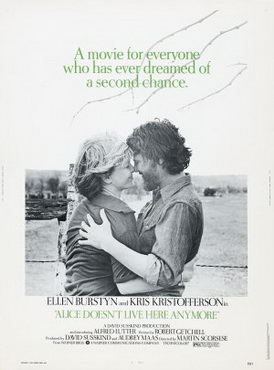 And just who is Alice, anyhow? Other than Ellen Burstyn, that is, giving a virtuosic performance. There are heavy hints that she's a survivor of childhood and domestic abuse, a caged bird who gets a second lease on life when her husband dies in an accident. He is the quintessentially Scorsesean man, brooding and angry but not without moments of tenderness. Shortly after his passing, Alice leaves with her young son to follow a long-forgotten dream of becoming a singer. She sings and plays piano well, so why not? Unfortunately, for a single mother in the 1970s, the world is not so welcoming. She finds herself frequently unemployed, working for less than she deserves, and entangled in a destructive affair with a young Harvey Keitel. When Kris Kristofferson finally comes along offering old-fashioned masculine strength, it clashes with the newfound freedom Alice has grown to enjoy, even as she secretly yearns for such paternalism. Compared to the toxic but numbing sameness of her married life, self-determination comes with some nasty thorns. All the while, her son Tommy (oddball Alfred Lutter) aches for stability and acceptance. His mother's new life is a draining change the two of them aren't sure they can endure forever.
According to my dad, this is a chick flick. Strip away the element of derogatory judgment that implies, and I'd have to agree. This is very much a movie for women. It was developed by Ellen Burstyn at the height of second wave feminism and released during that tumultuous time in American gender relations. I almost wonder if my mom saw it all those years ago, or what she'd think of it now. There's an empathy for women in this film that's borderline extinct in American movies, despite a brief 70s resurgence. To watch it is to almost reimagine from scratch what an American movie can be. My dad, for his part, remarked that this is the kind of movie he wouldn't have watched at a younger age. He noted the familiar Scorsese kineticism, but he was surprised to see it in the story of a housewife's emancipation. I understand, because it is surprising to see Scorsese so passionately and skillfully depicting the life of a woman, and it is the kind of movie that gender policing keeps young men away from. This is as much a gap in our ongoing Scorsese retrospective as it is a gap in our own lives spent away from women. But where my dad has mostly kept up his phallocentric ways, I watch this movie having spent the last decade surrounded by women and their lives, emotions, beliefs. So we come at this movie from opposite angles, and from different lives. This is our nexus, a revered male auteur's detour into the wider world of women.
If it seems ironic that I'm mentioning my dad so much in relation to a film so wonderfully gynocentric, it's because that's the strange history I bring with me to any film we watch together. With my dad in the room, I'm made to ponder my own gender identity in relation to the film, to him, and to the child I was when he was more fully my parent. An adult relationship to a parent is weird in many ways, even in the reverie of movie watching. He was surprisingly talkative when we watched ALICE, and that's because it set off a series of flashbacks he wasn't expecting. The late-film turn towards Alice's diner job revealed to him that this movie is the basis for the TV sitcom "Alice." He was stunned, having enjoyed that show for the many years it was on TV (and it seems, incidentally, that the more feminized medium of cable TV plays on different expectations in him than auteurist masculinism). My dad excitedly informed me that Vic Tayback was the same Mel from TV, but that everyone else was played by someone different. He remembered the characters, though, and I'm amused to imagine how that affected his experience of the latter half of the film. He was also insistent that the character of Audrey was played by a brother of Jodie Foster, which I thought too. We were cartoonishly dumbfounded to discover it was, in fact, Jodie Foster herself (the DVD skipped, so we may have missed any contextualizing gender information).
It was fun to talk our way through a movie experience together. I pointed out at one point that Ellen Burstyn looked a lot like my middle sister's piano teacher, which my dad was eager to share with the rest of the family. He was more animated than I'm used to, and I think I can see that as him trying to be more open than he's been for most of his life. It's a good development, and I hope it keeps up, but I won't be around to watch it continue. Because I've just told my dad I'll be moving in with my girlfriend soon, and he's given it his blessing. And I just told my little brother, who sighed and lied about being "a little sad," but told the truth when he said he was happy for me, and for my girlfriend. And soon I'll tell my middle sister, whose best friend will soon be living in this house with her. And then I'll tell my littlest sister, who will live in my room once I've left. My room of twenty years or more, my home for most of my life. It's too small for me now, and we only just replaced the bunk bed I've had for all that time. But it will always be my room in my heart, and I'll remember it as it was. It's right next door to the room my oldest sister always lived in, one she's unlikely to return to either. She's moved on now, and soon I will be too, and then only the second generation of our family will be left in this house, with my dad at the center of it all once again. And as my oldest sister and I converge, diverge, and converge again over the spans of our lives, we'll live in this house in our minds, the house we knew best, and we'll walk through it together in ways our parents have long ceased to with each other. We'll remember where we spent our youngest years, and we'll remind each other of who we were, and how nothing seems to have turned out the way we expected. We'll grow old alongside each other the way our parents won't, and we'll make the trips back to see our parents wherever they end up in their last few decades. And I'll see my dad and remember all the sad times, the bad times, the long and hard times of never knowing what to do or say.
But I'll also remember the good times, when words fell away and we let down our guards long enough to make this house a home. I'll remember the games and the toys, the puzzles and the stuffed animals, the spaghetti and the baked potatoes. And I'll remember the movies, the ones that eased us into sharing a space together, however briefly. I'll look back on ALICE and others, filtering them through what I know about my dad and myself. So even as I remember the man who didn't know what came next after the kids grew up, I'll remember the days when I thought he knew, when it seemed like only a few more movies stood between me and adulthood. Because it's here, adulthood, now more than ever. And I've certainly watched a few more movies. And I'll certainly watch a few more still. But for now, ALICE DOESN'T LIVE HERE ANYMORE. Alice has somewhere else to live. Somewhere else to be. Something else to find.
(photo credit: en.wikipedia.org)
Sunday, January 18, 2015
ON THE SILVER GLOBE (Żuławski 87): [N/A]
An incomplete post for an incomplete movie. Different kind of writing for a different kind of movie. I think i can say what I want, because I am what I am. Because I am what i am. I can say anything. I don't need a chorus or verses. Make some money. Blue and silver light in a field of white. That similar hybrid color draped over a beach at the ends of the earth, not our earth, but another's, whoever they may be.
It's not long before we lose our way in Żuławski's extraterrestrial pagan phantasy. Three astronauts leave at some point, there's no Earth worth saving. this is understood to be our life. They arrive and find vast emptiness. does this emptiness bring them to doom? Time comes rushing in like white waves, lives peak and crest and dissolve, children are born and Jerzy is still alive, a society emerges in which he transforms from man to king, divine alien.
the problem with pastiche might be that its makers have minds too small and fragile. an expansive and courageous mind, open beyond limits of selfhood, can cobble something together new and amazing just by virtue of existence, brushing away all faint and obvious pastiche.t hat must be how its always been the synthessi comes from the big artists they make it all new as everything else turns pale and cold, warmth from warm hearts ond brains
My partner and i both have family from Poland, the glum, grim giant of Europe. She knows more than I do of this, but I know the pressure point of Poland and Germany held my forebears. What does it mean for me to be in this relationship, experiencing the art of a land I don't know Who? is Andrzej Żuławski, and what is he to me? What makes me adore this film. How Polish is my adoration?
Marek, Szern, Malachuda, Thomas (the Third, Aza? Arta? Jacek, and others.
(photo credit: en.wikipedia.org)
the only hint this film's of humans is blasts of 70s/80s cockrock a blue globe's extrusion not a silver one's
 Philosophy screamed like the bare truth of life, in contrast to the filmic dollops of Europudding spooned into American maws. This is how we speak of our convictions and terrors, at the top of our lungs. I should scream feminism, because the world can't hear me without disruption. murmurs won't do
Jump cuts from behind your eyes, and the people speaking twitch from word to word, we see them anew but though they are new to us already. seeing them as we do, their planet is ours.
No rating? 4.5, 4.56788654? futility, untenable hierarchies, strained binaries. I begin to suspect there's a world out there beyond ranking films. Graded art. to return to this place implies we've left it, or I sure have, so I mourn my spontaneous creativity and find solace in Żuławski the madman. I pull my punches, not him.
Whatever wrongness a blue globe holds a silver globe might yet show us new life
Science fiction is served well by abstract art, because the convulsing life in ON THE SILVER GLOBE seems to flow unprompted from a group of aliens. inscrutable and spectacularly strange i accept them as undiscovered beings. orgies are no longer orgies expressions of unknown passions in misunderstood bodies. Keep us on edge and we consider more deeply than when these sights are known to us.
faces of mud they're not so clear, fetid stench of blood and fear, the bird men and Men who converge away from earth, life undefined but needing it after all, defintion not so easily ignored
The Żuławski camera roves and dashes, even the exposition he must provide for this 80% of a film fills in the gaps with sprints, his eye and ours eyes racing through anonymous stretches of Poland, always Poland, Poland from which this film radiates its scorching mystery, Poland where Żuławski learned his Żuławski, Żuławski the elder who dreamed of birds and women breeding men, it's all Poland and we are all Poland, if anyone is Polish in the end after all
poesia.
I want to commit to sharing my emotions but the act of sharing is bogged with presuppositions for recipient + giver so what does sharing look like can it look like i want it to, how much sharing is mine, or yours, who shares and why, and how will it sound when something is, at last, shared?
Narrative's not dead, it's just in bad shape in worse hands, it won't save us and we can't fully trust it but we can let it in like a harmless friend from time to time, it may have things to tell us if we have ways to listen, but those ways come from us and we build them in our privacies
make art and feel your love for it, and all who articulate your art affect you but not your art, the art lives and maybe you die, if they decide to kill you, my hope is that made art is a heart's strongest pulse
The tragedy of censorship is not its abstract threat toward all voices but its malevolent gaze upon highly specific voices. The silver globe is dented, damaged, flawed, unfinished, but how many movies are complete, how many were allowed their life, and why was this one not, and why is Żuławski so far from our minds, and when will we know Żuławski, twitter in 2014 did indeed like POSSESSION but how many POSSESSIONs will it take to bring us back to Żuławski, how many worlds hide behind infinite space, where Poland resides and we do not?
i am a reflection of What is in you but you are not a reflection of What is in me
It's not long before we lose our way in Żuławski's extraterrestrial pagan phantasy. Three astronauts leave at some point, there's no Earth worth saving. this is understood to be our life. They arrive and find vast emptiness. does this emptiness bring them to doom? Time comes rushing in like white waves, lives peak and crest and dissolve, children are born and Jerzy is still alive, a society emerges in which he transforms from man to king, divine alien.
the problem with pastiche might be that its makers have minds too small and fragile. an expansive and courageous mind, open beyond limits of selfhood, can cobble something together new and amazing just by virtue of existence, brushing away all faint and obvious pastiche.t hat must be how its always been the synthessi comes from the big artists they make it all new as everything else turns pale and cold, warmth from warm hearts ond brains
My partner and i both have family from Poland, the glum, grim giant of Europe. She knows more than I do of this, but I know the pressure point of Poland and Germany held my forebears. What does it mean for me to be in this relationship, experiencing the art of a land I don't know Who? is Andrzej Żuławski, and what is he to me? What makes me adore this film. How Polish is my adoration?
Marek, Szern, Malachuda, Thomas (the Third, Aza? Arta? Jacek, and others.
(photo credit: en.wikipedia.org)
the only hint this film's of humans is blasts of 70s/80s cockrock a blue globe's extrusion not a silver one's

Jump cuts from behind your eyes, and the people speaking twitch from word to word, we see them anew but though they are new to us already. seeing them as we do, their planet is ours.
No rating? 4.5, 4.56788654? futility, untenable hierarchies, strained binaries. I begin to suspect there's a world out there beyond ranking films. Graded art. to return to this place implies we've left it, or I sure have, so I mourn my spontaneous creativity and find solace in Żuławski the madman. I pull my punches, not him.
Whatever wrongness a blue globe holds a silver globe might yet show us new life
Science fiction is served well by abstract art, because the convulsing life in ON THE SILVER GLOBE seems to flow unprompted from a group of aliens. inscrutable and spectacularly strange i accept them as undiscovered beings. orgies are no longer orgies expressions of unknown passions in misunderstood bodies. Keep us on edge and we consider more deeply than when these sights are known to us.
faces of mud they're not so clear, fetid stench of blood and fear, the bird men and Men who converge away from earth, life undefined but needing it after all, defintion not so easily ignored
The Żuławski camera roves and dashes, even the exposition he must provide for this 80% of a film fills in the gaps with sprints, his eye and ours eyes racing through anonymous stretches of Poland, always Poland, Poland from which this film radiates its scorching mystery, Poland where Żuławski learned his Żuławski, Żuławski the elder who dreamed of birds and women breeding men, it's all Poland and we are all Poland, if anyone is Polish in the end after all
poesia.
I want to commit to sharing my emotions but the act of sharing is bogged with presuppositions for recipient + giver so what does sharing look like can it look like i want it to, how much sharing is mine, or yours, who shares and why, and how will it sound when something is, at last, shared?
Narrative's not dead, it's just in bad shape in worse hands, it won't save us and we can't fully trust it but we can let it in like a harmless friend from time to time, it may have things to tell us if we have ways to listen, but those ways come from us and we build them in our privacies
make art and feel your love for it, and all who articulate your art affect you but not your art, the art lives and maybe you die, if they decide to kill you, my hope is that made art is a heart's strongest pulse
The tragedy of censorship is not its abstract threat toward all voices but its malevolent gaze upon highly specific voices. The silver globe is dented, damaged, flawed, unfinished, but how many movies are complete, how many were allowed their life, and why was this one not, and why is Żuławski so far from our minds, and when will we know Żuławski, twitter in 2014 did indeed like POSSESSION but how many POSSESSIONs will it take to bring us back to Żuławski, how many worlds hide behind infinite space, where Poland resides and we do not?
i am a reflection of What is in you but you are not a reflection of What is in me
Thursday, January 8, 2015
THE RIGHT STUFF (Kaufman 83): [3.5]
Recently, by suggestion of my father, I rewatched Clint Eastwood's FLAGS OF OUR FATHERS. I had viewed it and its companion film LETTERS FROM IWO JIMA shortly after their release and considered the latter a far superior film, humanist and broad-minded where most war films were blinkered and jingoistic. Of course, this easy binary obscures the achievements of films as diverse as THE THIN RED LINE to THE BURMESE HARP when considering what the portrayal of war can look like in film. Furthermore, as I was soon to find out, FLAGS OF OUR FATHERS is as complex and troubling a war film as any the medium has previously seen. Eastwood's film dives staggeringly, heartbreakingly deep into the cost of national myth-making. The soldiers at the center of the film become little more than pawns in a long game of mass-media chess, symbols badly needed for a country unsure of its standing in the world. Each has no choice but to allow their beatification, but the rewards of that acceptance are stratified by race, class, and, of course, hegemonic masculinity. He who fails to suppress his feelings will be chewed up and spit out by a media apparatus all too eager to anoint its newest secular saints.

If Philip Kaufman's 1983 film is less cynical in its examination of Project Mercury's role in galvanizing the Space Race, it is at least appropriately unsure of who, exactly, benefits from such nationalistic chest-thumping. After receiving an earlier draft of the film by screenwriter William Goldman, who was inspired to script the film as a heartwarming palliative to the ugly Iran hostage crisis, Kaufman reportedly sought to de-emphasize the film's focus on "patriotism." What that means is unclear, but we can read a certain amount of intention into Kaufman's insistence on re-inserting Chuck Yeager into the film. Yeager was the first man to break the sound barrier, and his standing as a local hero (note his Western-reminiscent scene on horseback) is what inspired the Mercury pilots to become the world's first astronauts. Tellingly, though, the film closes just as it began, with Yeager on the periphery of Project Mercury, an inspiration only to those in the know. For the Mercury astronauts, Yeager and his friendly rival Scott Crossfield were the heroes of olden times who modeled for them what pioneers of space might look like. For the rest of America, heroism looked like the brave young men on front pages of Life magazine.
So Kaufman too is asking us how we choose our heroes, and who does the deciding. It's probably no coincidence that Presidents Eisenhower, Kennedy, and Johnson make appearances in THE RIGHT STUFF, much like FLAGS OF OUR FATHERS featured Harry S. Truman giving his blessing to the central three soldiers. After all, who better than a sitting President to legitimize a national agenda in the hearts and minds of its citizens? Where World War II earned financing through our earnest belief in its moral righteousness, politicians and scientists alike slowly realized the Space Race would also not be won without the publicity that secures its funding. And so Project Mercury becomes the figurehead of a modern manifest destiny, the scrappy underdog nipping at the heels of the Communist menace. A TV show even refers to the astronauts at one point as "our Davids," in battle against the unspoken Goliath overseas. There's been a lot of talk recently about why our space programs have fallen to wayside in recent decades, and the short answer is simply that space travel will never be so mythologically important to the American character as it was in the 50s and 60s. The courageous pioneers, worshiped by media and public alike, encapsulated everything the United States wanted its men to be.
A comparison to Tony Scott's TOP GUN is pertinent here as well. Released a mere three years later, we see echoes of a film William Goldman would have recognized, in which a cocky young American pilot justifies his overconfidence with awe-inspiring aerial prowess. A sentimental, neon-drenched fantasy (not a bad thing, mind you; big Tony Scott fan here), TOP GUN was far less ambivalent about ideological and cinematic wish-fulfillment. Audiences certainly rewarded its brazen endorsement of machismo. THE RIGHT STUFF's box office earnings: $21,192,102; TOP GUN: $356,830,601. You can guess which film has engendered whisperings of a sequel.
Still, at risk again of easy binaries, it would be wrong to say that Kaufman's film doesn't have its fair share of testosterone. Importantly, it is the approach which differs. Perhaps the best way I can describe THE RIGHT STUFF's approach to masculinity is that its men are always given freedom to pontificate and test their strength, but without the consequence-free vacuum most white male American films construct around their characters. Witness the spellbinding moment when the Grissoms realize the military will not honor Gus' finish-line fumble the way it has honored his forebears' resounding successes. Veronica Cartwright gives you the full force of Betty's repressed loneliness finally bursting the dam, and Fred Ward as Gus can do little more than murmur and cry. He's staked his self-esteem on being the homecoming hero, and instead he finds himself having to answer for a long list of failures all at once. He tries to escape, either to a potential mistress or his band of merry gentlemen, but Betty Grissom isn't having it. He will stay, and he will own up to the pain his absence has caused his wife, the disappointment for which the Air Force never prepared them.
Or look at Gordon Cooper, played amiably by Dennis Quaid in one of his best roles (and one which Tom Cruise must have studied closely). Coasting lackadaisically above the earthbound troubles around him, he nevertheless finds himself humbled, even emasculated, by the women around him. First his wife Trudy leaves in a fit of anguish, unable to handle the overwhelming fear of being widowed. Cooper watches with a burning weenie (!) in his hand, grin blown out like a dead lightbulb. In her absence, he invites a nurse charged with collecting his sperm to "join him." He considers his proposition a good-natured bit of flirtation; in 2015, it looks a lot more like sexual harassment. This incident does not go unpunished in the film, however. Cooper is ignominiously banished to a latrine to masturbate alongside fellow astronaut John Glenn (Ed Harris), who cheerfully hums his way through the procedure. Afterward, Cooper re-attempts his seduction, only to be rebuffed by the nurse demanding to see his wife. Cooper tenses up, suddenly aware of the consequences he'd been ignoring. A day later, he watches from afar as the Trudy and the nurse laugh about him in her office. He is equal parts terrified and humiliated, hilariously incapable of maintaining an air of indifference as he waits for the hammer to fall. Instead, Trudy cheerfully rejoins him, reporting that they were only joking lightly at his expense. Relieved and reinflated once more, he sneers "Yeah, she's just one of those women who has a problem with men." Machismo has rarely fallen flatter on its face.
Kaufman knows his male characters are borderline deluded in their single-minded pursuit. At a picnic early in the film, one wife exclaims to the others "Look at them! It's like they're talking about sports!" The men are outside horsing around, while the wives sit indoors speaking of nightmares and all-encompassing dread. Kaufman is canny enough to position the men at a remove from the everyday lives of American families, because the rarefied air the Mercury pilots figuratively and literally occupy is off-limits to all but a few. It does indeed take superhuman bravery to risk death on a regular basis, and that drives these men to take comfort in old-fashioned masculinity. Decades earlier, ONLY ANGELS HAVE WINGS was just as perceptive in its bittersweet admiration of the pilot life. This isn't an easy job, and the men have to stick together to make it through. Kaufman grants them the outsized confidence needed to survive, but never at the expense of the socially marginal people who fill out rest of their world. Alan Shephard (Scott Glen), the first American in space, enjoys watching and mimicking a racist TV comedy routine in his spare time, but when he finds himself on the verge of incontinence after a test, his position of power over the Latino nurse vanishes. Quite literally too, as he shuffles feebly along to the bathroom with the tall man's hand firmly on his shoulder. Consider, also, John Glenn's defense of his wife Annie (an impressive Mary Jo Deschanel) when Vice President Lyndon Johnson himself is demanding entrance into their home. Glenn defies both NASA and the United States government to protect her from being harassed over her speech impediment, and when he faces repercussions for his act of solidarity, the other astronauts back him up by refusing their services to NASA if Glenn is punished.
By establishing his perspective as a ground-level skeptic, both of national myth and masculine braggadocio, Kaufman allows his film to celebrate this exciting era in American history without glossing over its ugly moments. He sees history in context, and his humility in the face of THE RIGHT STUFF's inherent grandiosity prevents unseemly overreaching. Instead, it's the smaller moments that register. I was stunned by those technicolor tears painted onto John Glenn's helmeted face as he sat in waiting within the Mercury-Atlas 6. What a beautiful reminder of the emotions hidden beneath the astronauts' stoic exteriors. Additionally, Kaufman's hiring of avant-garde filmmaker Jordan Belson as a special effects artist strikes me as fairly ingenious. Along with Belson's recreations of Earth seen from orbit, the impressionistic cloud surfaces and John Glenn's "fireflies" go a long way in communicating to us not just what it looks like, but what it feels like to see the universe from such a perspective. For the billions of us who will never see space the way the Mercury astronauts do, only the awe of seeing beautiful art is comparable.
Philip Kaufman is apparently notorious for creating films considered too lengthy for the filmgoing public, but THE RIGHT STUFF justifies his intensive process. From sharp characterizations to fleeting moments of unearthly beauty, he crafts an enormous mosaic of a truly titanic span of history. The film breathes with a lived-in sense of how landmark moments in human history are surrounded by mundane ones. Life goes on for everyone involved, as Project Mercury was neither the beginning nor the end of their lives. Through hindsight, we can see the lives of these astronauts and the people they knew, so ordinary in most respects, made legendary through the weight of their accomplishments and our recollection of their story. This film knows better than most that glory is brief and life is long, but it is able to acknowledge those seemingly contradictory understandings without trivializing one or the other. That makes THE RIGHT STUFF a very wise film, just as FLAGS OF OUR FATHERS was imbued with the wisdom of an artist who's spent decades negotiating his own legend. For while Project Mercury was a human undertaking like any other, its resonance as a legend comes from our awe in the face of the universe's vastness. History often gives birth to its legends by accident, but it's the people who believe in those tales that immortalize them. Our narratives reflect who we are, because we use them to grasp at what makes us human. This is the story of our first steps toward higher understanding, a necessarily human narrative that, in its telling, catches glimmers of the transcendent.
(photo credit: en.wikipedia.org)
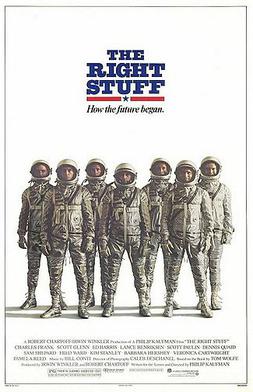
If Philip Kaufman's 1983 film is less cynical in its examination of Project Mercury's role in galvanizing the Space Race, it is at least appropriately unsure of who, exactly, benefits from such nationalistic chest-thumping. After receiving an earlier draft of the film by screenwriter William Goldman, who was inspired to script the film as a heartwarming palliative to the ugly Iran hostage crisis, Kaufman reportedly sought to de-emphasize the film's focus on "patriotism." What that means is unclear, but we can read a certain amount of intention into Kaufman's insistence on re-inserting Chuck Yeager into the film. Yeager was the first man to break the sound barrier, and his standing as a local hero (note his Western-reminiscent scene on horseback) is what inspired the Mercury pilots to become the world's first astronauts. Tellingly, though, the film closes just as it began, with Yeager on the periphery of Project Mercury, an inspiration only to those in the know. For the Mercury astronauts, Yeager and his friendly rival Scott Crossfield were the heroes of olden times who modeled for them what pioneers of space might look like. For the rest of America, heroism looked like the brave young men on front pages of Life magazine.
So Kaufman too is asking us how we choose our heroes, and who does the deciding. It's probably no coincidence that Presidents Eisenhower, Kennedy, and Johnson make appearances in THE RIGHT STUFF, much like FLAGS OF OUR FATHERS featured Harry S. Truman giving his blessing to the central three soldiers. After all, who better than a sitting President to legitimize a national agenda in the hearts and minds of its citizens? Where World War II earned financing through our earnest belief in its moral righteousness, politicians and scientists alike slowly realized the Space Race would also not be won without the publicity that secures its funding. And so Project Mercury becomes the figurehead of a modern manifest destiny, the scrappy underdog nipping at the heels of the Communist menace. A TV show even refers to the astronauts at one point as "our Davids," in battle against the unspoken Goliath overseas. There's been a lot of talk recently about why our space programs have fallen to wayside in recent decades, and the short answer is simply that space travel will never be so mythologically important to the American character as it was in the 50s and 60s. The courageous pioneers, worshiped by media and public alike, encapsulated everything the United States wanted its men to be.
A comparison to Tony Scott's TOP GUN is pertinent here as well. Released a mere three years later, we see echoes of a film William Goldman would have recognized, in which a cocky young American pilot justifies his overconfidence with awe-inspiring aerial prowess. A sentimental, neon-drenched fantasy (not a bad thing, mind you; big Tony Scott fan here), TOP GUN was far less ambivalent about ideological and cinematic wish-fulfillment. Audiences certainly rewarded its brazen endorsement of machismo. THE RIGHT STUFF's box office earnings: $21,192,102; TOP GUN: $356,830,601. You can guess which film has engendered whisperings of a sequel.
Still, at risk again of easy binaries, it would be wrong to say that Kaufman's film doesn't have its fair share of testosterone. Importantly, it is the approach which differs. Perhaps the best way I can describe THE RIGHT STUFF's approach to masculinity is that its men are always given freedom to pontificate and test their strength, but without the consequence-free vacuum most white male American films construct around their characters. Witness the spellbinding moment when the Grissoms realize the military will not honor Gus' finish-line fumble the way it has honored his forebears' resounding successes. Veronica Cartwright gives you the full force of Betty's repressed loneliness finally bursting the dam, and Fred Ward as Gus can do little more than murmur and cry. He's staked his self-esteem on being the homecoming hero, and instead he finds himself having to answer for a long list of failures all at once. He tries to escape, either to a potential mistress or his band of merry gentlemen, but Betty Grissom isn't having it. He will stay, and he will own up to the pain his absence has caused his wife, the disappointment for which the Air Force never prepared them.
Or look at Gordon Cooper, played amiably by Dennis Quaid in one of his best roles (and one which Tom Cruise must have studied closely). Coasting lackadaisically above the earthbound troubles around him, he nevertheless finds himself humbled, even emasculated, by the women around him. First his wife Trudy leaves in a fit of anguish, unable to handle the overwhelming fear of being widowed. Cooper watches with a burning weenie (!) in his hand, grin blown out like a dead lightbulb. In her absence, he invites a nurse charged with collecting his sperm to "join him." He considers his proposition a good-natured bit of flirtation; in 2015, it looks a lot more like sexual harassment. This incident does not go unpunished in the film, however. Cooper is ignominiously banished to a latrine to masturbate alongside fellow astronaut John Glenn (Ed Harris), who cheerfully hums his way through the procedure. Afterward, Cooper re-attempts his seduction, only to be rebuffed by the nurse demanding to see his wife. Cooper tenses up, suddenly aware of the consequences he'd been ignoring. A day later, he watches from afar as the Trudy and the nurse laugh about him in her office. He is equal parts terrified and humiliated, hilariously incapable of maintaining an air of indifference as he waits for the hammer to fall. Instead, Trudy cheerfully rejoins him, reporting that they were only joking lightly at his expense. Relieved and reinflated once more, he sneers "Yeah, she's just one of those women who has a problem with men." Machismo has rarely fallen flatter on its face.
Kaufman knows his male characters are borderline deluded in their single-minded pursuit. At a picnic early in the film, one wife exclaims to the others "Look at them! It's like they're talking about sports!" The men are outside horsing around, while the wives sit indoors speaking of nightmares and all-encompassing dread. Kaufman is canny enough to position the men at a remove from the everyday lives of American families, because the rarefied air the Mercury pilots figuratively and literally occupy is off-limits to all but a few. It does indeed take superhuman bravery to risk death on a regular basis, and that drives these men to take comfort in old-fashioned masculinity. Decades earlier, ONLY ANGELS HAVE WINGS was just as perceptive in its bittersweet admiration of the pilot life. This isn't an easy job, and the men have to stick together to make it through. Kaufman grants them the outsized confidence needed to survive, but never at the expense of the socially marginal people who fill out rest of their world. Alan Shephard (Scott Glen), the first American in space, enjoys watching and mimicking a racist TV comedy routine in his spare time, but when he finds himself on the verge of incontinence after a test, his position of power over the Latino nurse vanishes. Quite literally too, as he shuffles feebly along to the bathroom with the tall man's hand firmly on his shoulder. Consider, also, John Glenn's defense of his wife Annie (an impressive Mary Jo Deschanel) when Vice President Lyndon Johnson himself is demanding entrance into their home. Glenn defies both NASA and the United States government to protect her from being harassed over her speech impediment, and when he faces repercussions for his act of solidarity, the other astronauts back him up by refusing their services to NASA if Glenn is punished.
By establishing his perspective as a ground-level skeptic, both of national myth and masculine braggadocio, Kaufman allows his film to celebrate this exciting era in American history without glossing over its ugly moments. He sees history in context, and his humility in the face of THE RIGHT STUFF's inherent grandiosity prevents unseemly overreaching. Instead, it's the smaller moments that register. I was stunned by those technicolor tears painted onto John Glenn's helmeted face as he sat in waiting within the Mercury-Atlas 6. What a beautiful reminder of the emotions hidden beneath the astronauts' stoic exteriors. Additionally, Kaufman's hiring of avant-garde filmmaker Jordan Belson as a special effects artist strikes me as fairly ingenious. Along with Belson's recreations of Earth seen from orbit, the impressionistic cloud surfaces and John Glenn's "fireflies" go a long way in communicating to us not just what it looks like, but what it feels like to see the universe from such a perspective. For the billions of us who will never see space the way the Mercury astronauts do, only the awe of seeing beautiful art is comparable.
Philip Kaufman is apparently notorious for creating films considered too lengthy for the filmgoing public, but THE RIGHT STUFF justifies his intensive process. From sharp characterizations to fleeting moments of unearthly beauty, he crafts an enormous mosaic of a truly titanic span of history. The film breathes with a lived-in sense of how landmark moments in human history are surrounded by mundane ones. Life goes on for everyone involved, as Project Mercury was neither the beginning nor the end of their lives. Through hindsight, we can see the lives of these astronauts and the people they knew, so ordinary in most respects, made legendary through the weight of their accomplishments and our recollection of their story. This film knows better than most that glory is brief and life is long, but it is able to acknowledge those seemingly contradictory understandings without trivializing one or the other. That makes THE RIGHT STUFF a very wise film, just as FLAGS OF OUR FATHERS was imbued with the wisdom of an artist who's spent decades negotiating his own legend. For while Project Mercury was a human undertaking like any other, its resonance as a legend comes from our awe in the face of the universe's vastness. History often gives birth to its legends by accident, but it's the people who believe in those tales that immortalize them. Our narratives reflect who we are, because we use them to grasp at what makes us human. This is the story of our first steps toward higher understanding, a necessarily human narrative that, in its telling, catches glimmers of the transcendent.
(photo credit: en.wikipedia.org)
Tuesday, November 25, 2014
DIVERGENT (Burger 14): [3]
It's a good idea to watch movies with your sisters. Not only do you discover what excites them and have something to share with them, you also get the chance to expand outside your viewing habit comfort zone. More generally, watching movies intergenerationally can teach you about how people more naive with media and narrative art -- or, perhaps in this current era, more sophisticated! -- enjoy things with which they've yet to become jaded. This can only help when trying to understand how time and age affect our engagement with the world around us. As an example, I suspected my intuitive response to the Faction system of DIVERGENT was because of its similarity to the various Houses of Harry Potter. I couldn't say whether this construct has some innate narrative appeal or if it's simply a trend on the ascent with the recent YA Lit boom, but it's very interesting to wonder if my sisters were experiencing a rapport with the story similar to how I had with Harry Potter more than a decade ago.
 Four's striking down of the hated father follows his third fear, where he has to push past his reluctance to kill in order to dispassionately shoot an innocent girl. That scene, in turn, is reprised in Tris' own fourth and final confrontation with fear, a scene which initially scans as taking place after a waking re-entry into the real world. The society's overlord (Kate Winslet) hands Tris a gun and directs Tris toward her newly-arrived family members. With little hesitation, Tris points the gun toward her loved ones and begins to fire. We may recognize this set-up as a deliberate echo of Four's own mental reckoning with murder, and we may unconsciously recognize that Tris has only conquered three of her four fears at this point, but by now I hope I've adequately set up for you the daring things this film is doing with perspective and identification. The effect of watching Tris shoot her family is fleeting and ultimately misleading, but it lingers just as the imagined sexual violation by Four does. For a movie about the moral triumph and self-actualization of a young girl, DIVERGENT is impressively willing to imagine its protagonist in some ugly situations.
I should mention at this point that DIVERGENT owes much of its success to Shailene Woodley, a favorite of my middle sister (THE FAULT IN OUR STARS!) and rapidly growing on me too. Woodley ably switches between steely resolve, fear, heartbreak, and bravery with naturalistic ease as the scene requires. It goes without saying that her facility for broad-ranging emotional expression comes in handy for a movie about the unpredictability of personality. Less obviously perhaps, Woodley is a superlative avatar for impressionable viewers to vicariously navigate life's conflicts. While Theo James, as Four, acquits himself well in the beginning, his devil-may-care charisma is less convincing when he is called upon to be earnest and openhearted. Shailene Woodley has no such difficulty; she can hide herself behind uncertain defensiveness just as easily as she reveals layers of inner strength. While I look forward to her continuing experimentation in films along the lines of Gregg Araki's WHITE BIRD IN A BLIZZARD, she deserves praise for stopping off in the YA world first to give young girls a heroine worth admiring.
I haven't paid much attention to the central metaphor of the film because I don't think it carries the philosophical weight it seeks. The concept of externally imposed identity has been dissected with much more passion and weirdness elsewhere. As a storytelling device, though, it's pretty unimpeachable. Consider: Tris' closest girl friend in the film always speaks her mind - because she's from the Candor faction! Her other friend can relay plot exposition to her - because he's from Erudite! And when Tris' mom comes to save the day despite belonging to Abnegation, it's because she was actually born into Dauntless at first! Character traits are textual in this movie, and enjoyably so. The rigidity of factional allegiances also gets an interesting workout where the emerging group of friends compare their lives before each had joined the Dauntless faction. It's clear they've all been shaped by their previous factions, and that their entry into Dauntless is shaped by where they come from. Again, as a metaphor for leaving home and meeting new people, this is really solid stuff! We come from many homes and many families, and even as we mature and build new kinds of relationships with each other, we are constantly negotiating against the private worlds that shaped us. Foregrounding that process through metaphor is one of DIVERGENT's best and most subtle conceits.
Even the (vaguely defined) central conflict gains a certain amount of weight from its metaphorical backing. The tough Dauntless faction prides itself on its authoritarian obedience, or not resisting orders from above. It is literally a training ground for soldiers, and so its militaristic nature comes ported in from the real world. Eric (Jai Courtney) leads Dauntless with the inflexibility of a drill sergeant, all the better to create contrast with the softer Four and more empathic Tris. Masculinity, as represented by Eric and his cold adherence to rules, is cast as something that inflicts pain and increases hostility between its adherents. Tris wants the freedom of Dauntless/masculinity, but her sensitivity to the Factionless/homeless and other vulnerable people places her in opposition to Eric. When Eric eventually manipulates Dauntless into a robotic police militia, this seems less like a co-optation by higher powers than an extrapolation of the warrior culture it had been consciously cultivating all along. The climax of the story has Dauntless enacting what basically amounts to an ethnic cleansing. There had been hints of unilateral aggression against the passive Abnegation faction throughout the movie. Tris and her brother are too late to realize the faction system has been fomenting this kind of unrest all along, a realization which costs them the lives of their parents. DIVERGENT ends with Tris stunned and hurting, disillusioned but determined, on her way by train to parts unknown.
One last, related point: Tris' rejection of the faction system can be read a number of ways. The most obvious (as well as the presumable intention) is as an affirmation of the importance of identity, the ubiquitous Be You-nique! message directed at misunderstood teens craving such validation. However, it's also possible to draw the exact opposite meaning out of the metaphor. If, like me, you believe that a strong belief in personal identity has fascistic under-/overtones (i.e. Eric, most Dauntless of all), you can read DIVERGENT as a rejection of identity altogether. In the real world, dominant culture commands that we create for ourselves an identifiable and consistent personal brand. Believing in the importance and uniqueness of our identities, we consolidate our social capital and become better and more marketable consumers. By contrast, Tris Prior represents an amorphous and uncategorizable form of being. For me this brings to mind Terre Thaemlitz's idea of the anti-essentialist, unreconciled identity. Terre advocates refusal to tame the contradictions of our most private selves, both to be more honest to our unruly self-concepts and to be more resistant to the capitalist segregation by predetermined target demographics. Tricky, in his own way, also feels it's more honest to reject the strict boundaries of identity in favor of a fluid internal state. I mention these artists, my personal heroes, not to "reclaim" DIVERGENT as some sort of secretly, militantly queer anti-capitalist samizdat. Rather, I think this is the ultimate utility of pop culture objects. They are so appealingly broad that we are compelled by their simpleness and left free to write our own interpretations over top of them. I don't doubt that DIVERGENT was deliberately designed to be an ode to individualism, but I think it's interesting and exciting that I can dig a totally oppositional reading out of it with minimal effort. Like a pop song, and by nature of its own looseness, DIVERGENT can contain many seemingly contradictory meanings. The very title and structuring metaphor of the story hints at departing from preconceptions, but it doesn't necessarily dictate that there's only one way to do so. The narrative of the film suggests that you rebel against authority and be true to your unique self. You could, however, just as well rebel against the film's plot and find a queer message of resisting false binaries and oversimplification of selfhood. It's a radically open text, and its radicalism comes from refusing to impose an authorial point-of-view as the lone true interpretation. Its mass popularity means it will be seen and adored by many people around the world, and it will mean things to them that we could never predict just by outlining its story beats and metaphors. I can't say for certain what my sisters see in it, but even as we come together to watch it, we each leave with a vastly different experience. There is no objective DIVERGENT, only a multiplicity of DIVERGENTs constructed in the mind's eye of each viewer who comes to it, ready to learn.
I haven't read the book series upon which this film and its upcoming sequels are based, nor do I particularly plan on it. I don't consider my decision to be unfair to the film or its universe, though I recognize that my unfamiliarity with this book series and others is rapidly aging me in the eyes of a young population for whom they will be future generational touchstones. Books, especially book series, require a lot of time, investment, and attention that I'm not sure I can feasibly devote. I feel this same way about television, so I see consistency in my choice to avoid most serialized narratives. (At least I watch the movie versions of pop culture phenomena!) And I do think we have to accept at some point that we will not be able to preserve the intensely meaningful relationships we have with books in our younger years. But I don't necessarily think that means youth-oriented books are off-limits either. I think age means we get to choose, and that means we can experience YA Lit as adults instead of children, or we can move on to more standard adult literature and experience that as adults too.
Anyhow, DIVERGENT. Where pure pop pleasure is concerned, I found it to be a fun (and colorful!) variation on the rather dour state of blockbuster filmmaking lately. The amount of eye-catching set design and saturated colors suggests we are meant to like what we see, if only for a while. The requisite turn towards seriousness comes with due diligence, but until then, at least we get Urbex, ziplines, and games of capture-the-neon-flag. This is supposed to be a utopian society, after all. Some allure helps to sell the illusion, and it comes the added bonus of fostering a better viewing experience for this weary filmgoer. Because while I do see value in THE HUNGER GAMES' (series) consideration of personal trauma and political self-assertion, the bleak world in which they take place is rather unenjoyable for me to take in after the recent deluge of joyless megamovies. The video game tide has risen nauseatingly high, and so we are condemned to a blockbuster hell in which the Call of Duty games seem to be the main artistic inspiration. THE HUNGER GAMES and its sequels only just keep their heads above this tepid water. Nevertheless, I expect time will treat those films kindly as we move on from fallacious filmic ultrarealism. My guess is that, one day, we'll look back on them as formative experiences in the lives of young women facing down hardships closer to home.
DIVERGENT, though, has quite a few things to say on trauma as well. Its observations are embedded within its clever use of induced hallucinations to draw out inner emotions from its protagonists (which seems like a much more accepting view of psychedelic drugs than I'd expect for a movie like this). We first see the threat of trauma as it affects the mind of Tris Prior, our protagonist. Her test in proving herself to the Dauntless faction, a group of soldier-like young adults, is to overcome her four most private terrors (shades of Neon Genesis Evangelion here). In mental simulations reminiscent of THE MATRIX, Tris pushes past her first two garden-variety fears of animal attacks and drowning...on through to attempted rape. Her recent infatuation with Four, a mentor figure in the Dauntless faction and mostly supportive presence so far, suddenly turns violent and sinister. The Four of her fears ignores her demands for him to stop, and he taunts her by suggesting her refusal implies cowardice.
DIVERGENT, though, has quite a few things to say on trauma as well. Its observations are embedded within its clever use of induced hallucinations to draw out inner emotions from its protagonists (which seems like a much more accepting view of psychedelic drugs than I'd expect for a movie like this). We first see the threat of trauma as it affects the mind of Tris Prior, our protagonist. Her test in proving herself to the Dauntless faction, a group of soldier-like young adults, is to overcome her four most private terrors (shades of Neon Genesis Evangelion here). In mental simulations reminiscent of THE MATRIX, Tris pushes past her first two garden-variety fears of animal attacks and drowning...on through to attempted rape. Her recent infatuation with Four, a mentor figure in the Dauntless faction and mostly supportive presence so far, suddenly turns violent and sinister. The Four of her fears ignores her demands for him to stop, and he taunts her by suggesting her refusal implies cowardice.
It's jarring to see such a stark scene in a YA Lit adaptation, and yet, really, this might be where it belongs most of all. After all, keeping such intimate violence off the screen hasn't decreased its ubiquity in real life. Young girls are dreadfully underserved by the indifference and trivialization of rape in ostensibly adult art. If YA wants to tackle this very serious problem through the safe remove of artistic interpretation, I can't imagine very much wrong with that (barring trigger potential). The potential rape scene flickers by quickly, but it is no less impactful for its succinctness. Tris' subconscious dread serves as a reprise of Four's fourth and deepest fear, an encounter with an abusive father several times refracted. This abuse had been set up earlier in the film as a plot point, and when we finally confront it, it's in a suitably primal fashion. Four's experience is a common one: alone at home, young and defenseless; a loved one looming with punishment in their hands, mania in their eyes. Before the assault, the cruelest of justifications: his father just wants him to be stronger.
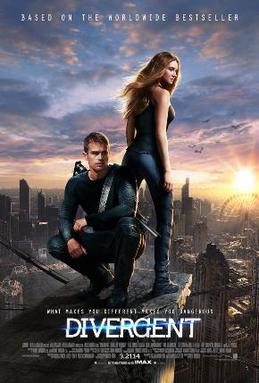 Four's striking down of the hated father follows his third fear, where he has to push past his reluctance to kill in order to dispassionately shoot an innocent girl. That scene, in turn, is reprised in Tris' own fourth and final confrontation with fear, a scene which initially scans as taking place after a waking re-entry into the real world. The society's overlord (Kate Winslet) hands Tris a gun and directs Tris toward her newly-arrived family members. With little hesitation, Tris points the gun toward her loved ones and begins to fire. We may recognize this set-up as a deliberate echo of Four's own mental reckoning with murder, and we may unconsciously recognize that Tris has only conquered three of her four fears at this point, but by now I hope I've adequately set up for you the daring things this film is doing with perspective and identification. The effect of watching Tris shoot her family is fleeting and ultimately misleading, but it lingers just as the imagined sexual violation by Four does. For a movie about the moral triumph and self-actualization of a young girl, DIVERGENT is impressively willing to imagine its protagonist in some ugly situations.
I should mention at this point that DIVERGENT owes much of its success to Shailene Woodley, a favorite of my middle sister (THE FAULT IN OUR STARS!) and rapidly growing on me too. Woodley ably switches between steely resolve, fear, heartbreak, and bravery with naturalistic ease as the scene requires. It goes without saying that her facility for broad-ranging emotional expression comes in handy for a movie about the unpredictability of personality. Less obviously perhaps, Woodley is a superlative avatar for impressionable viewers to vicariously navigate life's conflicts. While Theo James, as Four, acquits himself well in the beginning, his devil-may-care charisma is less convincing when he is called upon to be earnest and openhearted. Shailene Woodley has no such difficulty; she can hide herself behind uncertain defensiveness just as easily as she reveals layers of inner strength. While I look forward to her continuing experimentation in films along the lines of Gregg Araki's WHITE BIRD IN A BLIZZARD, she deserves praise for stopping off in the YA world first to give young girls a heroine worth admiring.
I haven't paid much attention to the central metaphor of the film because I don't think it carries the philosophical weight it seeks. The concept of externally imposed identity has been dissected with much more passion and weirdness elsewhere. As a storytelling device, though, it's pretty unimpeachable. Consider: Tris' closest girl friend in the film always speaks her mind - because she's from the Candor faction! Her other friend can relay plot exposition to her - because he's from Erudite! And when Tris' mom comes to save the day despite belonging to Abnegation, it's because she was actually born into Dauntless at first! Character traits are textual in this movie, and enjoyably so. The rigidity of factional allegiances also gets an interesting workout where the emerging group of friends compare their lives before each had joined the Dauntless faction. It's clear they've all been shaped by their previous factions, and that their entry into Dauntless is shaped by where they come from. Again, as a metaphor for leaving home and meeting new people, this is really solid stuff! We come from many homes and many families, and even as we mature and build new kinds of relationships with each other, we are constantly negotiating against the private worlds that shaped us. Foregrounding that process through metaphor is one of DIVERGENT's best and most subtle conceits.
Even the (vaguely defined) central conflict gains a certain amount of weight from its metaphorical backing. The tough Dauntless faction prides itself on its authoritarian obedience, or not resisting orders from above. It is literally a training ground for soldiers, and so its militaristic nature comes ported in from the real world. Eric (Jai Courtney) leads Dauntless with the inflexibility of a drill sergeant, all the better to create contrast with the softer Four and more empathic Tris. Masculinity, as represented by Eric and his cold adherence to rules, is cast as something that inflicts pain and increases hostility between its adherents. Tris wants the freedom of Dauntless/masculinity, but her sensitivity to the Factionless/homeless and other vulnerable people places her in opposition to Eric. When Eric eventually manipulates Dauntless into a robotic police militia, this seems less like a co-optation by higher powers than an extrapolation of the warrior culture it had been consciously cultivating all along. The climax of the story has Dauntless enacting what basically amounts to an ethnic cleansing. There had been hints of unilateral aggression against the passive Abnegation faction throughout the movie. Tris and her brother are too late to realize the faction system has been fomenting this kind of unrest all along, a realization which costs them the lives of their parents. DIVERGENT ends with Tris stunned and hurting, disillusioned but determined, on her way by train to parts unknown.
One last, related point: Tris' rejection of the faction system can be read a number of ways. The most obvious (as well as the presumable intention) is as an affirmation of the importance of identity, the ubiquitous Be You-nique! message directed at misunderstood teens craving such validation. However, it's also possible to draw the exact opposite meaning out of the metaphor. If, like me, you believe that a strong belief in personal identity has fascistic under-/overtones (i.e. Eric, most Dauntless of all), you can read DIVERGENT as a rejection of identity altogether. In the real world, dominant culture commands that we create for ourselves an identifiable and consistent personal brand. Believing in the importance and uniqueness of our identities, we consolidate our social capital and become better and more marketable consumers. By contrast, Tris Prior represents an amorphous and uncategorizable form of being. For me this brings to mind Terre Thaemlitz's idea of the anti-essentialist, unreconciled identity. Terre advocates refusal to tame the contradictions of our most private selves, both to be more honest to our unruly self-concepts and to be more resistant to the capitalist segregation by predetermined target demographics. Tricky, in his own way, also feels it's more honest to reject the strict boundaries of identity in favor of a fluid internal state. I mention these artists, my personal heroes, not to "reclaim" DIVERGENT as some sort of secretly, militantly queer anti-capitalist samizdat. Rather, I think this is the ultimate utility of pop culture objects. They are so appealingly broad that we are compelled by their simpleness and left free to write our own interpretations over top of them. I don't doubt that DIVERGENT was deliberately designed to be an ode to individualism, but I think it's interesting and exciting that I can dig a totally oppositional reading out of it with minimal effort. Like a pop song, and by nature of its own looseness, DIVERGENT can contain many seemingly contradictory meanings. The very title and structuring metaphor of the story hints at departing from preconceptions, but it doesn't necessarily dictate that there's only one way to do so. The narrative of the film suggests that you rebel against authority and be true to your unique self. You could, however, just as well rebel against the film's plot and find a queer message of resisting false binaries and oversimplification of selfhood. It's a radically open text, and its radicalism comes from refusing to impose an authorial point-of-view as the lone true interpretation. Its mass popularity means it will be seen and adored by many people around the world, and it will mean things to them that we could never predict just by outlining its story beats and metaphors. I can't say for certain what my sisters see in it, but even as we come together to watch it, we each leave with a vastly different experience. There is no objective DIVERGENT, only a multiplicity of DIVERGENTs constructed in the mind's eye of each viewer who comes to it, ready to learn.
Wednesday, October 1, 2014
ORIENTAL ELEGY (Sokurov 96): [4] / DOLCE (Sokurov 00): [5] / A HUMBLE LIFE (Sokurov 97): [3.5]
The lithe consistency of Alexandr Sokurov's filmography exerts a magnetic pull on me. From the opening of ORIENTAL ELEGY with its windy drafts and drifting fog, I feel immediately at home. Sokurov's searches for magic are a kind of poetry I've always hoped to find in cinema, because I think I knew instinctively that the medium was capable of this kind of mystical power. Tarkovsky and Ozu possessed a similar power, and Sokurov is as true a disciple of such singular artists as one could expect. He shares with Tarkovsky an interest in the atmospheric and the durational; with Ozu, a faith in the sometimes spiritual aspects of the mundane. It would be easy to describe ORIENTAL ELEGY as the closest intersection of those two styles, but despite its Japanese setting, this film shares quite little with Ozu's. Where Ozu cuts cleanly between images, Sokurov dissolves and layers his. Tarkovsky also tends towards discreteness in sequencing the images in his films, so Sokurov's insistent blending seems to be his own innovation. The blurred images and darkened corners of Sokurov's frames have an appealingly dream-like vagueness, though this is something he also seems to have developed on his own. So while it's useful to examine Sokurov's antecedents, any appreciation of his incomparable films should acknowledge the bold new techniques he has made his own.
I have always been very attentive to sound, and so I feel a certain delight to watch the films of a filmmaker who obviously shares that sensibility. Sokurov liberally applies both orchestral and traditional music in ORIENTAL ELEGY to establish the tone of the film, trusting it to convey meaning in cooperation with his images. The lonely hum of a Japanese song weaves its way in and out of the film, and though it is never translated or given a visual source, it feels essential to the texture of Sokurov's world. The intensive use of natural sound helps in this regard as well, creating a diegesis that envelopes the people in Sokurov's films much as we are surrounded by sound in life. It's remarkable how natural this all feels when watching Sokurov's films, the knowledge of his extensive editing never disrupting the unique moods it produces.
Poetry in cinema, as in writing, is characterized by a careful balancing of craft and intuition. I've foregrounded Sokurov's craft to praise its distinctiveness, but I'd be remiss not to mention that his films are quite emotionally affecting as well. Sokurov has an innate sensitivity to mood that belies the traditional understanding of slow cinema's austerity. The length of his shots are meant to expand upon a feeling, not to deaden it. The shape-shifting perspectives and points of focus follow an intuitive logic that Sokurov seems to fully understand, though the results are always unpredictable.
It's difficult to guess how much of the film Sokurov visualizes in advance of making it, but whatever his process, each film gives the impression that he has discovered something he had not already expected to find. Something only cinema gives him the ability to perceive. In ORIENTAL ELEGY, Sokurov the man is looking for meaning in the experience of living. Well beyond the realm of everyday existence, he is free to travel across Japan and into heartfelt conversations with the people (spirits?) he finds there. He is a searcher, and so the film searches as well. It never settles, even as it halts for lengthy periods of time. And so Sokurov pushes onward through time and space, following a path he senses but cannot quite see. We follow him because we are searching too.
-
-
DOLCE, the most impressive film I've seen in quite a while, misleads twice before getting to its true subject. First we see and hear Sokurov, as always pondering about the state of his soul. He begins to tell us of the life of Toshio Shimao, with voiceover narration overlaid upon images of Shimao's youth. We expect this film to be a biography of Shimao, as in Sokurov's previous (and excellent) DIALOGUES WITH SOLZHENITSYN. But, abruptly, Sokurov's narration informs us that Shimao passed away due to a stroke in 1986. Then the real story begins, that of his wife Miho. We'd followed Miho's story through the story of her husband's, but the narrative feint brings us closer in proximity to her than when she was merely partner to a renowned artist. It should be said that Sokurov is commendably adept at switching his focus between genders in all his films, that he has no fear of exploring the lives of women in addition to those of men. Miho begins her day, but as in many Sokurov films, this day will be spent exploring the deepest questions of self and soul.
Like ORIENTAL ELEGY before it, I am amazed at the emotional nakedness DOLCE draws from its Japanese subjects. Sokurov has always had a disarming talent for putting his participants at ease, freeing them to talk openly about the things that concern them most. This talent becomes all the more crucial in Sokurov's journey to Japan. Miho's remembrance of her immense grief after her mother's death is so overpowering that I was nearly unable to process it as it was happening. I couldn't believe such intense emotion was being offered willingly to a filmmaker, much less a foreign one. I don't want to overstate the national specificity of this particular situation, since I have after all noticed the uncommon openness of Sokurov's subjects before DOLCE. I can only marvel at what Sokurov has consistently managed to share with me in his travels. I have no question now that he is a consummate filmmaker, operating at the highest levels of his discipline. It's one thing to have an eye for filming landscapes and inanimate objects, and quite another entirely to coexist so genuinely with other human beings that they will open themselves fully to you and your camera. In terms of emotional truth captured by documentary form, DOLCE is among the best I've ever seen.
Remarkably, this isn't even the primary focal point of the film. With great difficulty, Miho's life continues on after her mother's death. She will go on to share with us her father's own immeasurable sadness. She recalls the decency and humanity of her parents, wondering how two people could be so unerringly good. She tells of her father's realization that his life had changed forever after his wife's passing, a transformation that compels him to banish Miho to Kobe. With great love and steely firmness, he warns her he will commit seppuku if she does not follow his wishes. Miho has no choice but to obey. The gravity of this moment in Miho's life contrasts her own gently distressed acceptance of fate, which she sees at work in many such difficult times. In the final segment of this triptych of filial pain and devotion, we are at last introduced to Miho's daughter, Maya, whose physiological development halted in her youth. She is mute, but she understands and can respond to Miho's tender proclamations of love and affection. Miho hugs her daughter and retreats to a private room of her own for spiritual comfort.
It is here, most plainly, that we can see the core of Sokurov's film. Miho, interestingly, is Catholic, though her altar has room for Japanese spiritual iconography as well. Miho prays and speaks again to the pain she has endured. In the prologue outlining her husband's life, we learned that Miho suffered bouts of madness after uncovering her husband's infidelities. Though he went so far as to live with Miho in her asylum ward, her own breach in sanity seems to have precipitated his, as well as the impairment of Maya. The story of this family is full of hurt and strife, but against all odds, Miho has carried on. Even she doesn't seem to understand how, as she remarks in this room of worship. It may appear that the worst is over, but it's apparent that Miho has not forgotten these many heartbreaks. She moves with air of someone who has endured great suffering, smiling rarely but sincerely, crestfallen but determined to continue living. In the face of such ongoing hardship, Miho's spirituality is the only way she can confront such devastating emotions and survive. The hugeness of faith gives space for these confrontations and offers solace after her trials and tribulations. A final brief encounter between curious Maya and mournful Miho informs us that Miho truly does find joy in caring for her daughter. Sokurov ends his film with Miho peacefully watching the hypnotic falling of rain outside her window. After traveling with Miho through the hardest times of her life, we fully appreciate this moment of peace.
-
I found A HUMBLE LIFE to be (comparatively) the least exciting of the three films on this disc, although a pivot late in the film suggests perhaps I'd been underestimating it all along. Sokurov's subject, Hiroko, kneels upon a tatami mat and reads from a book of her poetry. Where before an hour of the film had passed observing Hiroko in almost total silence, now we are witnessing an interiority no longer locked away. And unsurprisingly, the elderly Hiroko reveals a life lived in fullness. Amidst lovely lines of observational poetry, she expresses undying "pain and bitterness" over a husband who had died a decade ago, as well as heartache for a married daughter who does not feel for her mother as her mother clearly feels for her. Hiroko graciously shares these ongoing disappointments as a gift to Sokurov before he leaves (with little probability of returning, according to him). Just as quietly as she brought out this vital record of her life, she closes it, stands up, and walks away.
It's unclear how Sokurov and Hiroko know one another. Sokurov's elliptical cinema frequently hides such expositions from us, and we are left to infer the nature of their relationship from what we are given onscreen. Sokurov addresses Hiroko quite warmly in his opening narration, but Hiroko remains impassive and inscrutable as she gains prominence in the film. A day spent sewing kimonos, greeting visiting monks, and eating food in her remote mountain house passes mostly without speaking. I suspect this is a comment on the solitude of her usual existence, without Sokurov or his camera as companions. To return to the Ozu reference from before, this film is the one most reminiscent of Ozu, if in aim more than execution. Sokurov's camera roams and varies its distance from Hiroko with a freedom Ozu disavowed in his mature period, and there are impressionistic touches one can't imagine Ozu allowing himself. A pan from Hiroko's head to her toes ends, mysteriously, with an image of drifting fog layered over Hiroko's feet. Ozu could never be mistaken for an invisible auteur, but his patterns and restraint induce a calmness even as he plays subtly with film grammar. Sokurov makes his presence obvious with these wistful authorial touches, imbuing Hiroko and her house with a certain mysticism.
As in ORIENTAL ELEGY and DOLCE, Sokurov repeats the spoken Japanese of his subjects in Russian. This seemed jarring initially, but I soon found it to be a pleasantly personal touch. Sokurov's odd style of mixing immersion and disruption allows for such intrusions. The effect comes to feel as if Sokurov is translating their words in his own head as he listens. Most documentaries attempt to marginalize their film crew in order to allow the illusion of unmanipulated access. By translating the words of his participants, Sokurov implicitly admits that they are speaking so that he may listen. This strategy is especially pertinent in the case of DOLCE, where it's clear that Miho would not be vocalizing her remembrances so eloquently if Sokurov were not with her. Sokurov does not feign objectivity, but instead inserts a minimal subjectivity to clarify his relationship with the participants. The complication it adds to our understanding of the subjects is little more complex than admitting that all people everywhere are affected by their interactions with others. Sokurov's style of documentary abandons the pretense of total objectivity in order to pursue such artistic and personal illustrations. In many ways, this is more truthful than the guise of disinterested observer.
On a closing note: I'm fairly sure A HUMBLE LIFE reused a shot previously used in ORIENTAL ELEGY, of a moth fluttering against a window. This seems like a strange choice, since it seems to be the only such recycled shot. It certainly ruptures the implicit sanctity of a documentary, in which every image is assumed to have been captured for only one story. I am not bothered, only curious why Sokurov found this shot so meaningful as to include in two fairly different films (albeit with a different sound effect each time, furthering shattering the autonomy of the shot). He is a mystifying artist indeed.
Subscribe to:
Posts (Atom)